
Meridian MCP is live!
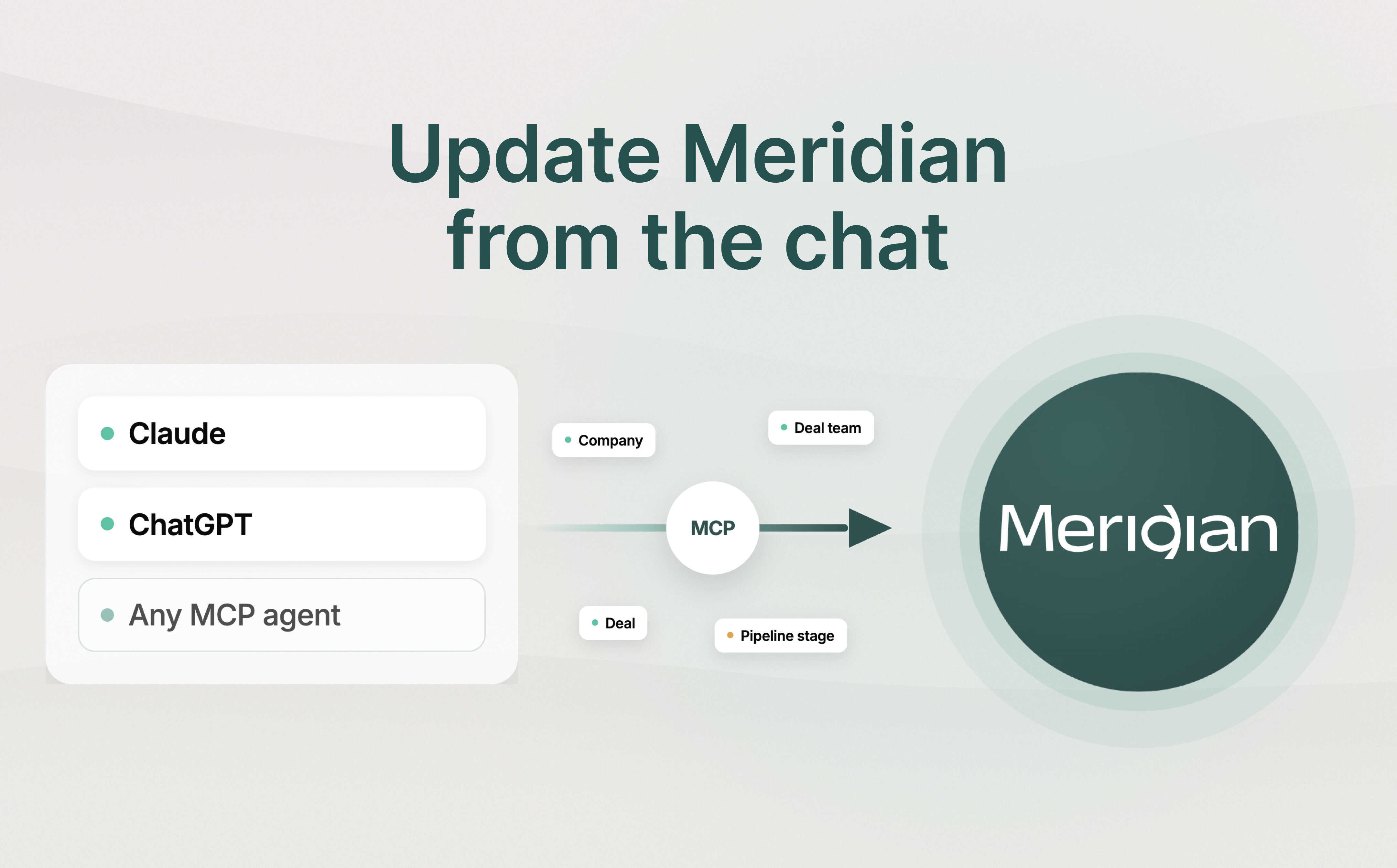
Connect your deal sourcing data to any AI tool.
Learn More
Meridian raises $7M seed round led by 645 Ventures.
Read More
Discover how Meridian revolutionizes Private Equity CRMs with intuitive design, AI integration, and unmatched data accuracy.
.webp)
The CRM in private equity is a massively underutilized asset. Think about it — it’s a unique piece of software that sits right at the center of your deal flow.
Used correctly, a private equity CRM should understand the companies you spend time with, recognize which advisors send you the best deals, and ultimately help you source better investments. A private equity CRM should allow you to focus more time on the deals that matter the most.
At Meridian, we speak to hundreds of PE firms a month. We hear a few messages repeatedly:
We hate our CRM. Nobody uses it. Manually logging interactions and deal metrics is a pain and takes forever.
Our old, clunky DealCloud implementation is jammed with out of date, inaccurate information. I don’t trust what’s in there.
I run my own pipeline out of Excel because our Salesforce sucks so much. I’m pretty sure people only log in a few times a month. What a waste of money!
We’d seen the pain firsthand. We’d wasted so much money on “custom implementing” tools like DealCloud and Salesforce only to receive software from 1995. We know from experience that the second a CRM becomes incomplete, it stops being useful.
Over the last year, we’ve spoken to nearly a thousand PE firms that feel the same way. People are sick of being gaslit by traditional CRMs made for sales teams and made to feel needy for expecting better from their core deal team software.
Well, we don’t think you should be made to feel bad for having high expectations. In fact, we spent more than a year crafting a CRM made for Private Equity. Building a private equity CRM that just works is much harder than replicating the base functionality of something like a DealCloud with a pretty UI.
Meridian was founded and funded by investors from top firms like:
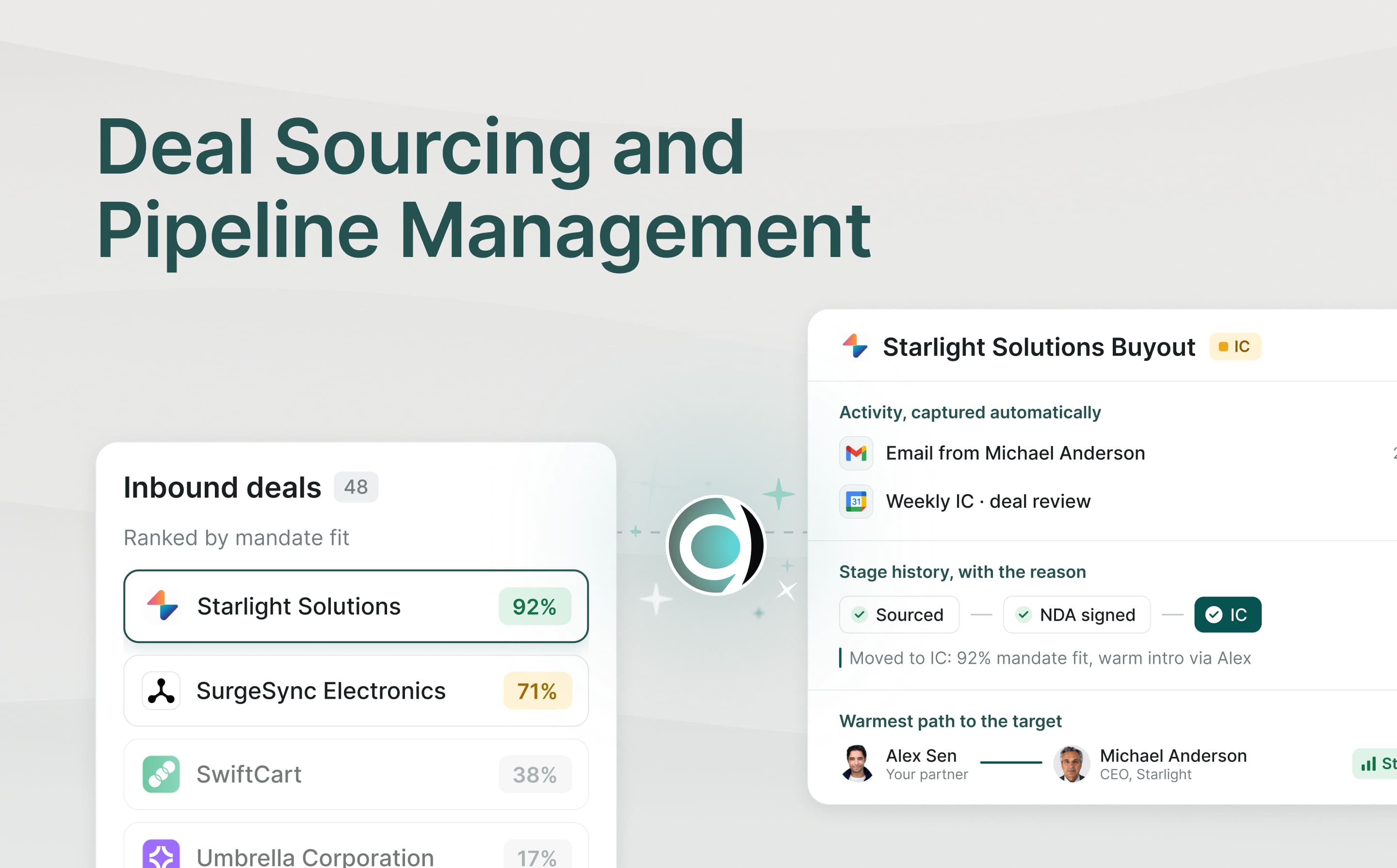
Meridian is the first private equity CRM that just works.

We set the bar for ourselves insanely high:
The beauty of Meridian is in its simplicity. Funnily enough, its simplicity is also why it was so hard to build. But we knew it was worth it, and the results speak for themselves.
You can ask Scout to summarize a document or tell you the risks associated with a potential deal. It also continually cross-references and validates all data points in your CRM to ensure everything is captured, verified, and enriched.
Finally, it checks both your private records and information from public databases to ensure complete accuracy. With this information, you can make faster and more informed decisions.
Our CEO and many other team members have worked at big private equity firms. We all had the same wishlist:
And so we built those exact features.

We really care about reducing friction. You don’t even have to log in to Meridian; you can forward an email to the CRM saying, "log meeting notes for this company" or “save this CIM”.
Instantly, our AI extracts key insights, updates relevant records in the CRM, and ensures critical information is saved centrally so all team members can access it. You don’t have to select what company or contact to save the information to, our AI figures that out itself.
Meridian was built in response to the gaps that became impossible to ignore in legacy CRMs. As private equity workflows grew more data-driven, it became clear that supporting modern investing required a fundamentally different system with modern CRM capabilities. The following capabilities reflect what Meridian was designed to deliver and what next-generation PE CRMs must support to operate effectively going forward.
A private equity CRM must function as a true system of record, bringing deal data, relationship history, activity, and context into one place. When information lives across inboxes, spreadsheets, and side systems, teams lose visibility and decisions slow down.
Data completeness cannot depend on manual entry. A PE CRM needs to capture emails, meetings, notes, and inbound deal materials directly from where work already happens, so the system stays accurate without creating more work for the team. A strong private equity CRM also integrates with third-party data sources like Pitchbook or Coresignal.
Private equity relationships unfold over years, not quarters. A PE CRM must preserve historical context across founders, intermediaries, companies, and funds, while making it easy to understand relationship strength and past interactions at any point in time.
Sourcing and pipeline management in private equity look nothing like sales. A PE CRM needs to support thematic sourcing, pre-deal tracking, and pipeline reviews without forcing teams into constant exports, reformatting, and follow-up cleanup.
Firms compound advantage when they remember why decisions were made. A PE CRM should retain deal rationales, IC discussions, and comparisons to similar companies so insight carries forward instead of resetting with each new process.
AI only creates value when it operates on trusted proprietary data inside real workflows. A PE CRM must embed AI directly into sourcing and analysis, rather than layering it on top of disconnected systems.
As firms add headcount, strategies, and deal volume, their systems must scale with them. A PE CRM should reduce operational friction as complexity increases, not introduce new bottlenecks or manual work.
We see all these legacy PE CRMs slapping chatbots on top of their sh***y slow databases and calling it a day.
At Meridian, AI is vertically integrated at every level of our application architecture. Ninety percent of the time, you won’t know it’s there, but stuff just starts to work.
Your emails sync perfectly. Your company records are complete with all the information available on a company. You just got sent a CIM, and suddenly, the private financials are logged for future reference. You’re reminded to follow up with that CEO you met last year and were considering raising next month.
Don’t settle for a chatbot. If you’re buying software this year, you deserve better.
When you use bolted-on AI in a legacy CRM that was never designed for private market firms, there are serious risks and limitations. Instead of improving decision-making, these AI add-ons amplify gaps in context, missing history, and inconsistent records.
Another risk is that AI becomes performative rather than operational. In legacy CRMs, AI is typically used to summarize documents or transcribe activity after the fact, without changing how work actually flows through the system. Teams may see surface-level automation, but the core workflows remain manual, disconnected, and slow. The CRM still requires exports, reformatting, and human cleanup, just with an AI layer on top.
It's harder for deal teams to trust a bolted-on AI chatbot, too. When AI operates outside the system of record or relies on partial data, its outputs feel generic and unreliable. Over time, teams stop using it altogether, reinforcing the perception that AI is a nice-to-have feature rather than a core capability.
Finally, surface-level AI limits how firms scale. As deal volume, team size, and strategy complexity increase, AI that is not embedded into the underlying architecture cannot keep up. Instead of reducing operational drag, it adds another tool to manage, leaving firms with the same legacy bottlenecks and more complexity to navigate.
When your PE CRM is AI-native, like Meridian is, AI fundamentally improves your workflow by shifting the CRM from a place where information is stored to a system where work actually happens. Instead of relying on manual entry and periodic cleanup, AI allows the CRM to capture activity automatically, interpret context, and keep records current without constant human effort.
In a PE context, this means deal data, relationship history, and institutional knowledge are no longer reconstructed after the fact. AI continuously absorbs emails, meetings, documents, and notes, then organizes that information in a way that reflects how investment teams think and decide. The CRM stops being a reporting burden and starts functioning as living infrastructure.
AI also changes how firms source and prioritize work. Rather than scanning static lists or relying on memory, teams can use AI to surface which relationships matter most, which companies show early signals, and where attention should be focused next. This shifts workflows from reactive updates to proactive decision-making.
Most importantly, AI makes institutional memory usable in real time. Past deals, IC discussions, and relationship history are no longer buried in archives or personal inboxes. AI brings that context forward inside everyday workflows, allowing firms to move faster while preserving judgment and continuity as they scale.
We haven’t spoken to a single private equity, credit, or growth firm that is happy with its CRM.
The main initial objection we face when selling is, “We’ve got our data in Salesforce; isn’t it a pain for us to switch?”
We love hearing this because we’ve made data migration one of our top strengths. Honestly, post-AI, the migration is the easy part. Sure, we can map your CSV export rows and columns.
But Meridian’s white-glove data service goes so much further. As part of your implementation, we do a full data transformation. We take your messy, incomplete and outdated CRM data. We cleanse it. We enrich it. And we extract structured data from the wealth of old forgotten deal folders.
When you onboard with Meridian, we ensure that you start day 1 with the absolute best database on your relationships and the companies you want to invest in.
At a certain point, you’re going to need to switch. Because trust us, you’ve already fallen behind.
Private equity is an increasingly data-driven industry. The biggest firms, like Blackstone and KKR have huge data science teams. There’s more data out there than ever before, and if you’re not harnessing it, you’ve fallen behind.
Using Meridian, you can keep up with the industry's biggest players.
Our North Star when creating Meridian was:
And we’ve done exactly that.
Book a demo and modernize your investment process with Meridian.
The future of private equity CRM software is an AI-native system that automatically captures, enriches, and maintains deal and relationship data as work happens. Instead of acting as a static database, a l becomes living infrastructure that supports sourcing, decision-making, and institutional memory as firms scale.
AI will change private equity CRMs by turning them from systems that require constant manual upkeep into systems that understand and maintain themselves. Instead of asking deal teams to log activity and reconstruct context, AI-native CRMs capture information as work happens, keep records accurate over time, and surface relevant insight at the moment decisions are made.
Yes, as private equity workflows become more data-driven, the AI-native CRM increasingly becomes the place where work is coordinated rather than merely recorded. Instead of sitting behind the scenes as a database, the CRM evolves into the system that connects sourcing, relationships, and decision-making in one continuous flow.
CRM data completeness means the CRM reflects reality without requiring people to remember to update it. It matters because once teams stop trusting what they see in the system, they stop using it, and the CRM loses its value entirely.
AI CRMs reduce manual logging by capturing information automatically as work happens, rather than asking users to enter it after the fact. Adoption improves because the system stays accurate without extra effort, so deal teams actually trust and rely on it.
The risk of AI in CRM comes when it is bolted onto a legacy system that was never designed for private equity workflows. In those cases, AI amplifies missing context and incomplete data, feels performative rather than useful, and ultimately fails to earn trust or scale as deal volume and complexity increase. AI add-ons can also create privacy and governance issues for private equity firms.
Discover how Meridian can streamline deal sourcing and enhance your decision-making


Table of Contents

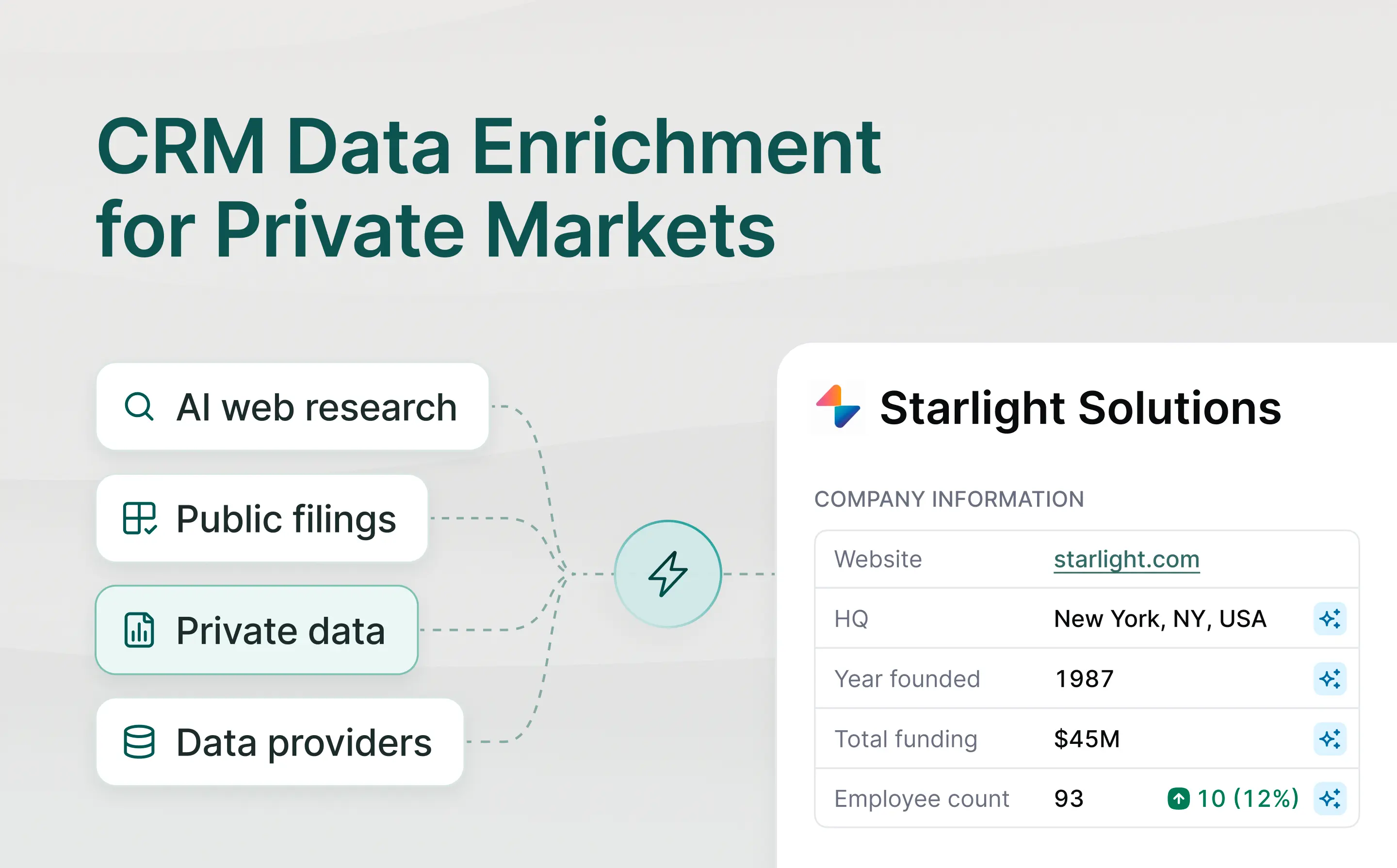
How deal teams keep company data clean and consolidate their vendors with built-in data.