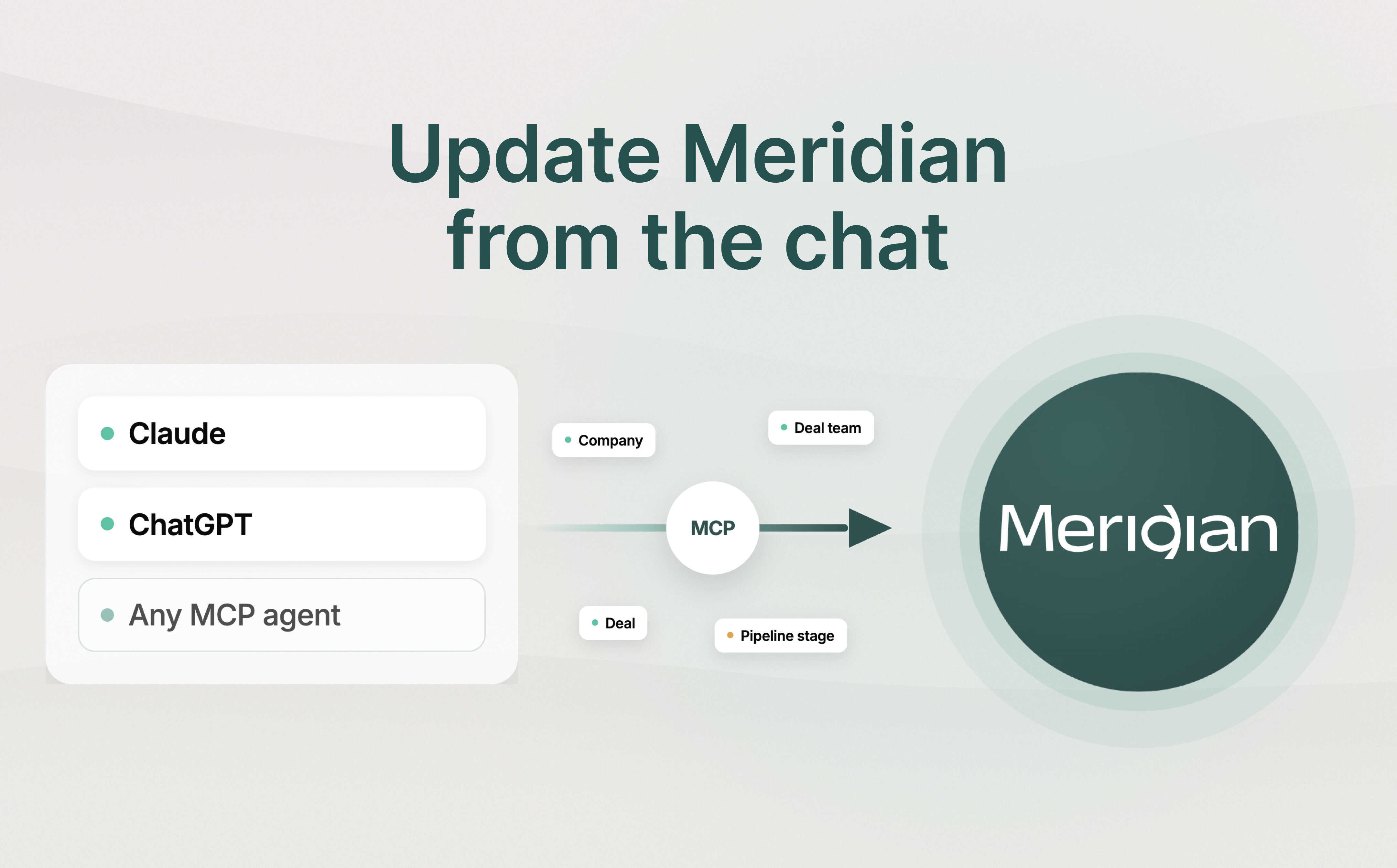

Meridian MCP is live!
Connect your deal sourcing data to any AI tool.
Learn More
Meridian raises $7M seed round led by 645 Ventures.
Read More
Discover why private equity firms need specialized CRMs over standard platforms and why Meridian AI is the best CRM for Private Equity firms in 2026.

If you're reading this, you've probably just spent an hour updating your CRM after an IC meeting. Or maybe you're a Partner who's stopped logging into your firm's CRM altogether because, let's face it, what's the point?
Here's a reality check: Private equity firms are still running their deal flow through old, clunky CRMs. This disconnect creates real pain at every level: Associates waste hours on manual updates, Principals scramble for deal history during critical meetings, and Partners who've given up on the system entirely.
A private equity customer relationship management (CRM) tool is a purpose-built platform that serves as a centralized system for PE deal teams and sourcing teams. It helps firms track deals and relationships over multi-year timelines, evaluate opportunities, and manage every stage of the investment lifecycle.
Let's get real about why sales CRMs fail spectacularly in private equity:
Sure, your CRM might integrate with 1000+ platforms you'll never use. But can it:
Didn't think so.
Sales CRMs want to know if someone downloaded your whitepaper. You need to know:
Think about your last pipeline review meeting. You probably:
This isn't a workflow - it's a waste of your team's time.
Sales teams measure relationships in quarters. PE firms measure them in decades. Your CRM needs to:
Sales CRMs and private equity CRMs are built for fundamentally different workflows, data needs, and time horizons.
Private equity isn't sales. Stop trying to force it into a box designed for tracking software subscriptions. PE needs technology built for:
Let's talk about what you're actually losing with a sales CRM:
Your analysts are smart. They're also busy. When they have to manually input every data point into a clunky system, crucial details vanish into the void.
We've seen Associates spending up to 20% of their time just managing CRM data. Your highest-performing young talent, essentially doing data entry. Madness.
Partner needs deal context before a crucial meeting. Deal lead is on vacation. CRM has random notes but zero context about why you passed two years ago. Cue the frantic email chains.
When was the last time your senior partners actually logged into the CRM? Be honest. When your most experienced team members avoid the system entirely, you've got a serious problem.

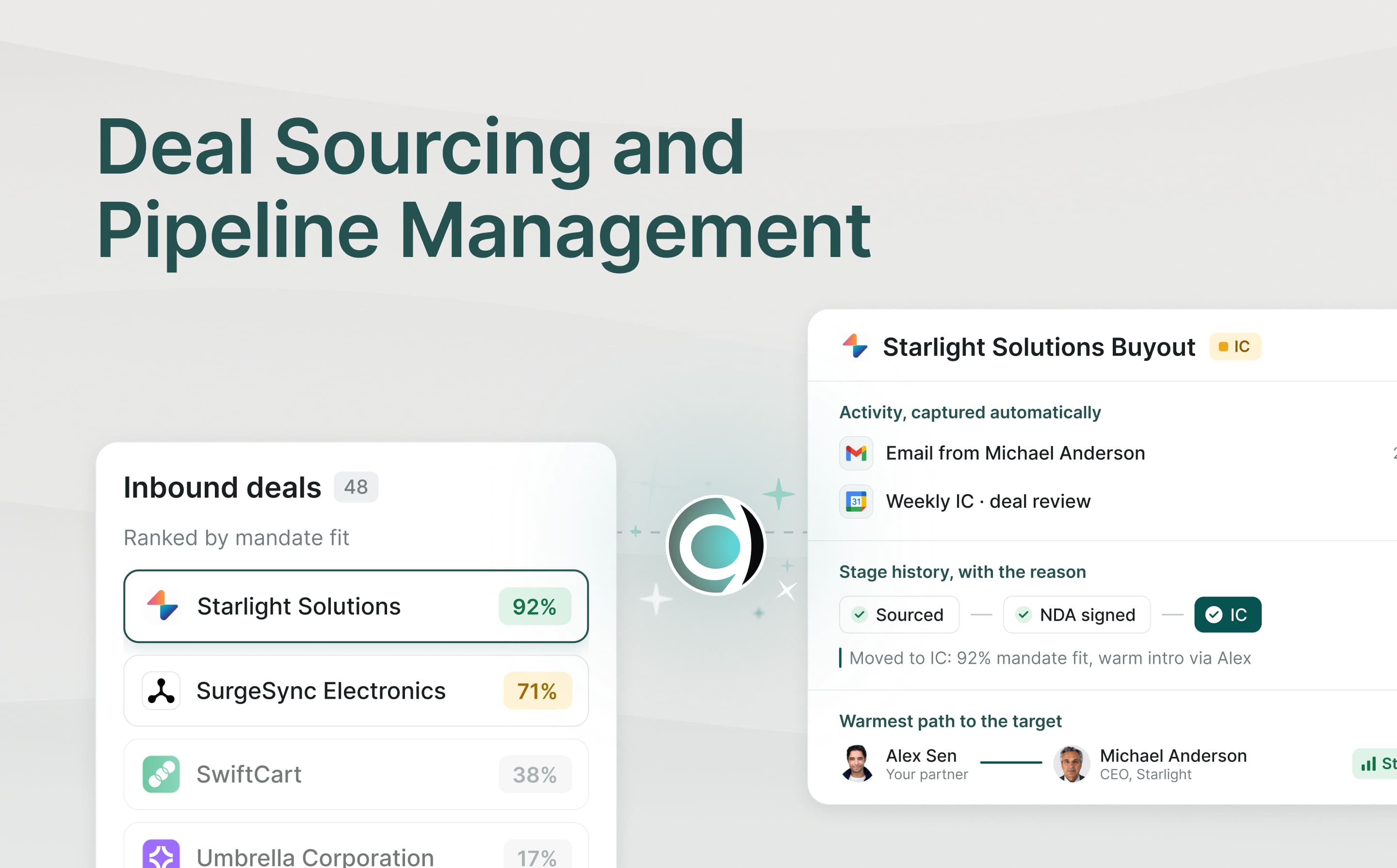
Not "sync every email and drown in noise," but intelligent capture of what matters. Your CRM should know the difference between a CIM and a lunch scheduling email.
Stop forcing PE deals into "Prospecting > Qualified > Demo > Closing." That's not how this works. That's not how any of this works. Instead, use a CRM with customizable pipeline tracking to mirror the way your team actually works. Tailor deal stages to reflect PE-specific workflows, ensuring accuracy and clarity for every opportunity in the pipeline.
If your team has to toggle between six different platforms to piece together a complete view of a target company, you're doing it wrong. Instead, use an all-in-one CRM with benchmarking and data enrichment out of the box to consolidate market intelligence into one place. Compare targets, uncover insights, and make data-driven decisions without the hassle of switching tools.
Your CRM should tell you when that founder you met last year is likely to be raising again, based on actual intelligence, not random reminders. Leverage a CRM with AI-driven insights to track key relationships and surface actionable intelligence. From investor follow-ups to founder milestones, your CRM becomes the ultimate proactive assistant.
IC memos shouldn't require all-nighters. Period.
Use this checklist to evaluate whether a CRM is actually built for private equity workflows, long-term relationships, and deal context, rather than sales tracking.
Integrations and data ingestion
Data capture and historical context
Private equity workflows
Relationship intelligence
Usability and adoption
Every legacy CRM provider is now slapping ChatGPT on their platform and calling it AI. But real AI for PE should:
The best part? It should do all this behind the scenes. No prompting, no training, no hassle. It just works.
The private equity industry is getting more competitive by the day. The mega-funds have armies of data scientists and custom tools. But you don't need a hundred-person tech team to compete.
You just need technology that was actually built for private equity.
At Meridian, we're not retrofitting sales tools for PE. We built a completely new platform, from the ground up, designed specifically for how PE firms actually work. Our team comes from Blackstone, Thoma Bravo, and CVC. We've lived your pain. And we've built the solution.
The days of settling for clunky, generic CRMs are over. It's time for PE firms to demand better.
Want to see what a real PE CRM looks like? Let's talk.
A PE CRM is a purpose-built platform that helps firms track deals and relationships over multi-year timelines, evaluate opportunities, and manage every stage of the investment lifecycle.
Standard CRMs do not work for private equity firms because they are designed to support sales pipelines, not investment decisions. They lack the ability to capture long-term deal context and relationship history, which forces PE teams to rely on manual workarounds outside the CRM.
Private equity CRMs are built to capture deal context, relationship history, and investment decisions over long time horizons. They support PE-specific workflows like sourcing, pipeline reviews, and IC preparation without relying on manual exports or spreadsheets.
The most important integrations for PE CRMs are those that pull data seamlessly from email, calendars, and inbound deal materials (like CIMs). A PE CRM should also pull in relevant market and company data without forcing teams to toggle between tools.
PE firms should evaluate a CRM by whether it captures complete deal and relationship context automatically, fits naturally into how deal teams already work, and actually gets used without constant manual upkeep. Adoption and workflow fit matter more than feature count, because an unused CRM quickly becomes incomplete.
A PE firm should consider switching when its CRM no longer reflects how the team actually works and requires constant manual updates to stay accurate. If deal context, relationship history, and pipeline reviews live outside the system, a PE-native tool becomes necessary.
Discover how Meridian can streamline deal sourcing and enhance your decision-making


Table of Contents

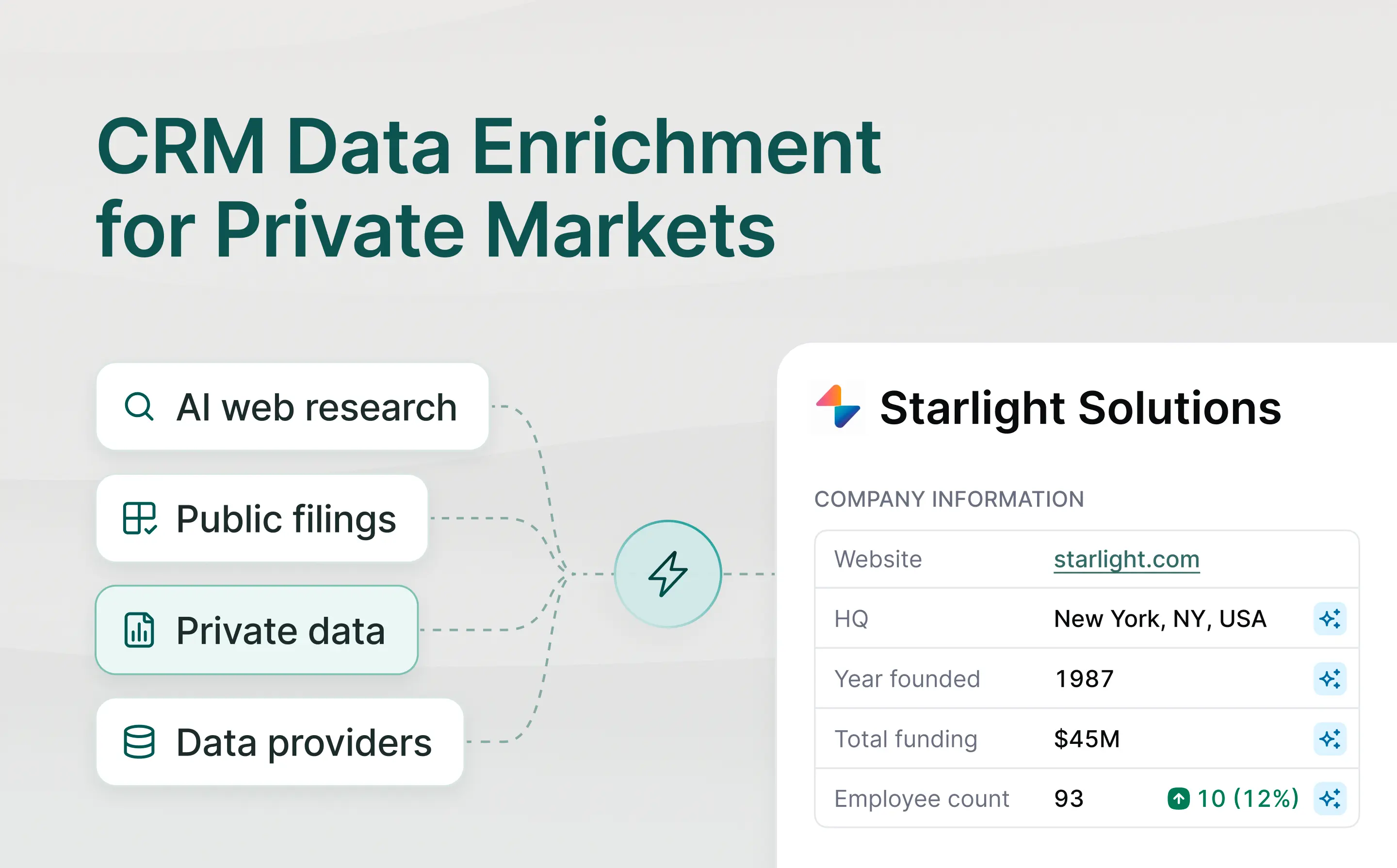
How deal teams keep company data clean and consolidate their vendors with built-in data.