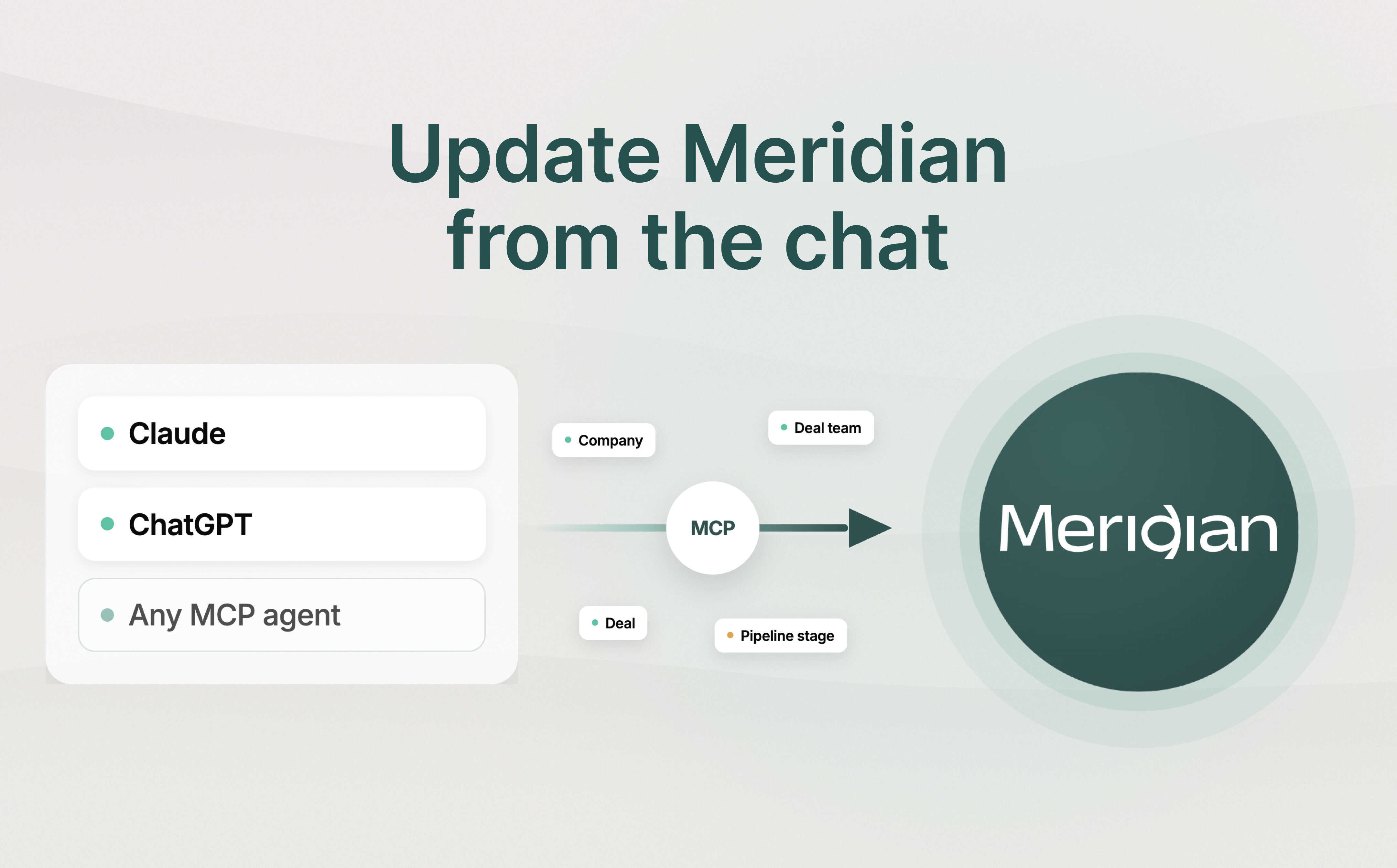

Meridian MCP is live!
Connect your deal sourcing data to any AI tool.
Learn More
Meridian raises $7M seed round led by 645 Ventures.
Read More
Explore the top 3 trends reshaping private equity in 2025. Learn how your firm can stay ahead with actionable insights and tools like Meridian AI.

Remember how BlackBerry dominated until suddenly it didn't? That's what's happening in PE right now.
The tools and strategies that built billion-dollar portfolios are about to feel as outdated as physical keyboards and email-only devices.
At Meridian, we’re uniquely positioned to see this transformation happening. As former PE investors who now build next-generation tools for the industry, we spend our days talking to hundreds of firms about how they evolve. Some are embracing change and thriving. Others are stuck in old patterns, not realizing the ground is shifting beneath their feet.
Here's our unfiltered look at what's really transforming private equity - and why 2025 will be the year everything changes.
Proprietary deal flow is making a comeback, but forget everything you know about how it works. The old-school approach of relationship-based sourcing is evolving into something far more powerful. Modern firms are building systematic processes that combine deep relationship intelligence with real-time market signals. They're using AI to identify and track high-priority targets months or even years before they're ready for a transaction.
The real innovation isn't just finding deals - it's in how firms nurture and manage relationships at scale. Leading firms are creating structured approaches to relationship intelligence that go way beyond traditional CRM. They track every interaction, measure relationship strength, and ensure no opportunity slips through the cracks. The result? More proprietary deals and fewer missed opportunities.
Operational impacts:
Using Meridian, you don’t waste time logging meeting notes manually. Instead, you can tap into AI to see what relationships you should invest in to make the best deals.
If you think data science in PE is just a trend, you're missing the bigger picture. Pioneers like Blackstone haven't built substantial data science capabilities for fun. They've done it because it gives them an edge that's becoming impossible to ignore. Mid-market firms are facing a critical inflection point: They can either invest millions in building internal capabilities or partner with platforms (like Meridian) that provide these capabilities out of the box.
What makes this trend particularly powerful is the combination of private deal data with public information. Firms are creating unprecedented insights into investment opportunities by analyzing patterns across their historical deals while incorporating real-time market data. But here's the catch: you can't play this game if you don't have a handle on your proprietary data. The firms that have diligently captured and organized their data are now pulling ahead dramatically.
Operational impacts:
If you’re wondering if you’re falling behind, give me a call and we can sort your data out in no time.
The old model of waiting for companies to share their numbers is dead. Forward-thinking firms are developing sophisticated early-warning systems that combine multiple data signals to spot risks and opportunities. They're monitoring nontraditional KPIs to identify growing companies, using supply chain analysis to spot market shifts, and tracking digital footprints to measure company health in real-time.
This isn't just about having more data - it's about having better insights sooner. For instance, a PE firm used anonymized credit card and web traffic data to uncover a surprising trend in the retail sector: a surge in online houseplant purchases. After identifying top-performing companies in this niche, they conducted due diligence and acquired a stake in a leading e-commerce company poised to capitalize on this growth.
Using external, alternative data sources, a PE firm can gain a huge advantage over its competitors by identifying a change in buying patterns or a company poised to shake up a market.
Operational impacts:
The implications are clear: 2025 is the year that determines who will lead private equity for the next decade. To stay competitive, you need:
The difference between good and great PE firms in 2025 won't just be about having AI. It'll be about how deeply AI is woven into your operations. Let's cut through the hype and look at what actually matters with modern deal flow systems.
Most firms are still playing with AI at the surface level - transcribing calls, summarizing documents, maybe generating some basic insights. That's AI theater.
Real AI transformation happens when artificial intelligence is so deeply integrated into your workflows that it feels invisible. AI-powered investment tools are the difference between having a smart assistant and having an entire team of experts working 24/7 to make you better at every aspect of your job.
Here's what true AI integration looks like in practice:
Your emails sync perfectly without you thinking about it. Company records complete themselves with all available information. That CIM you just received? The private financials are automatically logged for future reference. You get reminded to follow up with that CEO you met last year who mentioned they might be raising capital soon.
But it goes deeper. When evaluating a new opportunity, AI doesn't just summarize the data, it cross-references every deal you've ever seen in that sector, pulls relevant insights from your firm's collective experience, adds extra data from external sources, and highlights patterns you might have missed.
This is where Scout, our AI agent, comes in. Scout isn't just another chatbot - it's a true AI agent vertically integrated into every level of your deal flow. It understands the metrics that drive your decision-making because it's been trained specifically for private equity workflows.
What does this mean in practice?
Most importantly, Scout learns from your firm's specific approach to deals. It's not just applying generic AI to PE problems - it's applying your firm's intelligence to your opportunities.
Imagine walking into an investment committee meeting where:
This isn't science fiction - it's what leading firms will be doing in 2025. The question is whether you'll be one of them.
Our platform represents our reimagining of what it means to work in private equity.
We've created a system in which AI isn't just a feature. It's integrated into every level of your operations, working quietly in the background to make everything smarter and more efficient.
We've developed a thematic sourcing module that goes beyond simple sector tracking to help you build and maintain real expertise. Alternative data signals are woven directly into your workflow, giving you early insights into opportunities your competitors might miss. And we've revolutionized relationship building with tools that help you scale your network systematically.
The future of private equity belongs to firms that embrace these changes now. Every day, we watch the gap widen between firms embracing transformation and those standing still. In 2025, that gap will become unbridgeable.
Don't wait for the future to arrive - shape it. Book a demo today and discover how Meridian can put your firm at the forefront of private equity's transformation.
Private equity in 2025 is being shaped by deeper use of data science, tighter AI integration, and growing reliance on alternative data to source and evaluate deals earlier.
AI is driving more systematic deal sourcing and earlier insight into opportunities by analyzing proprietary and external data together. Combining AI with a thematic deal sourcing approach is helping firms get ahead of the competition at speed.
Alternative data signals are nontraditional indicators, such as digital activity or supply chain data, used to understand company performance before financials are available.
Firms use alternative data to identify emerging opportunities, monitor company health, and spot market shifts sooner.
An AI-first infrastructure means having a modern foundation where AI is embedded into the firm’s core systems instead of bolted onto disconnected tools.
AI theater is surface-level AI, like transcribing calls, summarizing documents, or generating basic insights. Real AI transformation is when AI is so deeply integrated into your workflows that it feels invisible.
Firms should prioritize AI initiatives that are embedded into core investment workflows and built on trusted proprietary data, rather than experimenting with standalone tools or surface-level features.
Discover how Meridian can streamline deal sourcing and enhance your decision-making


Table of Contents

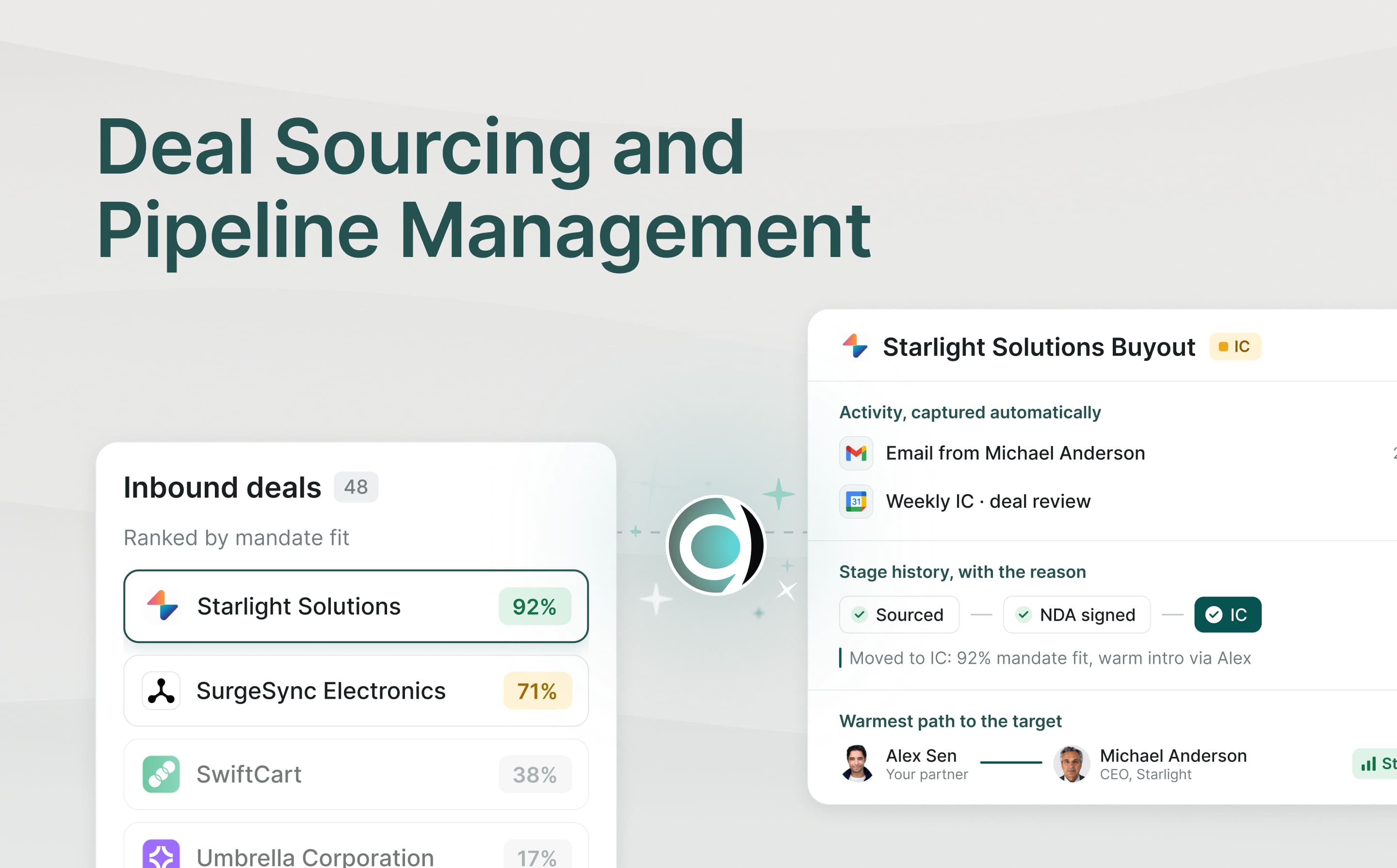
Why deal sourcing and pipeline management belong in one system, how proactive thematic sourcing wins proprietary deals, and how to stop pipeline leakage.