

Meridian MCP is live!
Connect your deal sourcing data to any AI tool.
Learn More
Meridian raises $7M seed round led by 645 Ventures.
Read More
AI doesn't fix a messy CRM, it exposes a firm's data problem.
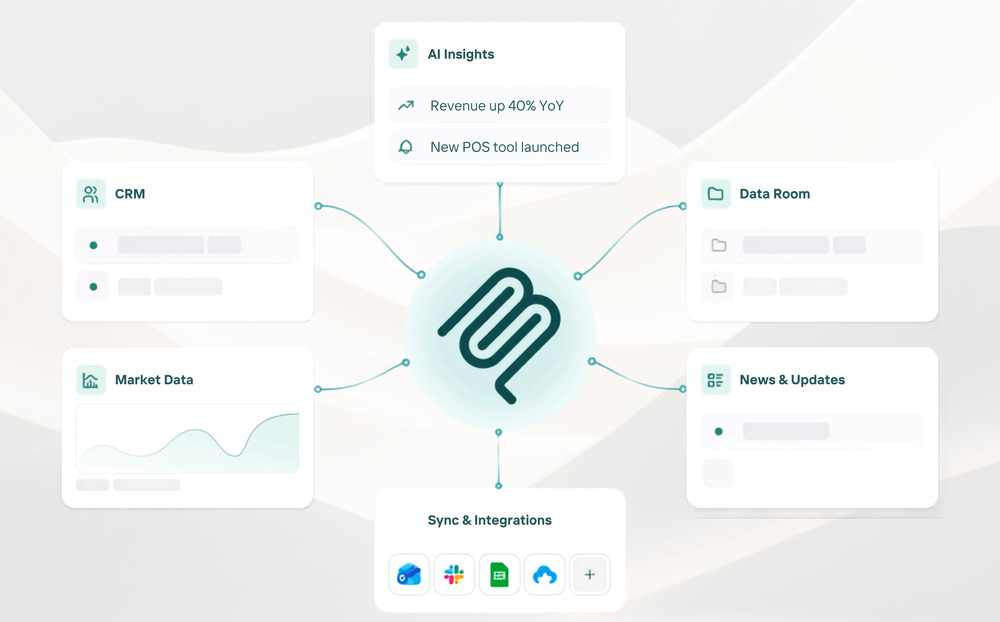
I keep getting the same questions from PE firms thinking seriously about AI. The first: Should we invest in an AI-native platform, or just layer ChatGPT or Claude on top of the CRM we already have? The second, usually asked later: As AI gets better, will we even need a CRM at all?
Both questions are reasonable. Yet both, I think, start from the wrong place. And the firms moving fastest right now are the ones who already worked that out, usually the hard way.
The “just layer AI on it” path is a valid approach to consider right now, with how much easier it has become to connect software and databases to AI models. Unfortunately, it almost always exposes a problem people did not expect to find.
The fastest-moving firms I talk to are often the ones who already tried this on a legacy system. What they discovered was that the bottleneck was not the AI. It was the database underneath. Stale companies, incomplete contacts, inconsistent tagging, missing relationship context, years of custom fields that were never designed to be read by anything other than a human clicking through screens.
A model is only as useful as what it can see. Most legacy CRMs were never built to be seen by a machine at all.
This shows up in the price tag. Even upgrading to DealCloud’s own AI product can come with a $40,000 to $60,000 reimplementation fee, because the company has to do real work just to get a customer’s database into a shape where AI can begin to operate. And that figure comes before the manual cleanup, enrichment, and workflow redesign required to make the data actually useful.
At Meridian, that work is part of implementation, not a separate project. We have tuned the cleanup, enrichment, and migration process so firms are upgrading the quality of their institutional memory in the process of switching systems.
There’s a second path I’ve watched firms take. Instead of layering AI onto a legacy CRM, they build internal tools directly on Claude, ChatGPT, Gemini, or a vertical financial model like Rogo.
For narrow workflows, this works. As the foundation for a firm’s operating system, it carries a different kind of risk.
The model market is moving too fast to safely anchor to one provider. Claude may be best for one use case today, OpenAI for another tomorrow, Gemini a year from now, a finance-specific model for something else after that. Locking your firm’s proprietary memory inside a single foundation model ecosystem trades one dependency for another.
Any provider can throttle token usage, raise prices, shift enterprise policies, or build in dependencies that make switching harder later. None of this is hypothetical. We’ve watched versions of all of it play out at the application layer over the last eighteen months.
The thing worth protecting is the structured record of how a firm actually thinks. Relationships, deal history, IC reasoning, sourcing patterns. That is the durable asset. The model sitting on top of it should be interchangeable.
Treat the LLM as a tool and the system of record as the foundation.
Which brings me back to the other question. If you can just chat with your data, do you still need a system of record?
My answer is that AI makes the system of record more important, not less.
Anyone can run a model against a bad CRM, and the output will reveal exactly how thin the data underneath really is. You’ll see stale records, inconsistent tagging, fragmented activity history, and the kind of gaps a human user learned to navigate around but a model cannot.
Purpose-built, AI-native systems of record are getting more important for the same reason. They are the only place where a firm’s proprietary memory is structured well enough for any model to actually use it effectively.
So the real question is not whether to keep the CRM. It’s whether you have a clean, portable, investment-specific data layer that any AI system can work with. The model you pick today will not be the model you use in two years. The data layer underneath is what carries forward.
I had a conversation recently with a managing partner at a mid-market firm who put it plainly: Their CRM is their memory, and if it is wrong or incomplete, the firm loses something it cannot rebuild.
That framing stuck with me, because it captures why the AI question is different here than almost anywhere else.
For most companies, the database is a record of customers. Important, but largely replaceable. For a private markets firm, the CRM is institutional memory. The structured trace of every founder the team has spoken to, every banker they’ve sourced from, every deal passed on and why, every IC discussion that shaped a thesis, every relationship that took years to build.
So when firms ask how AI fits into that picture, my view is that AI raises the stakes on the underlying database. It does not lower them. A model run against a messy CRM produces confident-sounding nonsense. A model with clean access to a firm’s full sourcing history, relationship map, and IC reasoning becomes a real second brain.
The question is whether the firm has built its data layer to a standard where AI can work on it. Most have not. The ones that do will compound much faster than the ones still planning to figure out AI later.
Memory has always been an edge in this business. AI just made it a structural one.
Discover how Meridian can streamline deal sourcing and enhance your decision-making

Meridian’s Scout AI agent surfaces and benchmarks new opportunities so you can find winning deals before the competition.

Table of Contents

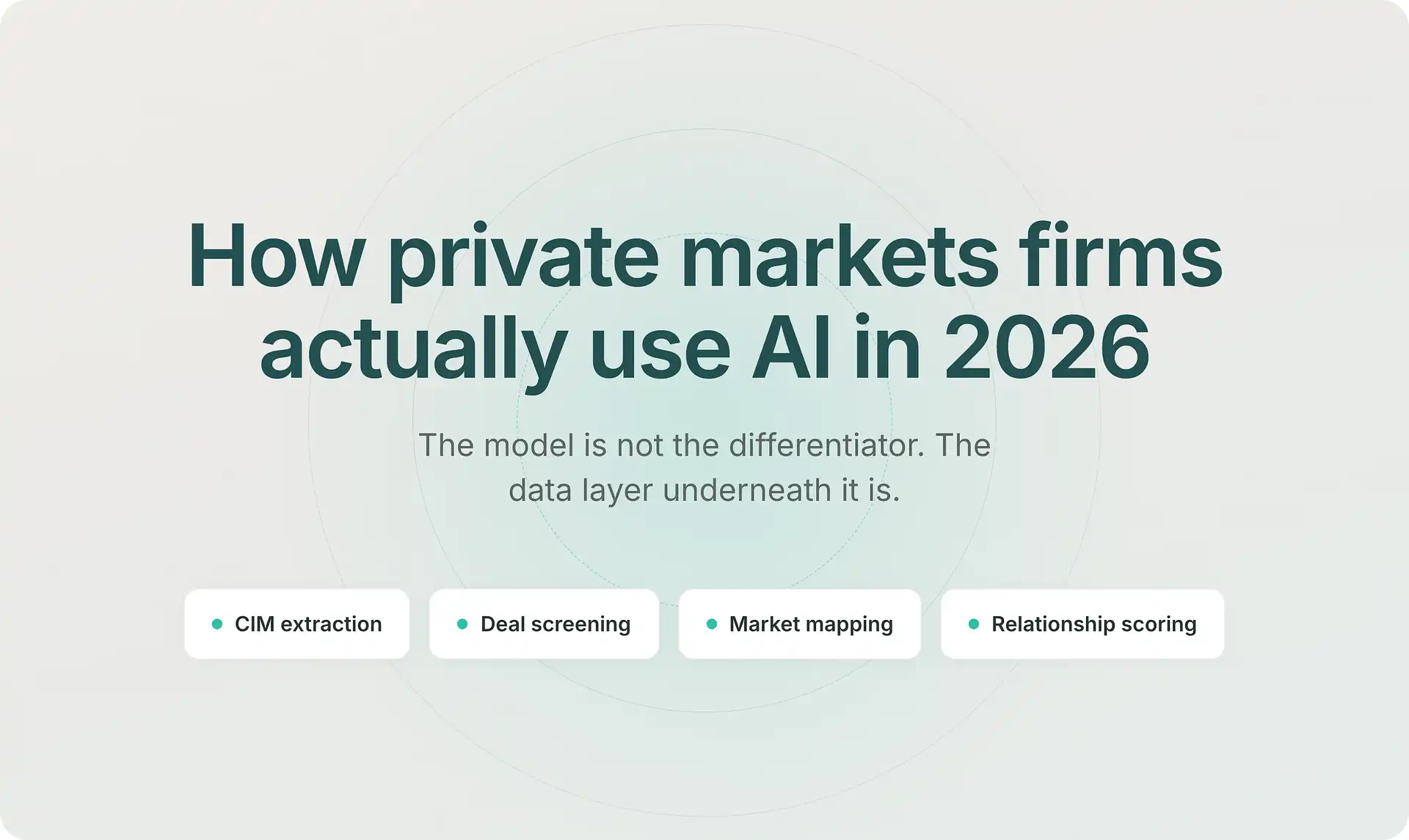
AI adoption has outpaced results in private markets. The four workflows that change deal-team output, and why the data layer matters more than the model.

.webp)