
Get the Meridian mobile app!
Your deal data travels with you.
Learn More

Meridian raises $7M seed round led by 645 Ventures.
Read More
Meridian ships with a hosted MCP server, giving approved AI agents secure, permissioned access to a firm's full deal context.
Private markets firms are moving from software that humans click through to systems that AI agents can read, reason across, and act on.
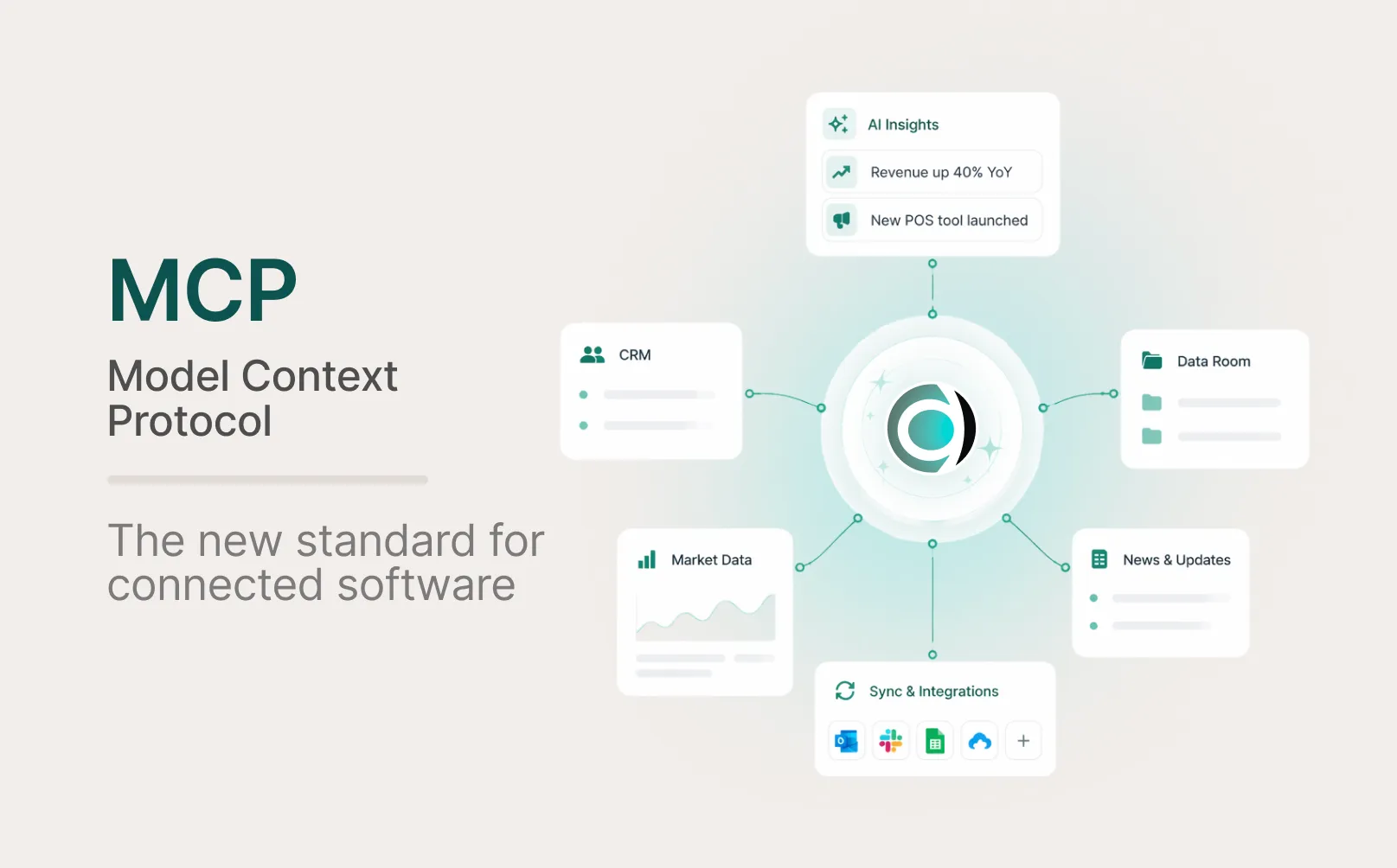
Today, Meridian becomes the first private markets system of record to ship with a hosted MCP server, giving Claude, ChatGPT, and any MCP-compatible agent a secure, permissioned way to read firm deal data through one native endpoint.
With Meridian MCP, your firm's deal history, IC decisions, and document contents are now directly readable by your AI agents — no exports, no copy-paste, no walled garden.
Today, most private markets AI workflows are improvised. An associate exports deal history into a spreadsheet so they can query it in Claude. A partner pastes the last quarter of IC decisions into ChatGPT to draft a memo. A deal team copies CIM excerpts into a prompt because the model cannot see the actual deal room.
The intelligence exists. The context does not travel.
That is the gap Meridian MCP closes. It lets approved AI agents read from the system of record directly, with firm permissions intact, instead of forcing users to manually shuttle fragments of institutional memory into a chat window.
Model Context Protocol is an open standard, originally developed by Anthropic, that gives AI models a consistent way to connect to outside software and data. The most useful way to think about it is the way the financial industry thinks about SWIFT: an agreed-upon protocol that lets very different systems talk to each other without anyone building custom integrations.
Every major AI tool is converging on MCP support. A system of record that makes data accessible through MCP becomes usable by any agent on any model. A system that does not will stay walled off from the AI workflows their customers actually want to run.
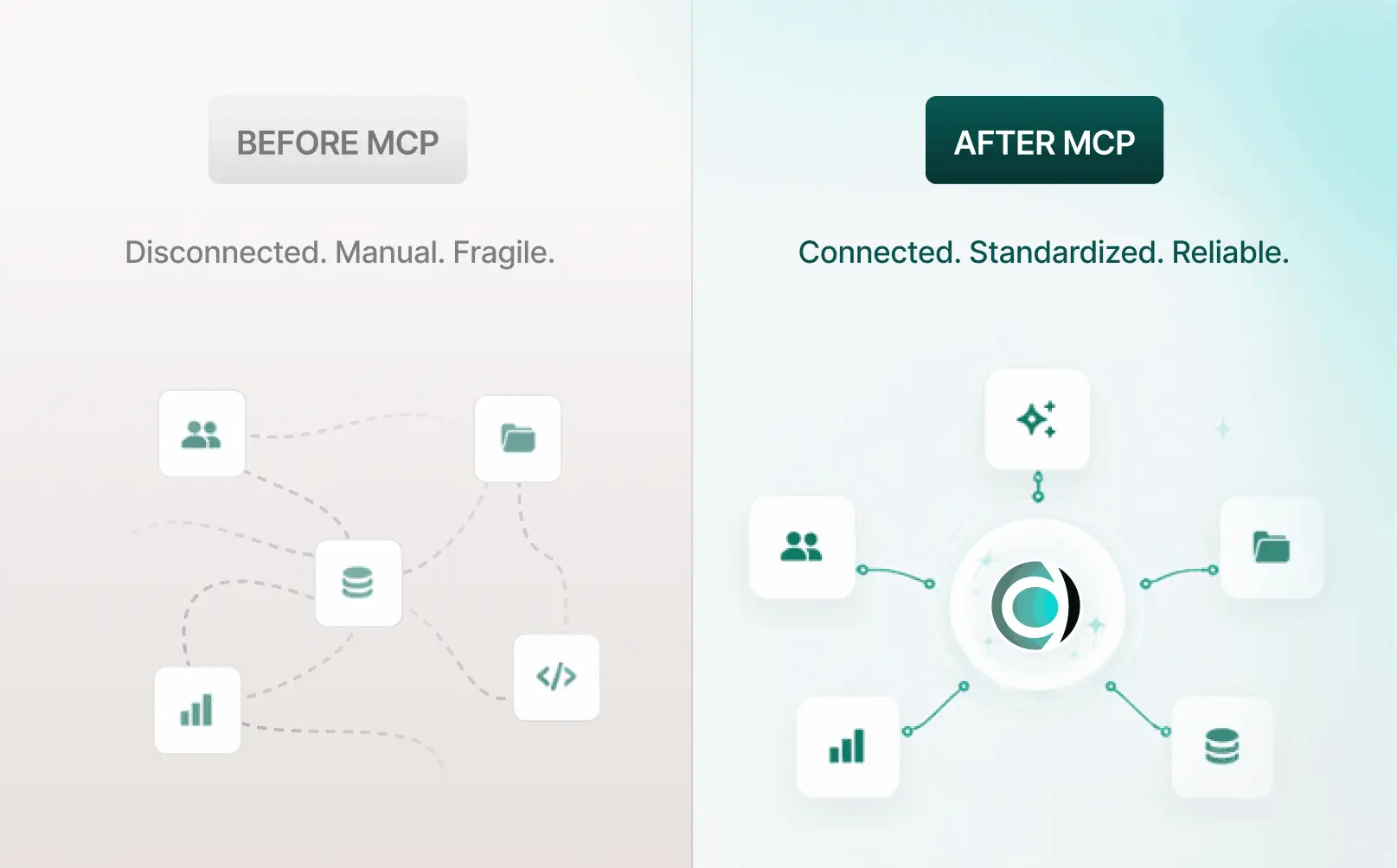
The CRMs that private markets firms rely on today were built for an era before AI agents. They were designed for humans clicking through screens, not for agents reading and reasoning across a firm’s deal history, IC decisions, relationships, and documents.
As firms invest in AI, they usually end up with one of two compromises.
The first compromise is closed AI inside the CRM. The vendor embeds its own assistant, controls the model experience, and decides which workflows get built. The firm gets AI features, but inherits the vendor’s roadmap.
The second compromise is external AI without context. Claude or ChatGPT can draft a memo, summarize a banker relationship, or analyze a CIM, but only if a user manually gives it the relevant information. Pipeline state, IC history, sourcing attribution, portfolio activity, meeting notes, and document contents do not travel with the query.
Meridian MCP is a third path.
Meridian remains the system of record, while the firm’s approved AI agents can read the underlying context directly. That means firms can adopt the best models and agent workflows without abandoning governance, permissions, or auditability.
The system of record and the agent can finally see each other.
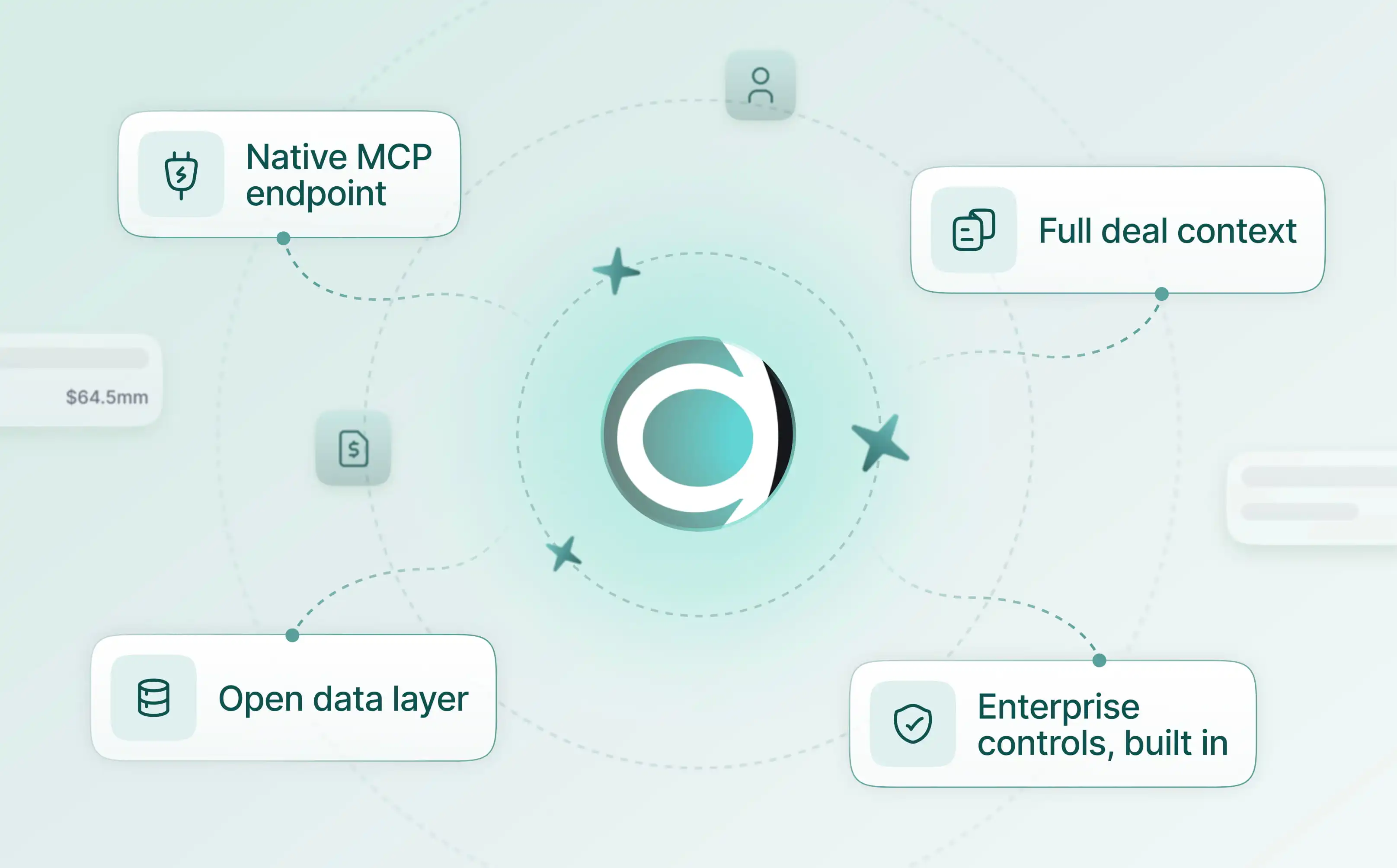
Native hosted MCP server. Meridian exposes approved firm context through a secure MCP endpoint. Claude, ChatGPT, and other MCP-compatible agents can access Meridian data without spreadsheet exports, CSV workarounds, or one-off connector projects.
Full deal context. Context travels with the query. When an agent answers a question or drafts a memo, it can draw on pipeline, interactions, IC decisions, meetings, notes, portfolio data, and document contents together. The answer reflects your firm's actual institutional memory, not a snapshot pasted into a prompt.
An open data layer. Meridian remains the single source of truth while firms choose the AI tools they want to use. A team can use Claude for diligence, ChatGPT for drafting, and another model for internal analytics without changing the underlying CRM.
Enterprise controls are built in. Granular privacy settings, data masking for sensitive LP information, per-agent scopes, and full action logging come standard. Private notes and private meetings remain visible only to their creator and attendees. Every agent action inside Meridian is logged and reviewable.
The clearest way to see the difference is to look at the kind of question an agent can answer with full Meridian context behind it.
“Which high priority prospects have we not met with in ninety-plus days?”
“Which deals have been sitting in the diligence stage the longest and why?”
“Pull the average revenue growth rate and gross margin across all consumer deals we've seen in the last 12 months”
“Give me a top 10 list of the number of deals sourced by bank, and show me which percentage of these deals have made it to investment committee”
These are not chat-window prompts. None of them work by copying a document or a deal record into ChatGPT. They require an agent that can search across companies, deals, people, meetings, emails, notes, and document contents in one motion, with the firm's permissioning intact. That is what MCP unlocks.
Meridian is currently the only AI-native CRM in private markets that:
Other systems are either closed by design or sell openness as a premium feature. Meridian treats it as foundational.
The firms investing in AI today are doing so because they expect a real productivity and judgment advantage from it. That advantage compounds when the agent has full firm context. It stalls when it does not. And it disappears entirely when the firm is locked into a single vendor's model and the vendor's view of how AI should fit into the workflow.
Meridian's bet is that the firms with the best deal intelligence will be the ones whose system of record was built to be read by agents from day one, and whose data is portable across whatever AI tools come next. Meridian MCP is the first production version of that bet.
To see Meridian MCP in action, book a 15-minute demo.
Discover how Meridian can streamline deal sourcing and enhance your decision-making


Table of Contents