
Meridian MCP is live!
Connect your deal sourcing data to any AI tool.
Learn More
Meridian raises $7M seed round led by 645 Ventures.
Read More
Compare purpose-built M&A deal management platforms for 2026 and find the right fit for your corporate development team.
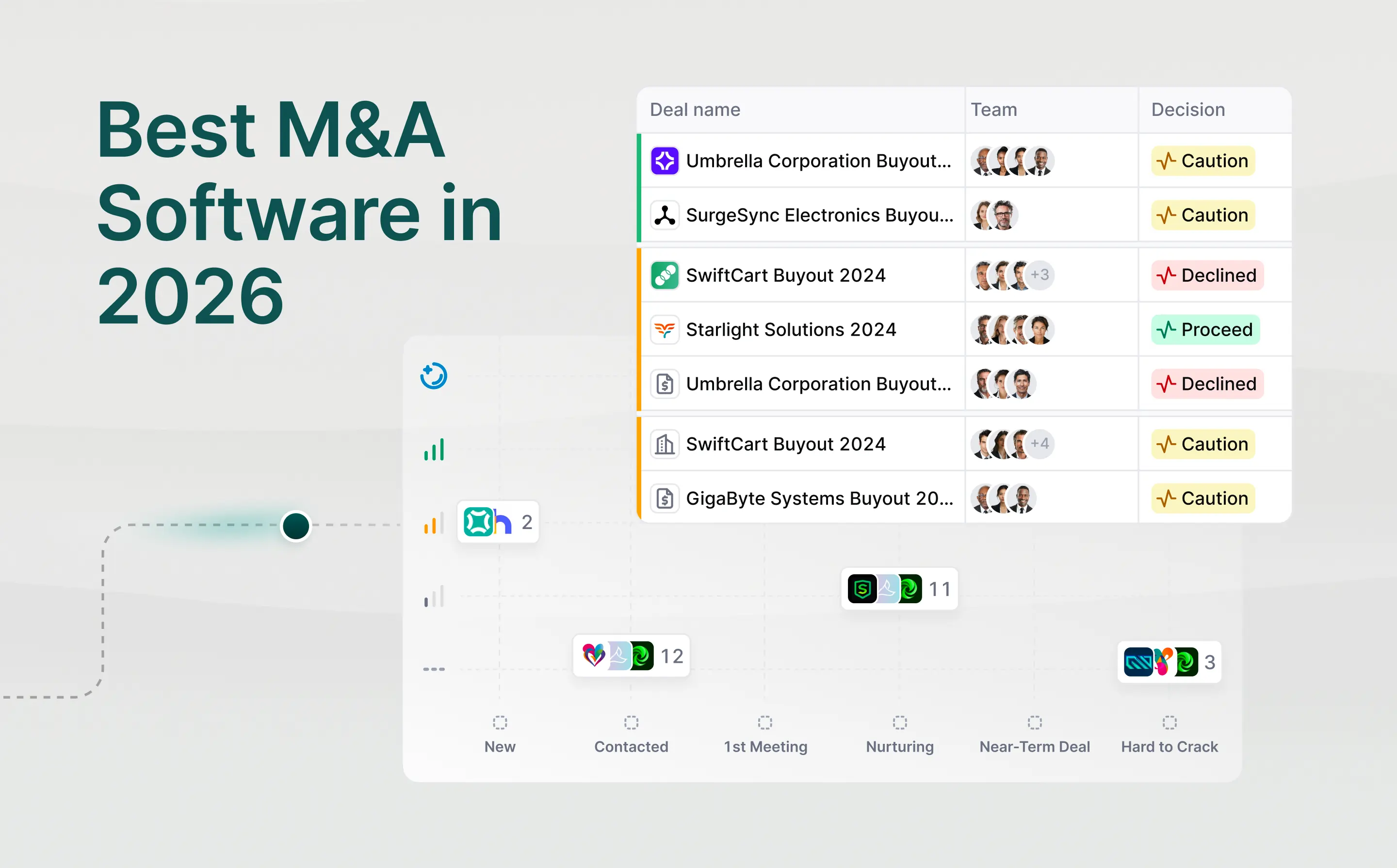
The best M&A and corporate development deal management software does more than track pipeline stages; it unifies target identification, relationship history, and deal execution in one system. With it, corp dev teams can run a professional acquisition process without stitching together spreadsheets and email threads.
Most corporate development teams know the pain of this setup. Target company data lives in a PitchBook export. Relationship context lives in someone's inbox. Post-close integration status lives in a deck that was last updated three weeks ago. When the CEO asks for a pipeline update, it takes two days to assemble. That is not a people problem. It is a tooling problem.
The pattern shows up at firms of every size. A small corp dev team at a mid-market industrial company is running the same spreadsheet workflow as a larger strategic acquirer, just with fewer people to maintain it. A VP of Corporate Development at a technology company with a dedicated acquisitions mandate is still manually copying PitchBook data into a Salesforce record that does not know what an LOI is. The tools have not caught up with how corp dev teams actually work.
The backdrop makes this problem urgent now. Global M&A rebounded sharply in 2025, reaching a projected $4.8 trillion in deal value, up 36% versus 2024 and the second-highest total on record, according to Bain & Company. Meanwhile, EY-Parthenon's June 2026 Deal Barometer projects US corporate M&A deal volume will rise 11% this year, with Q1 2026 already up 22% versus the same period in 2025. A rising volume environment is exactly when fragmented tools create the most damage: more targets to track, more relationships to manage, more deals competing for bandwidth.
A new category of purpose-built M&A software has emerged to replace the patchwork. Some platforms focus on virtual data rooms and integration workflows. Others adapt financial services CRM infrastructure for deal teams. The most effective options treat M&A as a relationship-driven investment activity — which it is — and unify sourcing, pipeline management, relationship intelligence, and execution in a single platform. This guide evaluates the leading options for 2026 based on the criteria that matter most for corporate development teams: full lifecycle coverage from target identification to post-close tracking, automated enrichment that eliminates manual research, and relationship intelligence that surfaces the firm's institutional knowledge.
Corporate development teams are expected to run a professional investment process, but most do it with tools built for entirely different jobs. Salesforce and HubSpot are designed for repeatable sales funnels with defined lead stages and short-cycle conversion logic. An acquisition process is none of those things. It is non-linear, relationship-driven, and can span months or years between initial target identification and close. The mismatch is structural, not cosmetic. A contact record in Salesforce does not know that the CFO of a target company was the COO at a portfolio company three years ago, or that a colleague last spoke to their banker six weeks ago.
Project management tools like Monday.com and Asana can track tasks and milestones, but they cannot map relationships, enrich company profiles automatically, or connect deal activity to the firm's broader institutional knowledge. They are execution layers, not intelligence layers.
The spreadsheet problem is well understood by anyone who has sat in a pipeline review meeting. A serial acquirer evaluating 200 or more targets per year cannot maintain data quality, track relationship history, or produce real-time pipeline reporting from a shared Excel file. Data goes stale. Updates get siloed in individual inboxes. A target drops off the radar because no one owns the follow-up. The pipeline report you hand to the CFO is, at best, accurate as of last Tuesday.
The appetite for M&A is only growing. Dentons research found that nearly two-thirds of business leaders plan to use M&A to bolster their AI capabilities within the next 12 months, with that figure rising to 70% over a three-year horizon. Corp dev teams are being asked to run more deals, evaluate more targets, and report on pipeline health in real time. Generic tools were not built for that volume or that reporting cadence.
There is also the institutional memory problem. When a deal team member leaves, their relationships, their context on a target company, and their read on a sector go with them, unless those things were captured somewhere. A generic CRM with no automated activity logging captures nothing unless someone manually enters it. Most people do not. Institutional memory gets rebuilt from scratch every time someone new joins the team, or every time the CEO asks why a target your firm evaluated two years ago is now being acquired by a competitor.
The combination of rising deal volume, shrinking timelines, and higher reporting expectations from C-suite stakeholders has made the case for purpose-built M&A software clearer than it was three years ago. The question is no longer whether to upgrade from spreadsheets. It is which platform fits your workflow and how to configure it for the way your team actually operates.
For a deeper comparison of why financial services CRMs differ structurally from sales CRMs, see our analysis of private equity CRMs versus standard CRMs. The dynamics that apply to PE deal teams apply equally to corp dev.
Evaluating M&A software is not the same as evaluating sales software. The questions are different: Can I see who on my team has a relationship with this target's board? Does the pipeline update automatically when I send an email? Can I pull a board-ready status report without spending an afternoon reformatting data?
The following criteria reflect what corporate development teams actually need.
A note on what to deprioritize: Feature count is a poor proxy for fit. Some platforms offer deep customization at the cost of long implementation timelines and high administrative overhead. Others are optimized for investment banking advisory workflows that differ meaningfully from a strategic acquirer's corp dev process. The goal shouldn’t be the most configurable system available; it should be the system that requires the least friction to keep current. A CRM that nobody updates is worse than a spreadsheet, because it creates a false sense of coverage.
The platforms below address different parts of the corp dev workflow. Meridian covers the full lifecycle; others address specific functions well. The right stack depends on your team's volume, budget, and how much of your pipeline is relationship-driven versus data-driven.
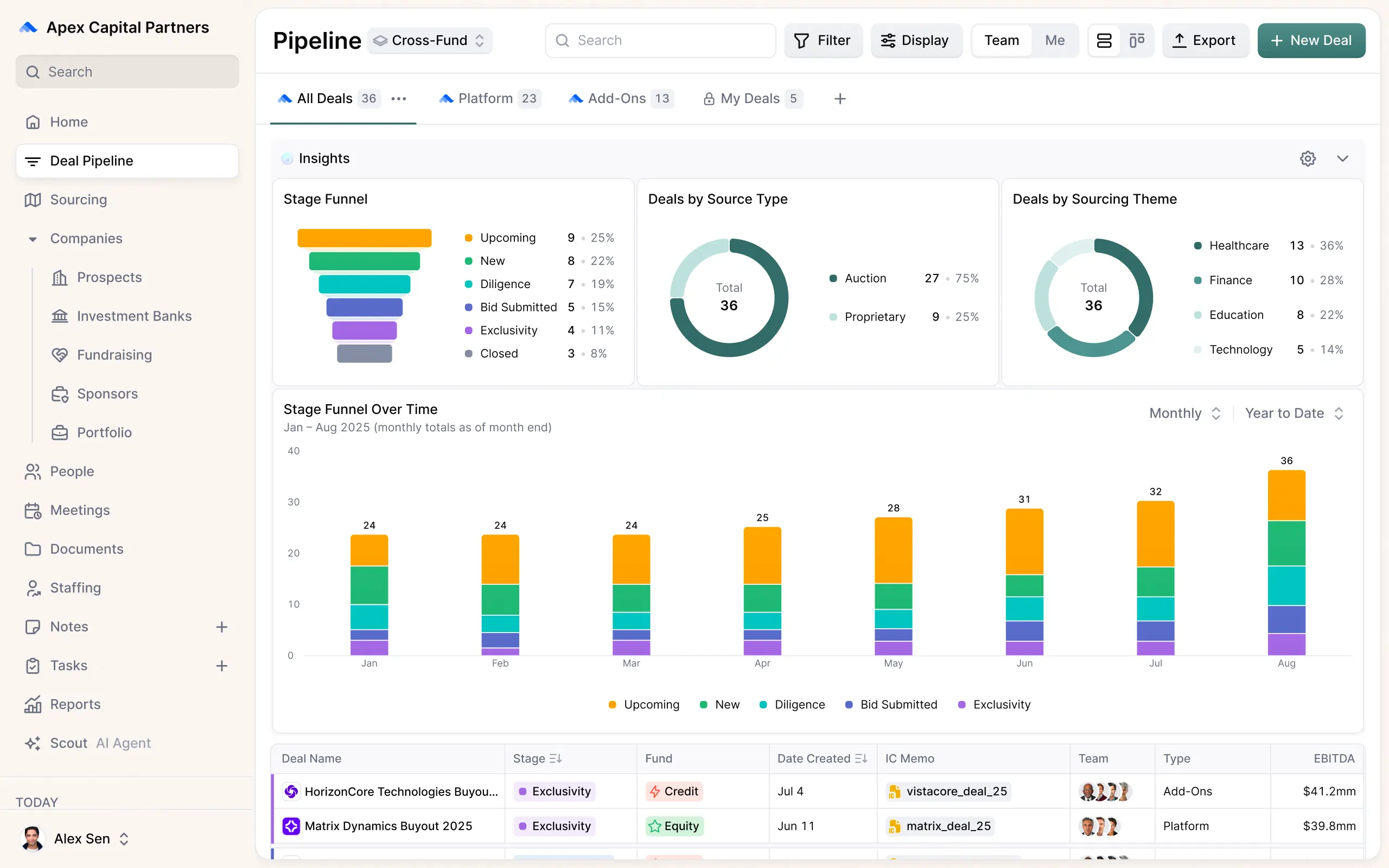
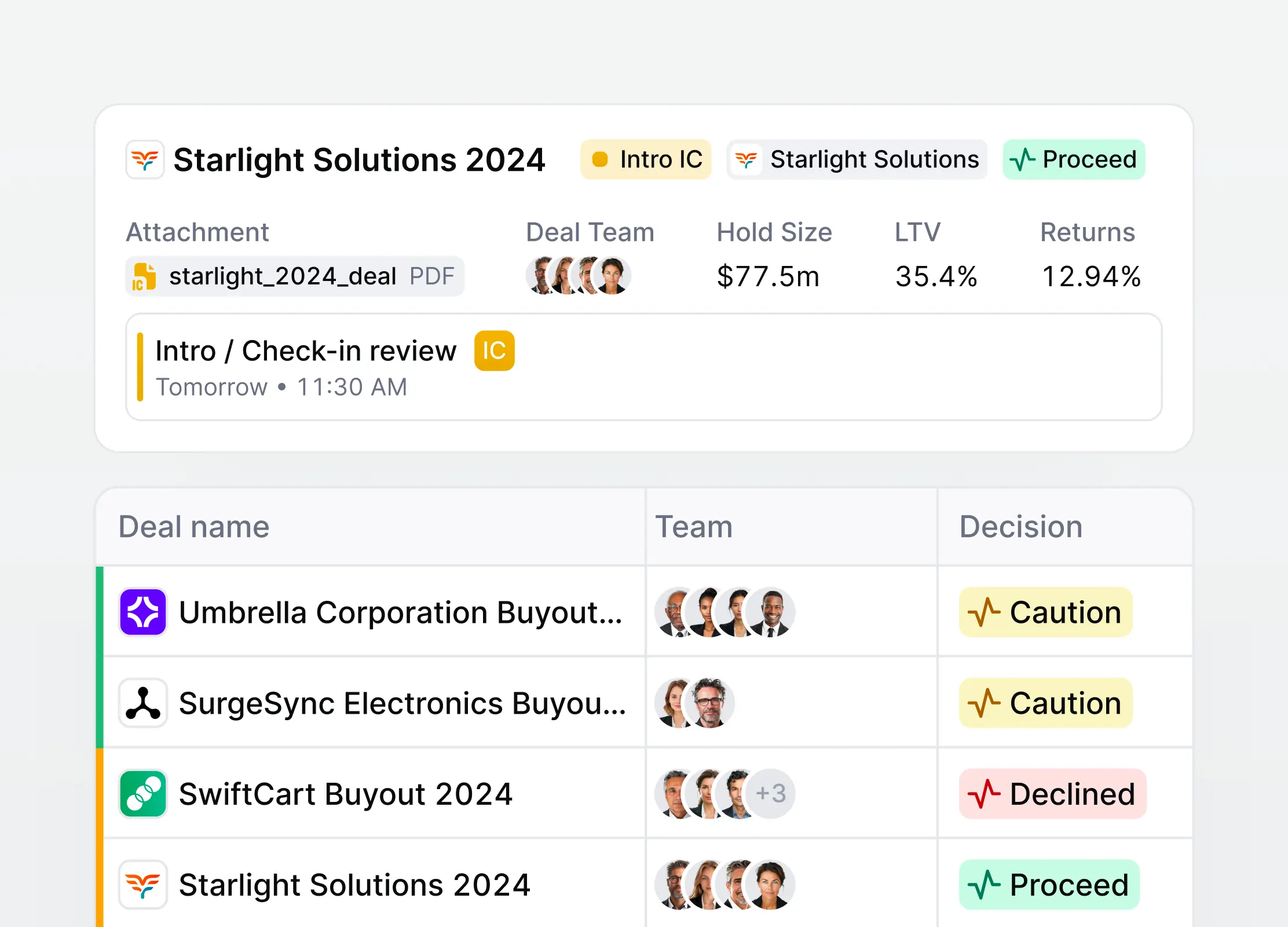
Meridian is an AI-native CRM and deal intelligence platform purpose-built for private markets, including corporate M&A and corporate development teams. The platform is designed to replace the patchwork of Salesforce, PitchBook, and spreadsheets with a single system of record that covers the full acquisition lifecycle, from initial target identification through pipeline management, due diligence coordination, and post-close tracking. Our corporate M&A solution is built for strategic acquirers and serial acquirers who run a professional investment process.
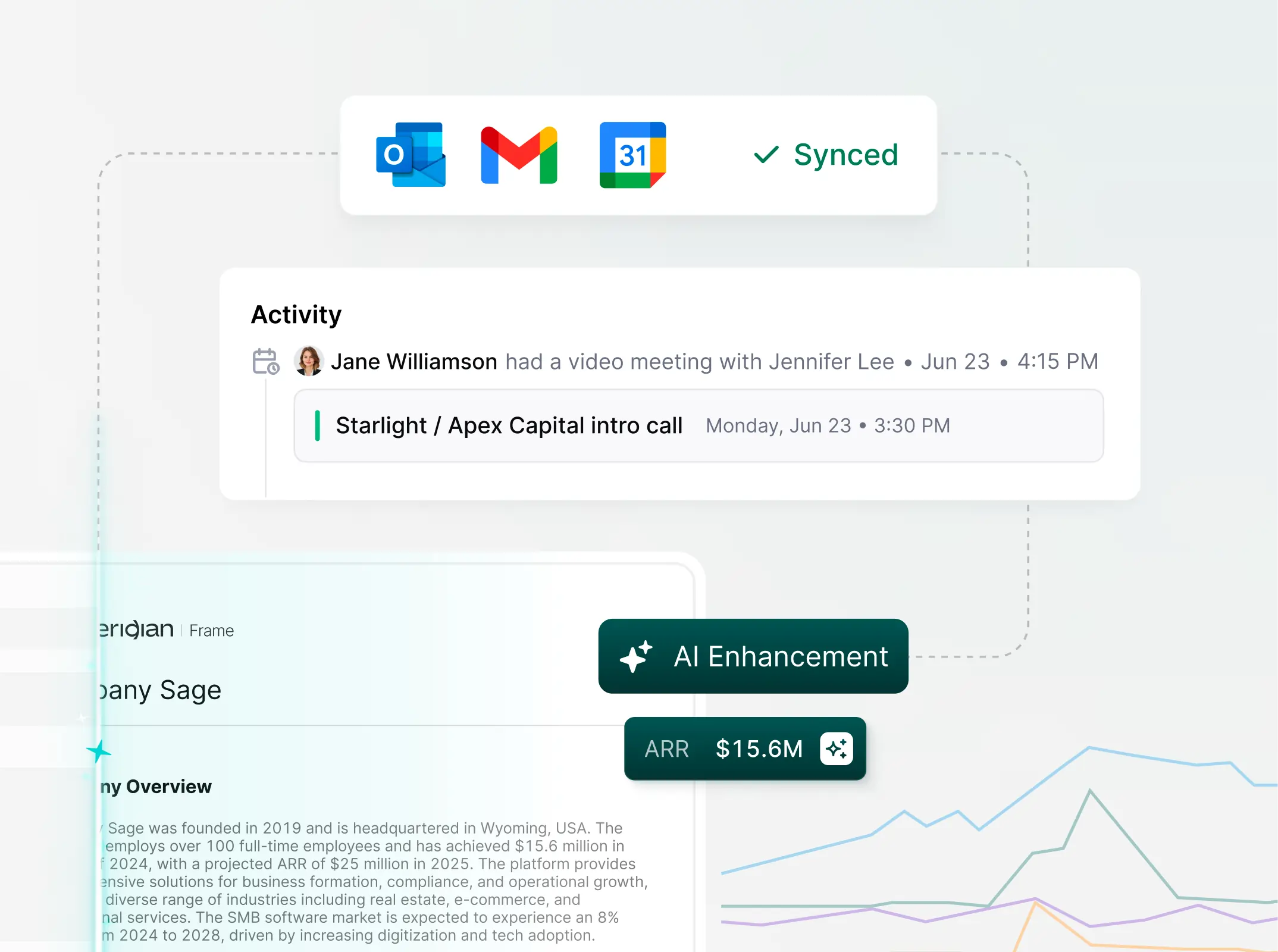
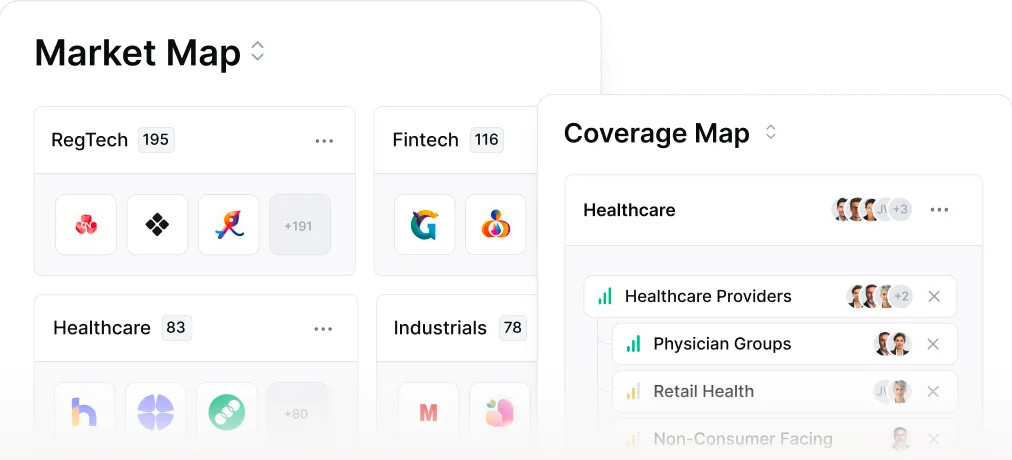
What sets Meridian apart for corp dev teams is the combination of proprietary data and automated relationship capture. The platform bundles access to 26 million+ company records, so target universe construction and company enrichment happen inside the CRM rather than requiring a separate data provider subscription. Scout AI, Meridian's embedded intelligence engine, proactively surfaces target company signals and suggests opportunities based on your acquisition mandate, rather than waiting for you to search.
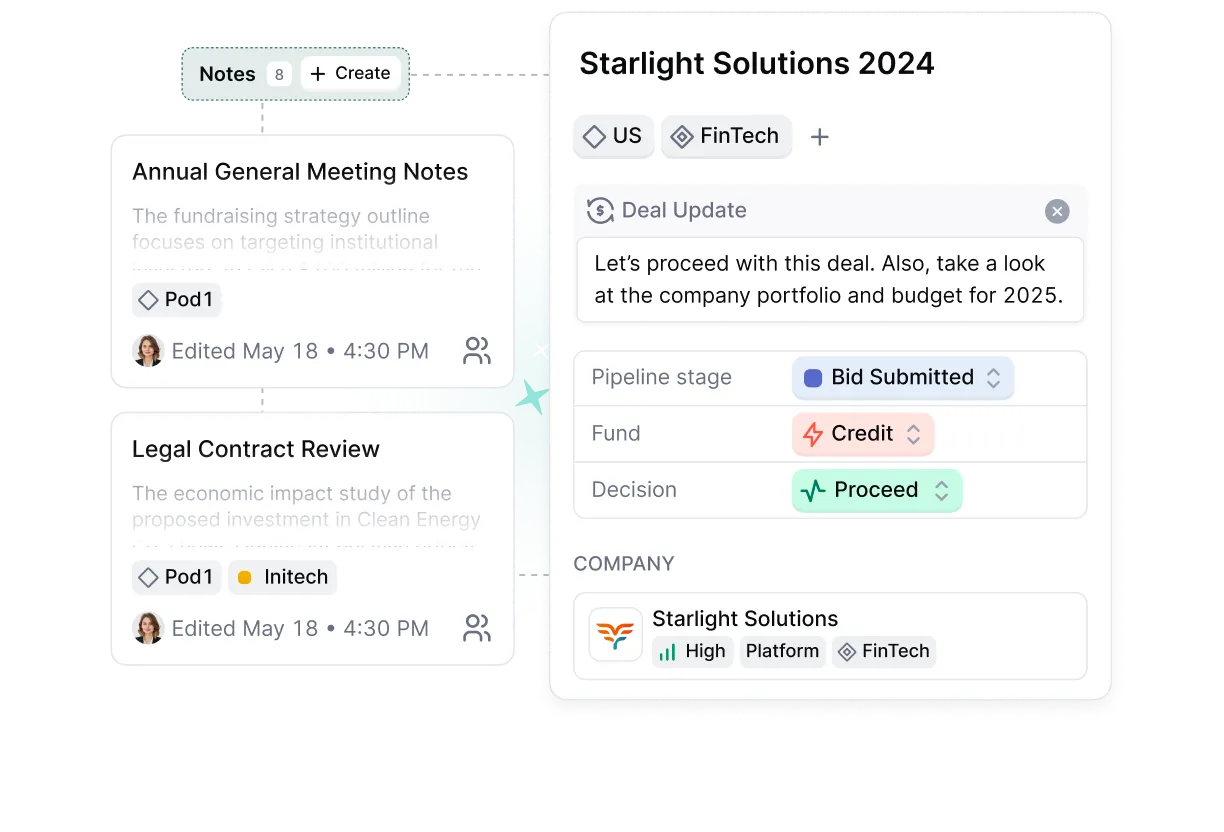
Relationship intelligence is automatic. Meridian captures every email, meeting, and interaction from your team's inboxes and builds a living map of who knows whom across your target universe, your banker network, and your portfolio. When a target company comes into the pipeline, you can immediately see whether anyone on your team has a prior relationship with the founder, the CFO, or their investment bank.
The deal sourcing and pipeline management layer is configurable for M&A stage gates: initial screening, term sheet, LOI, due diligence, and integration. Pipeline reporting pulls automatically from deal activity rather than requiring manual updates.
Honest trade-offs: Meridian is newer to market than DealCloud and does not include a built-in virtual data room. Teams that need VDR functionality will connect a dedicated tool.
For a broader look at how purpose-built PE and deal team CRMs compare to each other and to legacy options, see our best private equity CRM tools guide. Many of the criteria overlap with corporate M&A use cases.
Define your thesis and get insights into companies that fit it with AI-powered data enrichment and thematic sourcing features.
Grata is a company discovery and target screening platform designed to help M&A teams find acquisition targets that traditional databases miss. Its search engine indexes company websites, job postings, and public data to surface mid-market and lower mid-market businesses with specific characteristics: revenue range, geography, ownership type, technology stack, and growth signals. For deal teams building a proprietary target universe from scratch, Grata's coverage of private company data is a genuine differentiator. See Grata's M&A tools overview for a breakdown of how the platform supports acquisition searches.
Where Grata differs from a full deal management CRM is in workflow depth. The platform's strength is target identification and data enrichment, but pipeline management, relationship tracking, and deal execution logging require connecting Grata to a separate CRM like Salesforce or DealCloud. For teams that already have a CRM and need a better top-of-funnel data layer, Grata works well as a complementary tool. For teams evaluating a single unified platform, it addresses only part of the problem.
4Degrees is a relationship intelligence CRM built for investment professionals, with dedicated workflows for M&A and advisory teams. The platform's core strength is automated relationship capture: It indexes your team's email and calendar activity to build a network map of who has relationships with targets, intermediaries, and advisors, without requiring manual data entry. 4Degrees publishes a detailed M&A CRM buyer's guide that walks through the evaluation criteria their customers use.
4Degrees takes a relationship-first approach. If the primary workflow is managing introductions, tracking warm paths to targets, and logging banker conversations, it handles that well. Where their approach differs from Meridian's is in proprietary data depth. 4Degrees connects to external data providers rather than bundling a proprietary company database, which means target enrichment requires an additional subscription. For smaller deal teams with a focused mandate and an existing data provider relationship, 4Degrees is a strong option. For teams consolidating onto one platform, the additional data layer adds cost and complexity.
DealCloud is a highly configurable CRM built for financial services, with a strong installed base in investment banking and advisory. The platform supports deal pipeline management, relationship tracking, contact management, and firm-wide reporting across complex organizational structures. For large financial institutions running multiple deal types across multiple geographies, DealCloud's configurability and enterprise integration options are well-suited.
The trade-off is implementation complexity. DealCloud's strength in flexibility also means that deploying it for a specific corp dev workflow requires significant configuration work and ongoing administrative overhead to maintain. Implementation timelines tend to be longer than purpose-built alternatives, and the platform's investment banking heritage means some workflows require customization to fit a strategic acquirer's needs. Intapp's 2026 Amplify product announcements have added AI capabilities to the platform, though these operate as a layer on top of the existing architecture rather than as a natively integrated intelligence system.
For large enterprises that already run DealCloud across an investment banking or advisory function and want to extend it to a corporate development team, the consolidation logic can make sense. For corp dev teams evaluating standalone options, the configuration overhead and longer time-to-value make it a harder case relative to purpose-built alternatives.
A distinct category of platforms focuses specifically on virtual data room, due diligence, and post-merger integration workflows rather than full pipeline management. DealRoom, MergerWare, and Midaxo are well-regarded in this category. The CFO Club's M&A deal management software roundup covers this category in detail, including integration workflow features.
These tools are not CRMs. They are execution and coordination layers for the middle and back end of the deal process: organizing diligence workstreams, managing document access, tracking integration milestones, and coordinating across advisors and internal teams. Most corp dev teams use one of these alongside their CRM rather than instead of one. The question is whether your CRM handles the front end of the pipeline well enough that adding a dedicated VDR or integration tool is the right extension, rather than replacing a fragmented stack with another fragmented stack.
A common mistake is to evaluate VDR and integration tools first, since due diligence is often the most visible pain point, and then retrofit a CRM around them. The better sequence is to anchor on the CRM as the system of record and select VDR and integration tools that connect to it by deal record, so diligence status and integration milestones are visible in the same place as pipeline stage and relationship history.
Most corp dev teams probably don’t need the most feature-rich software available; they need to stop losing deals and relationships to tool fragmentation. The data suggests the market demands it. EY-Parthenon's June 2026 M&A outlook projects corporate M&A deal volume will rise 11% in 2026, following a Q1 already up 22% year-over-year. Running that volume on spreadsheets is not a scaling strategy.
The right architecture centers on a unified CRM as the system of record, with everything else connecting to it rather than existing in parallel. In practice, this means:
The firms that will run the best corp dev processes in 2026 are not necessarily the ones with the largest teams or the most capital. They are the ones with the best institutional memory, the fastest pipeline visibility, and the ability to move on a target before it becomes a widely known process. That is a data and systems advantage, and it compounds over time. Every deal you evaluate makes your model of what good targets look like more precise. Every relationship you log makes your network more legible. A platform that captures none of that institutional output is not a neutral tool; it is an active cost.
Serial acquirers running 100 or more target evaluations per year feel this most acutely. The overhead of managing a high-volume pipeline in spreadsheets is not just time spent reformatting data; it is the relationships that age out of the CRM because nobody had time to update the last conversation date, and the targets that slip through because the follow-up reminder lived in someone's personal calendar. For more on how AI-powered deal flow management changes these dynamics across the full private markets spectrum, see our deal flow management guide.
The choice of M&A deal management software is no longer an operational afterthought for corporate development teams. At $4.8 trillion in global deal value in 2025 and corporate M&A volumes projected to grow through 2026, the teams running pipeline on spreadsheets and generic CRMs are leaving speed and relationships on the table. Purpose-built platforms that unify target sourcing, relationship intelligence, pipeline management, and deal execution in a single system of record are not a luxury for large acquirers. They are the baseline for running a competitive process. If you want to see how Meridian applies this across the full acquisition lifecycle, we can show you.
Discover how Meridian can streamline deal sourcing and enhance your decision-making

Make confident, data-driven decisions to close the right deals and improve investment outcomes.
What is the best CRM for corporate development teams?
The best CRM for corporate development teams combines target identification, relationship intelligence, and pipeline management in one platform rather than requiring a separate data provider, CRM, and activity tracker. Meridian is built specifically for this workflow, with a bundled 26 million+ company database, automated inbox capture, and AI-powered sourcing. See our corporate M&A solution page for a full breakdown.
How do M&A teams track their acquisition pipeline?
Most teams start with spreadsheets and outgrow them as deal volume increases, moving toward purpose-built CRM platforms with configurable deal stages, automated data capture from email and calendar, and pipeline reporting that pulls from live deal activity rather than manual updates. Platforms like Meridian, 4Degrees, and DealCloud all offer pipeline management built for deal-driven workflows, each with different trade-offs in depth, configurability, and data integration.
What is the difference between a CRM and a VDR for M&A?
A CRM manages the relationship and pipeline side of M&A: target identification, contact management, deal stage tracking, and relationship history. A virtual data room (VDR) manages the document and due diligence side: secure file sharing, diligence checklists, and access controls for advisors and counterparties. Most corp dev teams use both, with the CRM as the system of record across the full deal lifecycle and the VDR activated during diligence.
Can a private equity CRM work for corporate M&A?
Yes, with caveats. PE CRMs built for the full investment lifecycle, including target sourcing, diligence, and portfolio management, share enough workflow overlap with corporate M&A that they can adapt well. The main difference is in reporting requirements and post-close tracking: corporate acquirers typically integrate targets into the parent company rather than managing them as a portfolio, which requires different post-close workflows. Our comparison of PE CRMs versus standard CRMs covers the structural differences in more detail.

Table of Contents

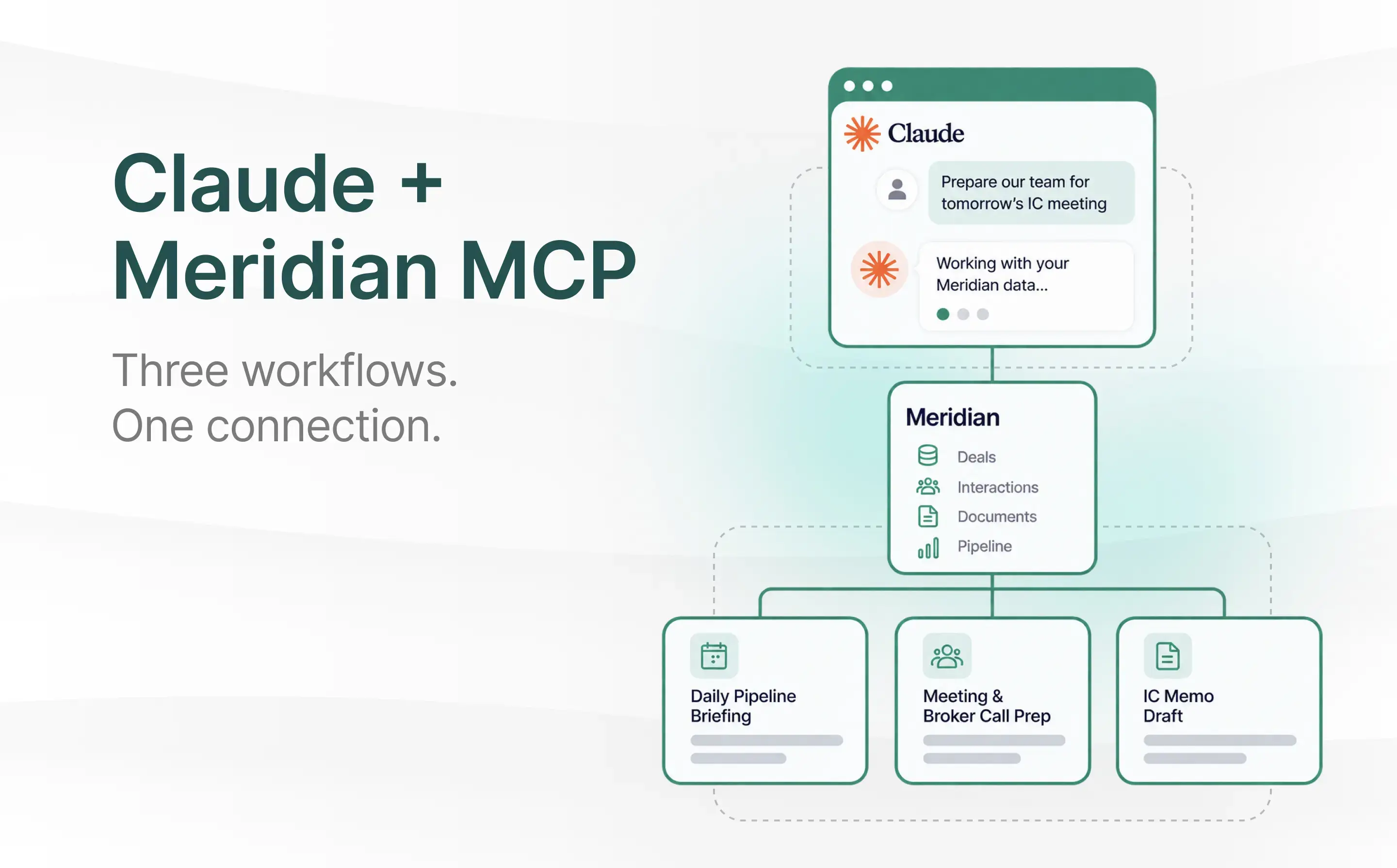
Learn how a private equity firm is using Claude with Meridian MCP in their real daily workflows.