
Meridian MCP is live!
Connect your deal sourcing data to any AI tool.
Learn More
Meridian raises $7M seed round led by 645 Ventures.
Read More
How relationship intelligence turns your firm's hidden network into a sourcing advantage, its five components, and how to evaluate vendors.
.webp)
Relationship intelligence is technology that automatically captures and scores the professional relationships across a firm, using email and calendar data, so anyone can see who at the firm knows a given person and how well they know them. That’s how it works in more traditional sales organizations, at least. The private markets investor version of relationship intelligence functions differently: A partner floats a target in Monday's pipeline meeting, somebody says "I think Dave knows the CFO," and forty minutes of inbox archaeology later it turns out the firm has three paths in, and the best one runs through a portfolio company CEO who sits on the target's board.
Every investment firm's most valuable asset is a network it cannot easily see without the right tools. Thousands of relationships across partners, associates, portfolio company executives, bankers, attorneys, and advisors, accumulated over years of dealmaking, sitting in individual inboxes and personal phones. When a partner leaves, their share of that network walks out with them.
The cost of managing it by hand is measurable. Salesforce's seventh-edition State of Sales report, published in February 2026 and based on a survey of 4,050 sales professionals, found that the average seller now spends only 40% of their time actually selling, and that the youngest reps lose roughly two hours a week to manual data entry alone. Deal teams are not sales teams, but the arithmetic of manual CRM upkeep is identical, and investment professionals cost more per hour.
Relationship intelligence software automates what used to depend on institutional memory and hallway conversation. The system reads email and calendar activity, enriches contact records from outside sources, and scores relationship strength on frequency and recency, which surfaces the firm's whole network and the warmest routes into it without anyone drawing a map.
This guide covers what relationship intelligence means for deal teams, the five components that make it work, the four deal workflows it changes, the two architectural approaches platforms take, and the six questions to ask any vendor selling it.
Relationship intelligence is built from five components: automated activity capture, contact and company enrichment, relationship strength scoring, network mapping, and introduction path identification. A platform missing any one of them delivers only a partial version of the capability, and the gap usually shows up the first time somebody asks a question the system cannot answer.
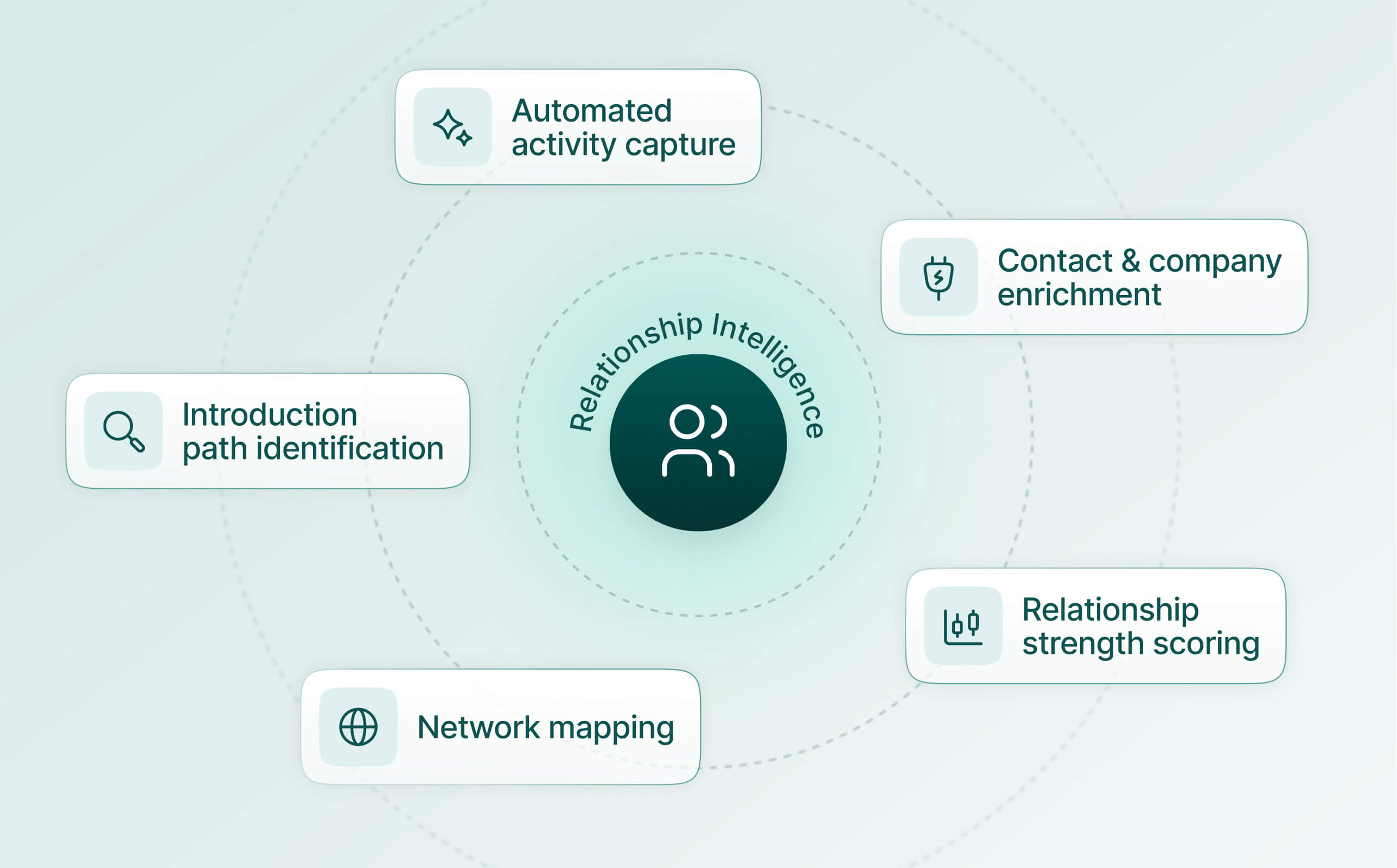
Automated activity capture connects the platform to the firm's email and calendar tools and treats every sent message, reply, and accepted meeting as a relationship data point, with no manual logging required. A contact who received three emails from a partner last month and two from an associate last quarter has a complete relationship record even though nobody opened the CRM.
This is the difference between relationship intelligence that works and relationship intelligence that only works when people remember to log it in the CRM. Passive capture runs on data the team already generates, which means adoption does not depend on discipline.
The gap this one component addresses is wide. S&P Global data cited by the World Economic Forum found that 41% of private equity firms sit at nascent stages of technology adoption, 13% are at advanced implementation, and 7% have fully integrated technology into operations. Automated capture is the practical entry point for the other 93%, because it asks nothing of the senior people whose relationships matter most.
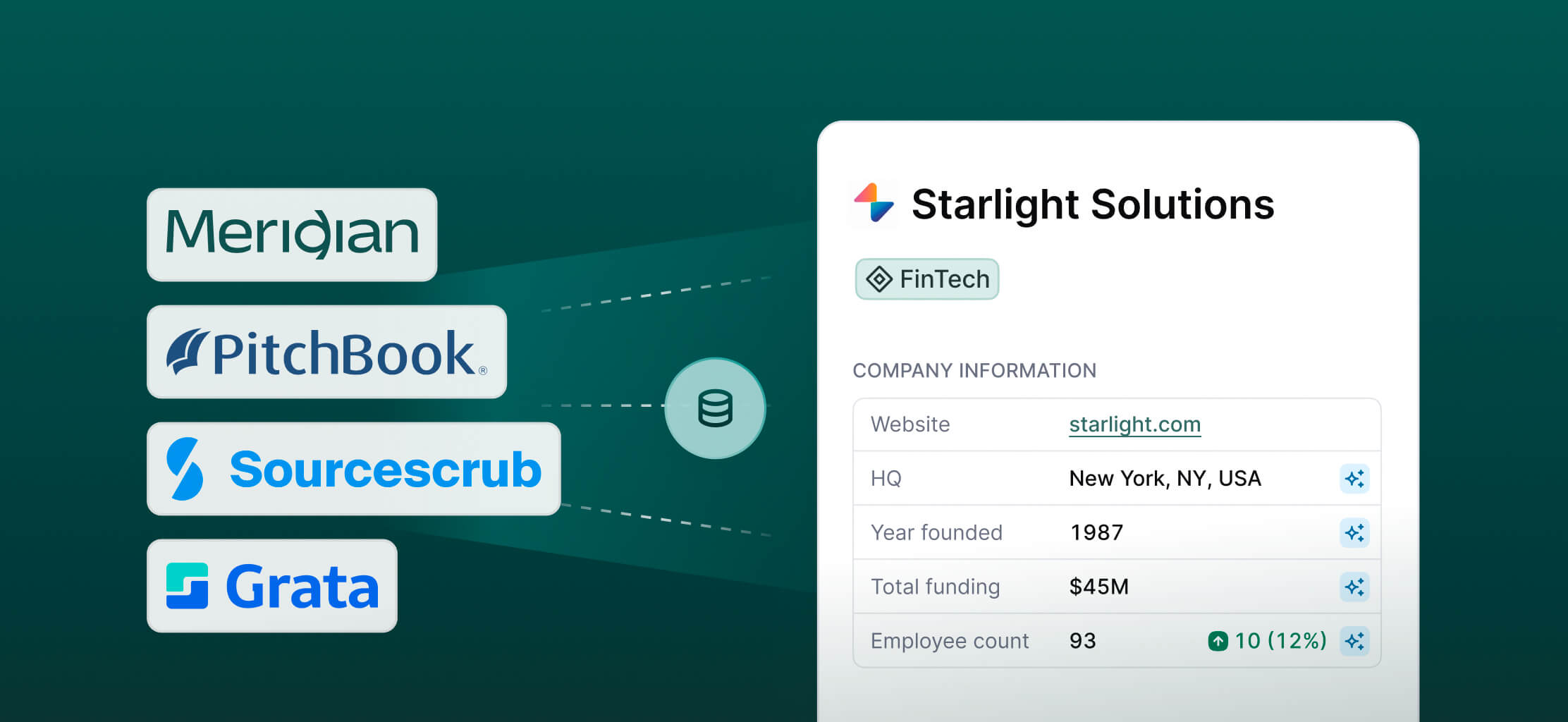
Contact and company enrichment fills relationship records from external sources, including company data, job history, board seats, and news, so the context extends past what sits in the inbox. A contact who changed employers six months ago shows the new company on their profile without anyone at the firm touching the record.
Enrichment quality depends on refresh frequency more than on the number of sources. A profile updated quarterly in a batch job is out of date for most of the quarter, and a stale title on a board member is worse than a blank field because somebody will act on it.
Meridian's enrichment layer draws on more than 26 million company records plus AI web crawls, and updates continuously rather than on a batch schedule. You can also connect other third-party datasets that you’re already paying for, like Pitchbook or Grata. We use a waterfall model with per-field source control, so a firm can decide which provider wins on headcount and which wins on revenue instead of accepting one vendor's view of everything.
Relationship strength scoring weighs the frequency, recency, and reciprocity of communication to rate how strong each connection is. A partner who exchanged 40 emails with a CFO last quarter scores above a partner who met the same person once at a conference in 2023.
Reciprocity is the signal firms underrate. Forty outbound emails with two replies is a weak relationship dressed as a strong one in the wrong CRM, and any scoring model that counts volume without direction will tell the coverage partner something flattering and inaccurate.
Scoring is what turns "who do we know here?" from a question into a query. The answer arrives in seconds, ranked, instead of arriving on Thursday after three people check their sent folders. This matters more as firms grow past the point where one person can hold the network in their head, which is usually somewhere around 20 investment professionals.
Network mapping renders the firm's full relationship graph as something a person can query or see, covering who knows whom across the entire firm rather than inside one inbox. The most useful implementations show the path from any person at the firm to any contact in the target universe, ranked by strength.
Standalone relationship intelligence platforms including Affinity and 4Degrees generally go deeper here than platforms where relationship intelligence is one capability among many. Network visualization is their core product surface, and it shows. For firms whose primary use case is mapping and analyzing the network itself, that depth is worth paying for. If deal sourcing is your most important use case for a CRM, however, you’ll want to continue shopping.
Skepticism about AI in sourcing is well earned, which is why mapping has to be demonstrable rather than asserted. In S&P Global Market Intelligence's 2026 Private Equity and Venture Capital Outlook, surveying global GPs, VCs, and LPs in February 2026, 64% of respondents rated AI as ineffective for deal sourcing. Ask any vendor to run the mapping on a real company in your sector before you believe the demo.
Introduction path identification takes a target company or a named person and surfaces the strongest internal route to them, ranked by relationship strength. The accounting partner who knows the founder, the portfolio company CEO on the target's board, the operating partner whose prior firm bought a competitor in 2022: None of those connections appear in a conventional CRM unless somebody logged them. They exist in email history and career data, and they surface only if the system is reading both.
Firms are already comfortable applying this class of technology to finding companies. EY-Parthenon reported in November 2025 that as of 2024, only one in ten of its private equity clients had not yet used data analytics and AI for due diligence and target identification. Path identification applies the same machinery to the question of how to reach the target once you have found it.
Relationship intelligence changes four deal workflows in ways a team notices within a quarter: sourcing, due diligence, live deal execution, and portfolio value creation. The change in each case is that a question which used to require asking around now returns an answer from the system.
In sourcing, relationship intelligence replaces the internal poll with a ranked list of introduction paths. The partner who did not know that a portfolio company CEO sits on the target's board gets alerted the moment that target matches the firm's thesis, rather than finding out after a banker runs the process.
This is the workflow where vendor claims outrun vendor delivery most often. The same S&P Global 2026 survey that found 64% of GPs rating AI ineffective for deal sourcing also identified fragmented and unstructured data as a barrier to AI adoption generally. Relationship intelligence built on a clean underlying record performs differently from relationship intelligence bolted onto a messy one, which is the whole argument for where it should live.
In due diligence, relationship intelligence answers who at the firm has spoken with the target's executives, customers, or competitors, and what was discussed. An associate preparing for a management presentation can pull the firm's full history with the target's CFO across every thread and walk in briefed instead of blank.
Diligence is where private markets AI adoption is furthest along, so this workflow tends to land with the least internal resistance. S&P Global's 2026 outlook found due diligence to be the highest-adoption area for AI integration, at 31% of firms somewhat or fully integrated, ahead of every other function surveyed.
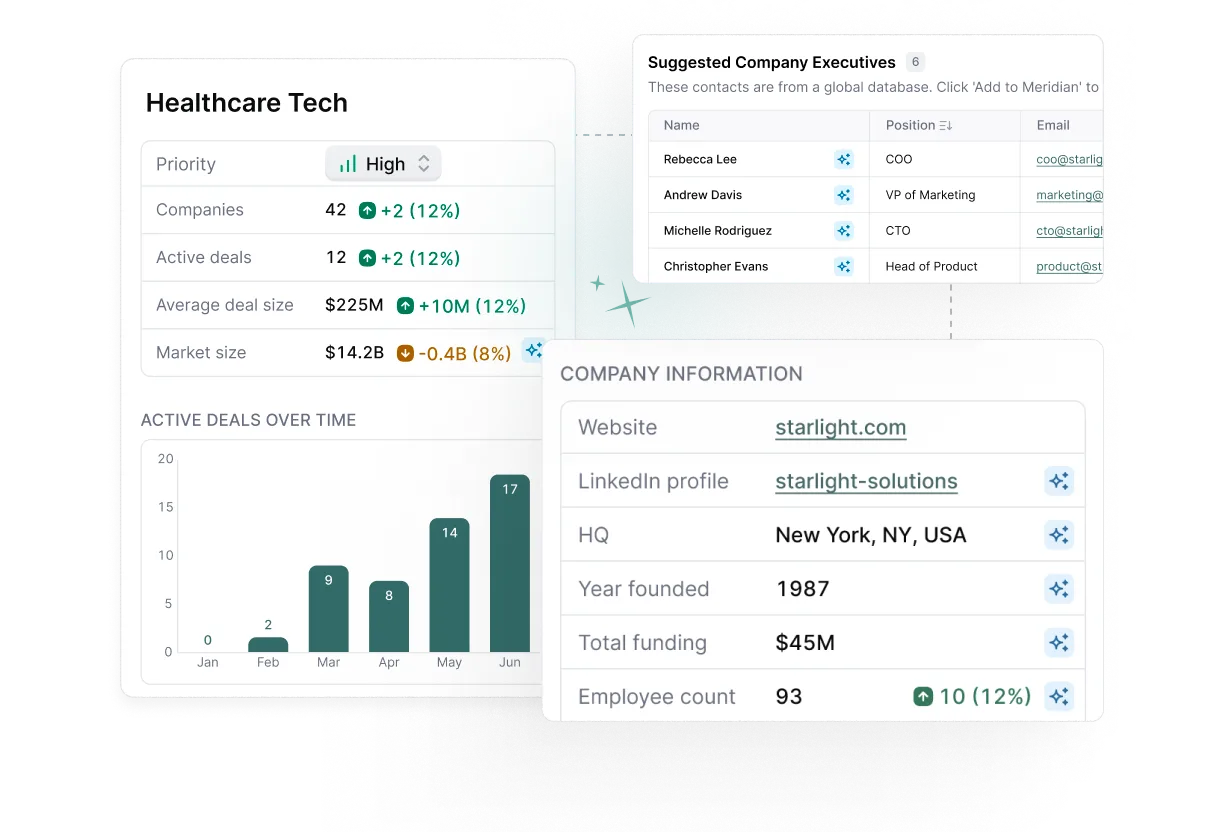
Meridian gives you the context and insights you need to nurture the connections that pay off.
During live execution, relationship intelligence tracks which relationships are active and which need re-engagement. If the banker running the process has not heard from the firm in three weeks, the score decays and the coverage partner gets told before the silence turns into a read-through on their interest level.
The value here is the absence of manual tracking rather than the alert itself. Any workflow that removes upkeep from a deal professional's week is buying back the scarcest input the firm has.
For portfolio value creation, relationship intelligence maps the firm's collective network against portfolio company needs. When a CEO needs a board member with operating experience in cold chain logistics, the system queries partners, operating partners, LP advisory boards, and portfolio executives at once instead of relying on somebody to remember the right name.
Portfolio-level AI work is no longer unusual. EY-Parthenon reported that about two-thirds of its private equity clients had implemented at least one AI initiative in their portfolios by 2024, and that 84% of PE funds expect AI to have a significant transformative effect on their business. Relationship intelligence is one of the few applications that serves the fund and the portfolio companies from the same dataset.
There are two legitimate architectures for relationship intelligence: a standalone platform built around it, or a CRM that produces it as a property of how the system stores data. The right answer depends on whether relationship mapping is your primary use case or one input into a wider deal process.
Standalone relationship intelligence platforms go deeper on scoring granularity, network visualization, and relationship-specific analytics than platforms where relationship intelligence shares the roadmap with pipeline, reporting, and fundraising. Affinity pioneered automated relationship capture in private markets, and 4Degrees built scoring and visualization specifically for deal-driven teams. Both have since expanded from relationship-first roots into fuller deal management.
The trade-off is architectural. A standalone platform either replaces the CRM or integrates with it, and an integration is a thing somebody at the firm now owns: field mappings, sync failures, two systems disagreeing about which record is current. For a firm with a working CRM it is not disqualifying, but it is real operational weight and it does not go away after implementation.
CRM-embedded relationship intelligence produces the same five components as a byproduct of the system of record's architecture, so relationship data lives where deals, pipeline, and reports already live. Nothing has to be consulted, because the relationship context surfaces inside the workflow the team is already in.
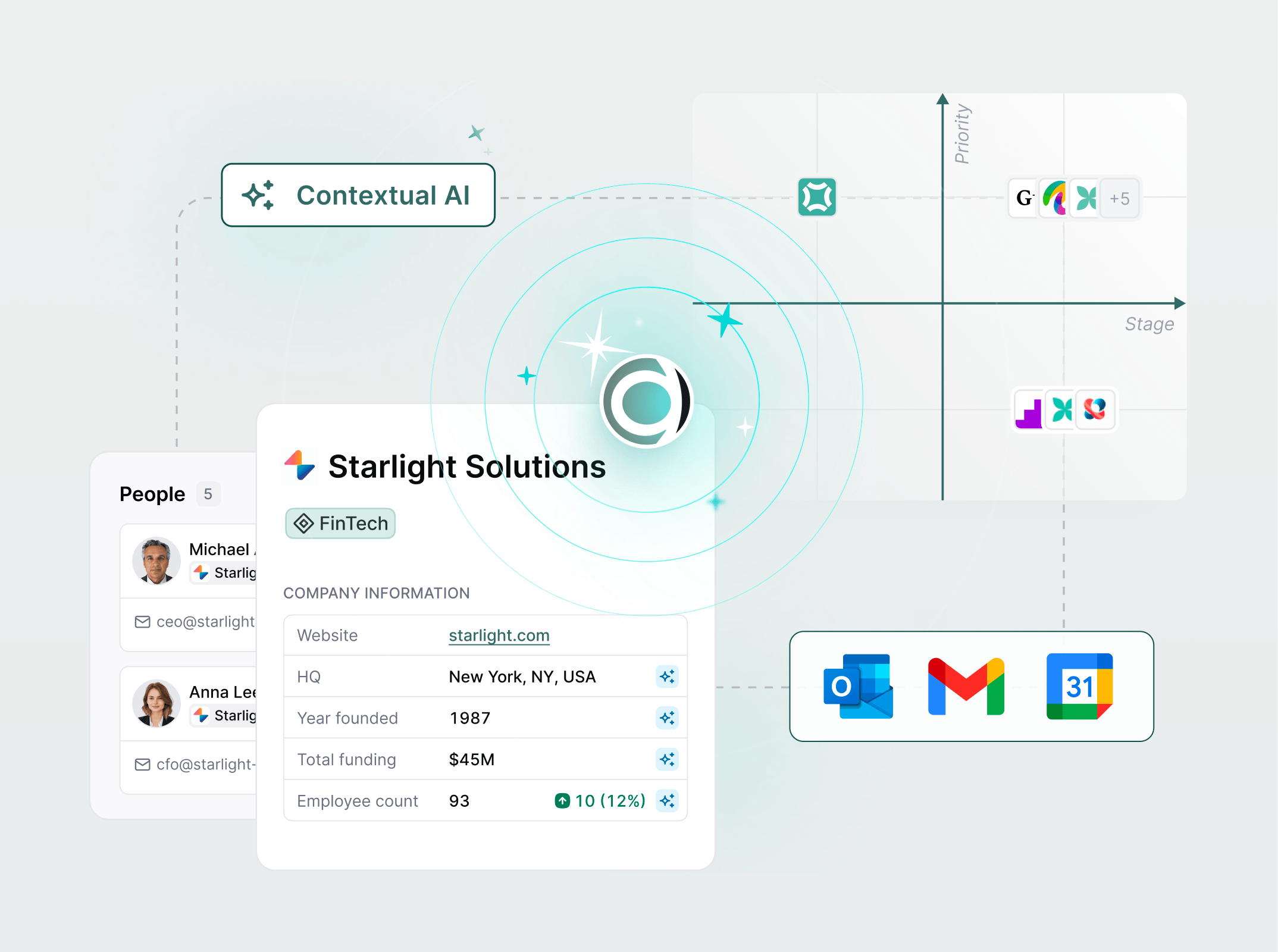
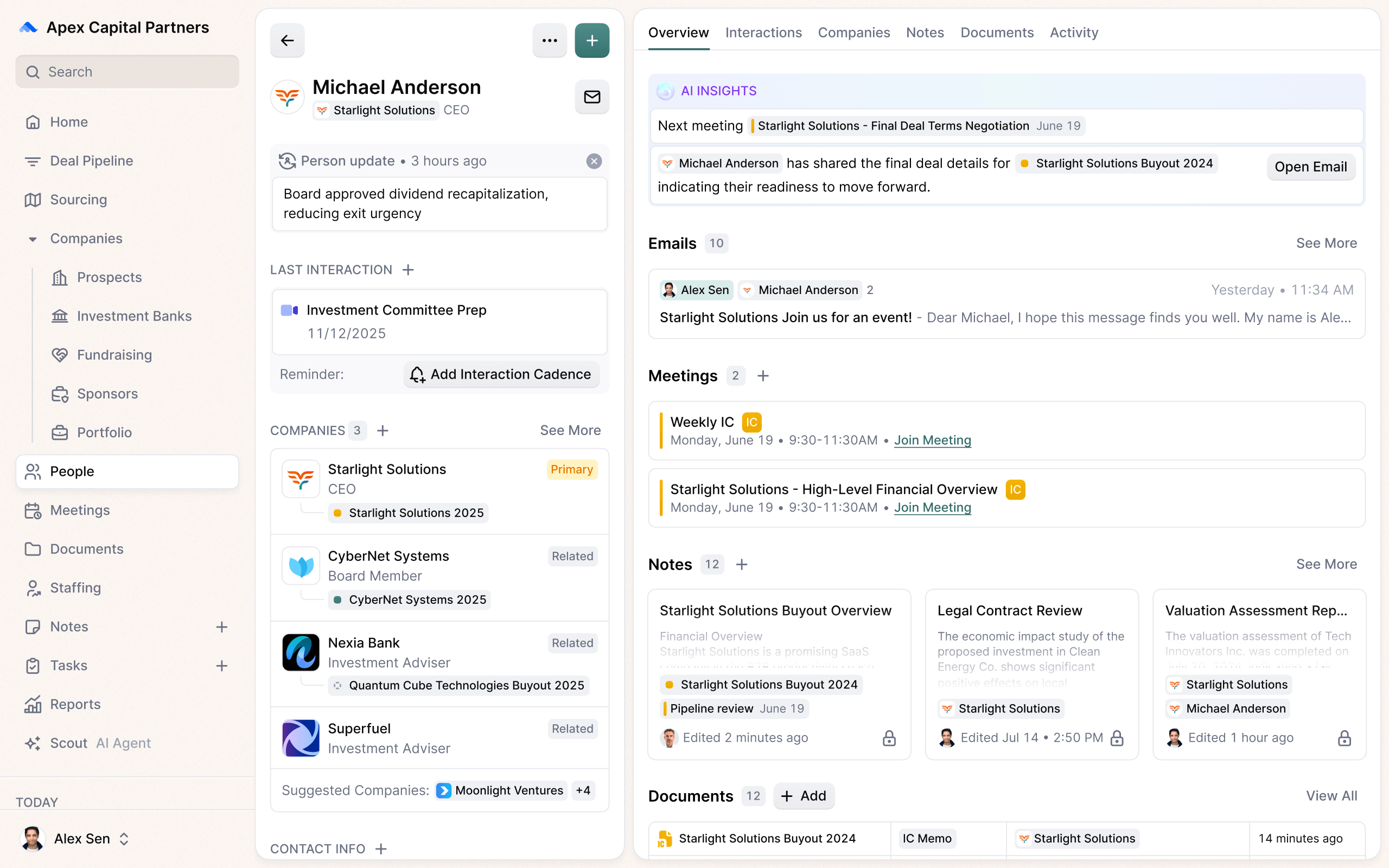
This is how we built Meridian. Scout AI captures email and calendar activity automatically, enriches contacts from more than 26 million company records and AI web crawls, and scores relationship strength as part of the core data layer rather than as a module sitting alongside it. When a company enters the pipeline because of a warm path, that origin travels with the deal through diligence, IC, and reporting.
The honest trade-off: A platform covering the full investment lifecycle will not match the network visualization depth of a product whose entire surface area is the relationship graph. If your firm's primary job to be done is network mapping and relationship analytics rather than running deals end to end, a dedicated tool will take you further, and we would rather say that than sell against it.
Six questions separate real relationship intelligence from a contact database with a score attached, and all six work regardless of which platform you are looking at. Bring them to the demo rather than to the follow-up call, because the answers determine whether the rest of the evaluation is worth running.
Email and calendar capture is the floor, not a differentiator, and any platform that cannot do both passively is not offering relationship intelligence. Ask whether the system also captures meeting notes, call transcripts, and third-party event data, because breadth of capture determines how complete the resulting graph is.
Enrichment should update a contact record when the person changes jobs, joins a board, or appears in the news, without anyone triggering it. Ask how many external sources feed a profile, how often profiles refresh, and whether the firm can control which source wins for a given field.
A defensible relationship score is built on frequency, recency, and reciprocity of communication, and the vendor should be able to explain the weighting without retreating into "proprietary algorithm." Ask whether the score is configurable and how it decays when communication stops, since a score that never decays is a record of the past rather than a picture of the present.
Given a target company, the system should return every introduction path the firm has, ranked by relationship strength. Ask the vendor to demonstrate it live on a company in your actual target sector rather than on a demo record, because seeded demo data hides exactly the gaps you are testing for.
Relationship intelligence that cannot reach pipeline stages, sourcing campaigns, and reporting produces insight the firm has to re-enter somewhere else. Ask what happens when a company enters the pipeline because of a warm introduction. Does that origin follow the deal through diligence and into the year-end sourcing attribution report, or does it stop at the contact record?
Automated email capture raises privacy questions that deserve a straight answer before procurement, not after. Ask where captured data is stored, which people inside the firm can see specific communications, whether captured data trains the vendor's models, and when the most recent SOC 2 Type II audit closed.
These concerns are not hypothetical objections invented by the security team. In S&P Global's 2026 survey, GPs named lack of expertise (49%), data privacy concerns (43%), and model accuracy concerns (38%) as the leading barriers to AI adoption. Our answers to the privacy questions are published on our security page, and every vendor you evaluate should be able to point you to the equivalent.
The remaining question is architectural rather than existential. Relationship intelligence can live as a standalone layer, which goes deeper on the network graph and costs an integration; or inside the system of record, which trades some visualization depth for relationship context that shows up in the workflow without being asked for. Both are defensible. Having neither is not, and it is the option most firms have effectively chosen by default.
Discover how Meridian can streamline deal sourcing and enhance your decision-making

Find out how leading PE firms are using Meridian to enhance their deal workflows.
.webp)
What is relationship intelligence in a CRM?
Relationship intelligence is technology that automatically captures, analyzes, and scores professional relationships across an organization by reading communication data, with no manual data entry. In a CRM it answers who at the firm knows a given person, how strong that connection is, and the shortest warm path from anyone at the firm to any target contact. It matters because buyers commit early: 6sense's 2025 Buyer Experience Report found that 94% of buying groups had ranked their preferred vendors before making contact, and bought from that favorite 77% of the time.
How does automated relationship tracking work?
Automated relationship tracking works in three stages: capture, where the platform connects to email and calendar and reads every message and meeting as a data point; scoring, where algorithms weigh frequency, recency, and reciprocity to rate relationship strength; and surfacing, where the system returns the strongest internal path to any contact on demand. No manual data entry happens at any stage, which is why it survives contact with busy senior people. Salesforce's 2026 State of Sales report found the average seller spends only 40% of their time selling, so removing logging work has direct value.
Do I need a separate relationship intelligence tool, or is my CRM enough?
A generic CRM built for sales teams will not deliver relationship intelligence, because it stores what your team chooses to log and that record is always incomplete. A private markets CRM with automated email and calendar capture, contact enrichment, and relationship scoring delivers it as a built-in capability. A dedicated tool such as Affinity or 4Degrees goes deeper on network visualization and relationship analytics, at the cost of an integration to maintain alongside your system of record.
How do PE and VC firms use relationship intelligence for deal sourcing?
Private equity teams use relationship intelligence to find warm introduction paths to owners and management before a banker formalizes a process, and venture teams use it to surface the strongest route to a founder in a target sector. Both applications depend on the same underlying graph of who at the firm has communicated with whom, and how recently. Skepticism is warranted on execution: S&P Global's 2026 survey found 64% of GPs rating AI ineffective for deal sourcing, which makes a live demonstration on a real target company the only useful test.

Table of Contents

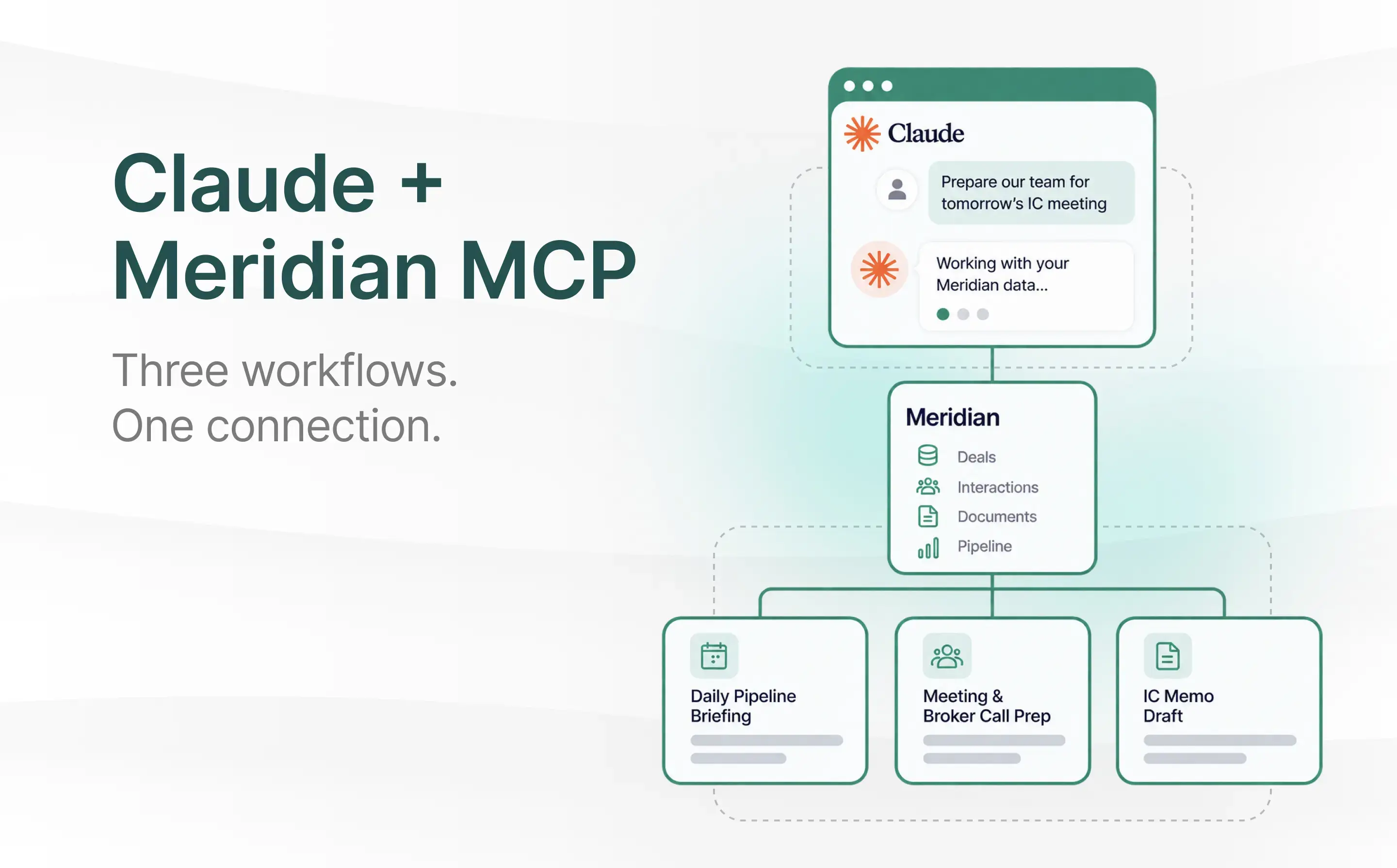
Learn how a private equity firm is using Claude with Meridian MCP in their real daily workflows.