
Meridian MCP is live!
Connect your deal sourcing data to any AI tool.
Learn More
Meridian raises $7M seed round led by 645 Ventures.
Read More
AI adoption has outpaced results in private markets. The four workflows that change deal-team output, and why the data layer matters more than the model.
Private equity firms use AI today across the full deal lifecycle, from sourcing and screening through diligence to portfolio monitoring, and adoption has stopped being the question. Deloitte's GenAI in M&A survey found 86% of corporate and private equity dealmakers already run generative AI in their M&A work, EY reports that 84% of US PE firms have appointed a Chief AI Officer, and most deal professionals we speak with here at Meridian keep a chatbot open in another tab during diligence.
The question now is why so little of that activity has changed what a deal team actually produces.
Adoption and results have come apart. Bain's field notes on the gen AI insurgency put the share of portfolio companies that have operationalized a use case with concrete results at nearly 20%, which means roughly four in five firms have bought tools and named leaders without changing how deals get done. Buying a license and appointing a Chief AI Officer is governance, not output.
The firms closing that gap share one trait: They run specific workflows on proprietary, source-tracked data instead of prompting a general model and trusting the answer. McKinsey's survey of private markets investors found 67% expect gen AI to have a transformational impact within five years, and 82% call it a high priority; but priority without a data layer underneath produces fast answers a deal team cannot verify.
This article covers how private markets investment firms actually use AI in 2026: the state of adoption, the four workflows where AI produces measurable output, and why the data and sourcing underneath any tool decide whether its output is trustworthy or just quick.
Private equity firms have adopted AI faster than they have operationalized it, and the distance between the two is the big story of 2026. The tools are in the building; the workflows are mostly unchanged.
Results have not kept pace with the spending. Appointing leadership and buying licenses is not the same as changing how a deal gets sourced, screened, or written up. Firms that conflate the two end up with the org chart of an AI-forward firm and the daily workflows of the one they were three years ago.
General-purpose language models miss much of the proprietary detail a deal decision depends on. In McKinsey's testing, about 40% of the important data points that surfaced in expert interviews were absent from public-LLM answers to the same questions, and could not be recovered with more prompting. Those gaps were not trivia; they covered market size, growth rates, pricing dynamics, and margin structure.
The same McKinsey study found LLM-generated research skewed optimistic in seven of ten industries. A model trained on the public corpus reflects what is publicly written, which is thinner and more flattering than what a sector operator will tell you across a table.
This is not an argument against using them. General models are good at first drafts, summarization, and turning a messy document into something readable, and we use them inside Meridian for exactly that. What they cannot do is stand in for verified, firm-specific data, which is the input that separates a fast answer from a correct one.
AI produces measurable results in four deal-team workflows: extracting data from documents, screening and scoring inbound deal flow, mapping target markets, and scoring the firm's relationships. Each one replaces a task that used to run on analyst hours and institutional memory, and each carries a trade-off.
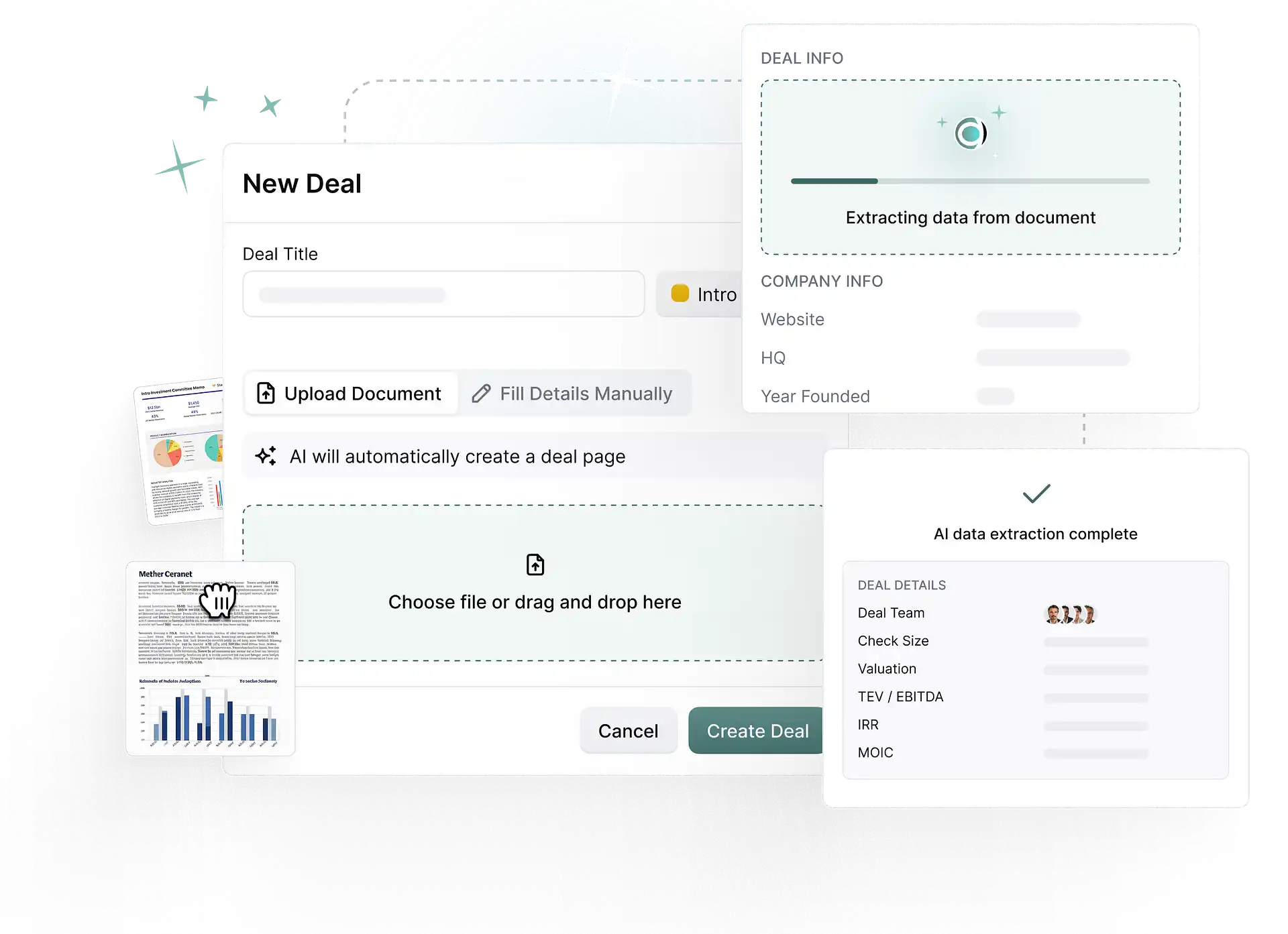
AI can read a CIM and pull the key figures in minutes, work an analyst used to do line by line over hours. Bain found that early adopters using generative AI for deeper diligence spend about one day summarizing the data instead of about one week. The time does not disappear; it moves from reading to analysis.
Meridian's Scout AI summarizes CIMs, extracts the key investment metrics, and drafts tear-sheet memos so the first pass is done before an analyst opens the file. That output flows straight into the deal record rather than sitting in a separate document that has to be re-keyed later.
The trade-off is that extraction still needs a human check on non-standard documents. A cleanly formatted CIM parses reliably; a scanned teaser with hand-built tables does not, and anyone claiming otherwise has not run enough of them.
Meridian was built by and for PE professionals, providing tools that keep your firm strategic, efficient, and ahead of the game.
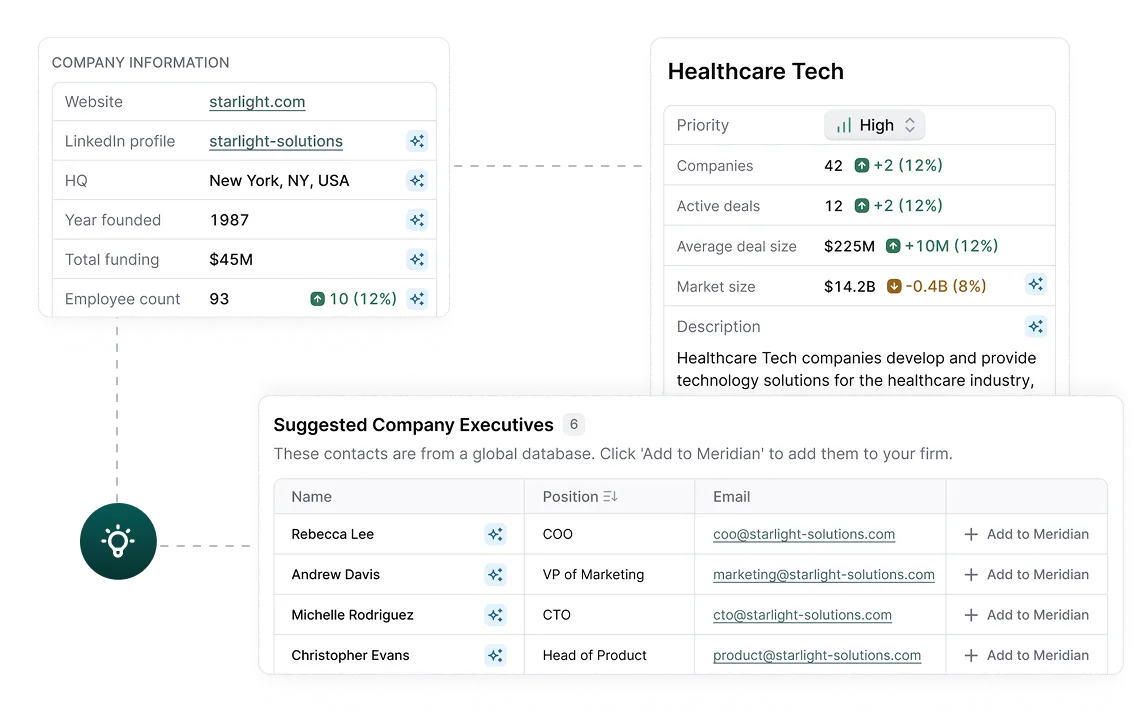
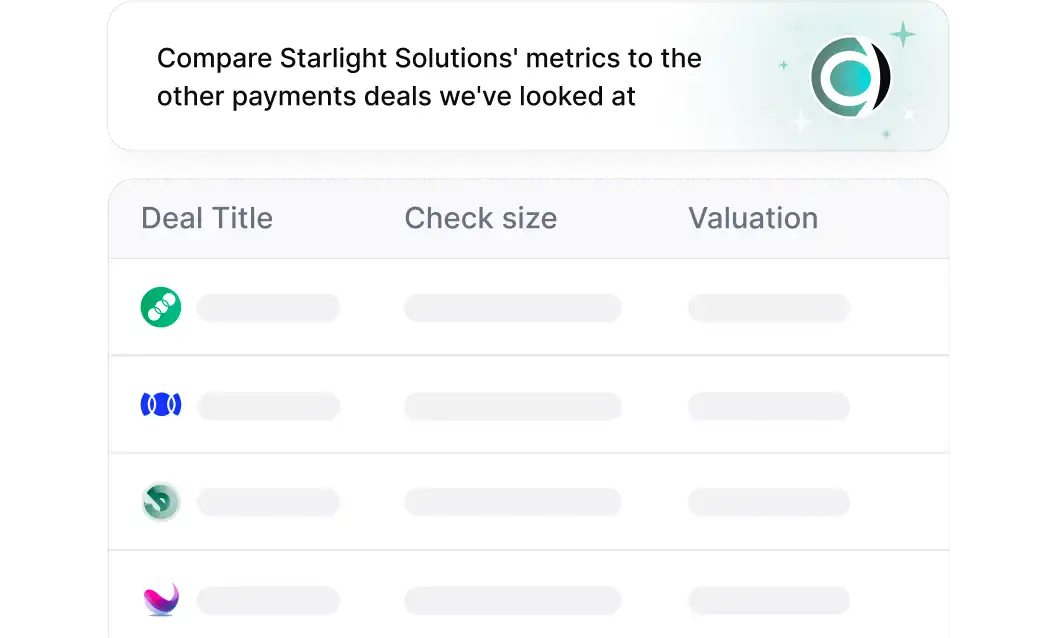
AI can rank inbound opportunities against a firm's mandate before an analyst opens the first file. For a mid-market fund seeing far more deals than it can review closely, the constraint is prioritization rather than volume, and a scoring pass puts the few worth attention at the top of the list.
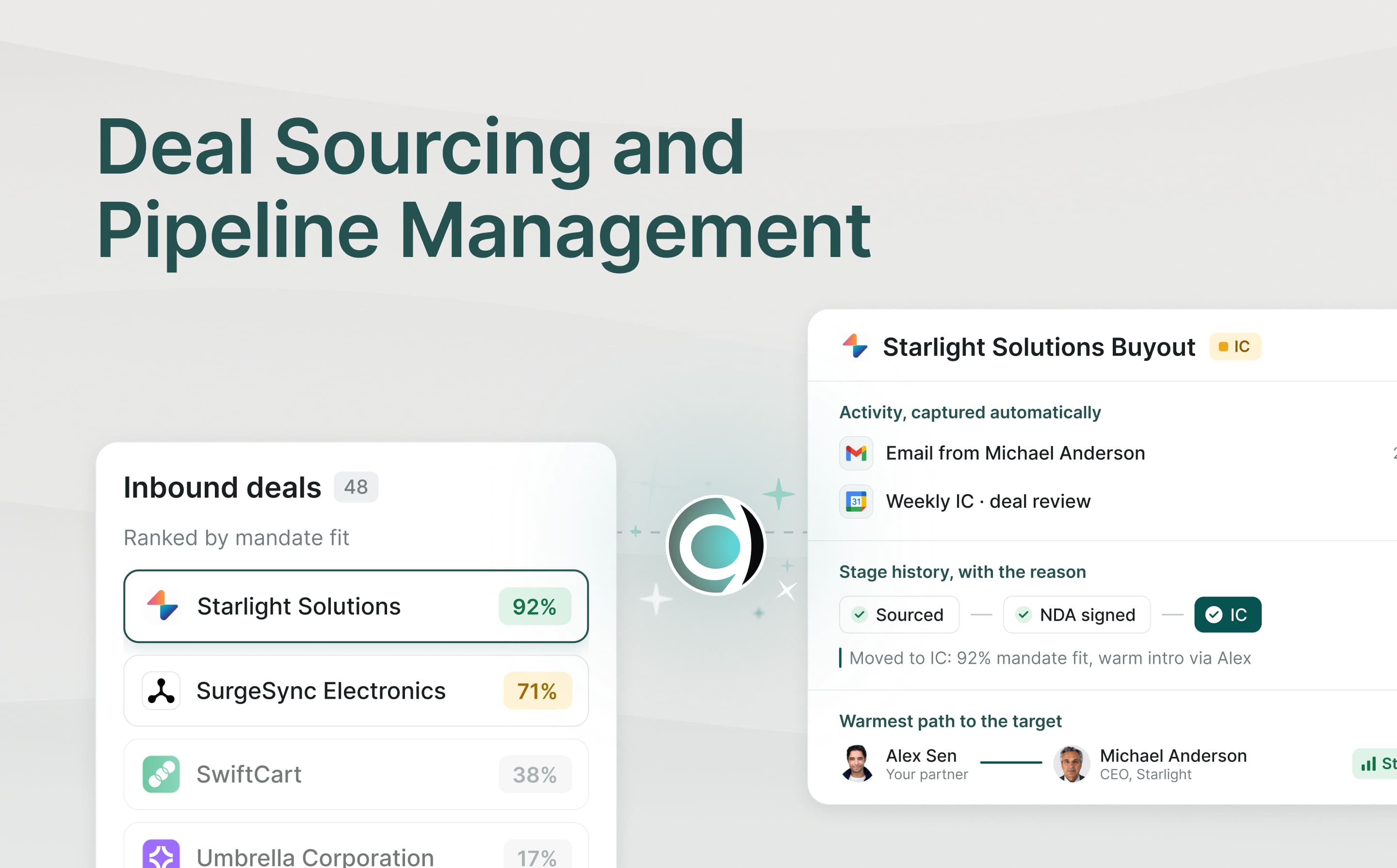
Scout AI benchmarks each opportunity against the firm's historical deals, private deal data, and public comparables to surface the ones that fit. Because Scout learns from the firm's own closed and passed deals, the score reflects how the firm actually invests rather than a generic definition of a good company.
The caveat is that a model trained on a firm's history will reproduce that history, including its blind spots. If a firm has never looked at a category, the score will not champion it, so the prioritization deserves a periodic human review rather than standing unquestioned.
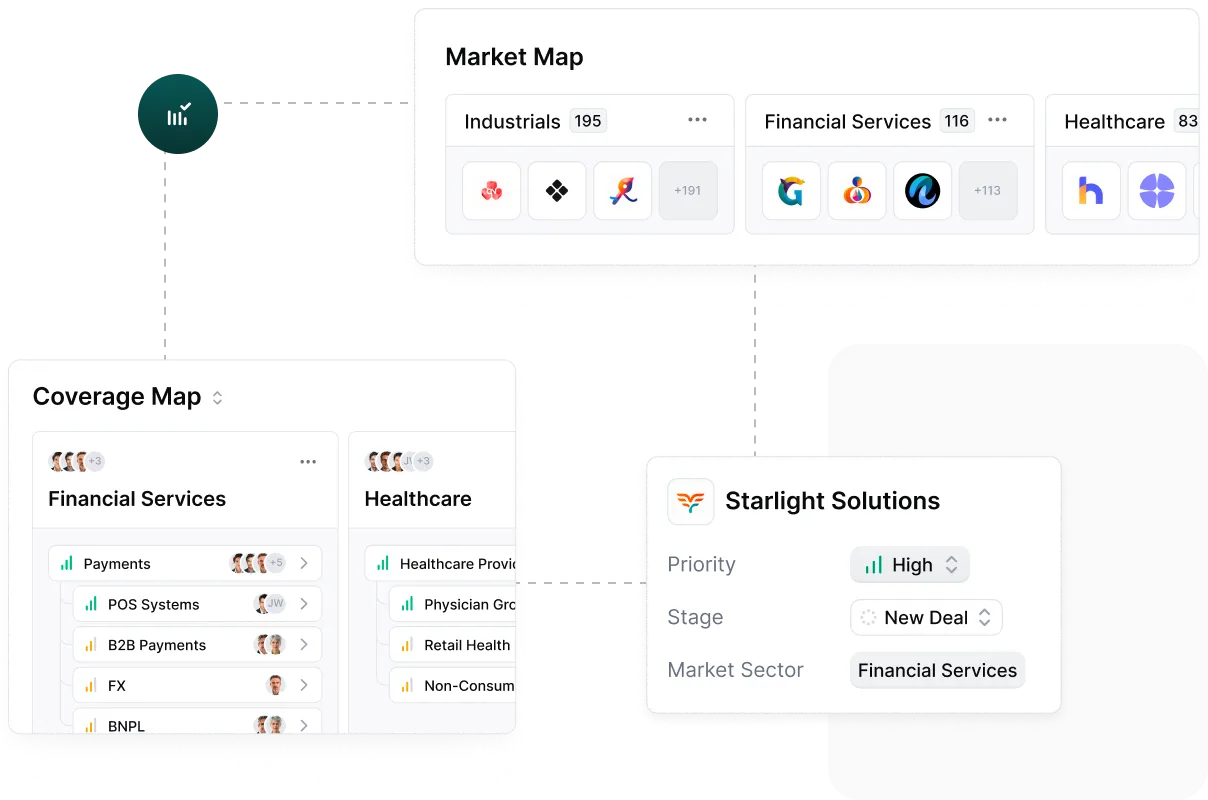
AI can build and maintain a map of a target market from deal history, market activity, and sourcing patterns, replacing the spreadsheet someone updates by hand and abandons by the third quarter. The map stays current because it is generated from live data rather than a one-time research sprint.
Scout identifies targets and add-ons by analyzing a firm's historical deals, market activity, and sourcing patterns, and benchmarks candidates against private deal data and public comps. For a thesis-driven or buy-and-build strategy, that turns thematic market mapping from a quarterly project into a standing view.
Dedicated sourcing-data platforms go deeper on raw company coverage, and for a firm whose primary need is the widest possible top-of-funnel database, that depth is worth paying for. Meridian takes a different approach, prioritizing a map that lives in the same system as the pipeline, so a match becomes a tracked deal without an export step.
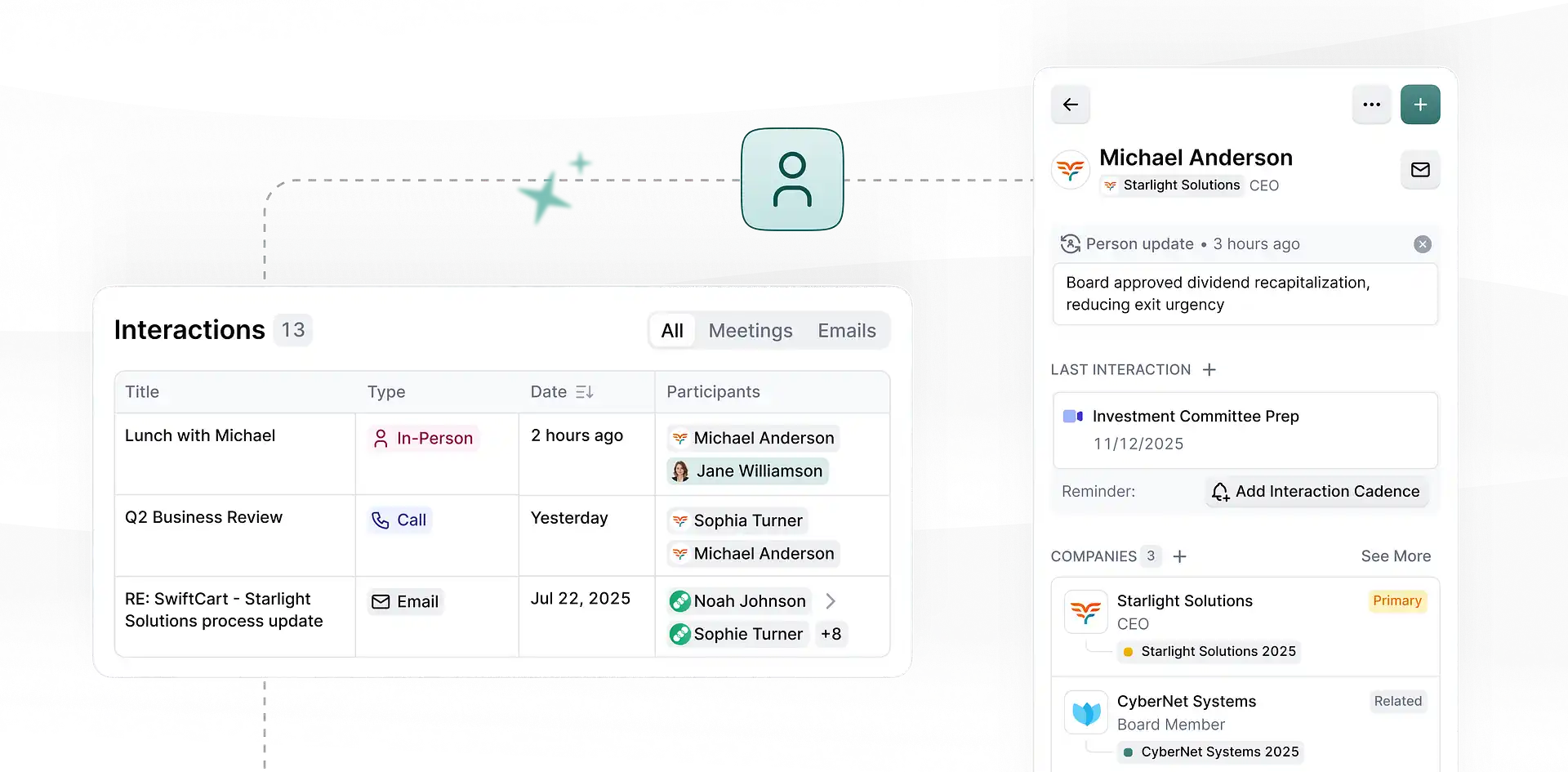
AI tools designed with relationship intelligence capabilities can surface who at the firm has the warmest path to a target and how strong that relationship is. The system reads email and calendar activity, scores each connection on frequency and recency, and answers “who do we know here” as a query instead of a round of messages to the team.
Scout captures email and calendar activity automatically, enriches contacts from more than 26 million company records and AI web crawls, and keeps profiles current with no manual entry. Because that data sits in the same system as deals and pipeline, a warm-path origin follows the company through diligence and into reporting. We covered the mechanics in more depth in our guide to relationship intelligence for deal teams.
Relationship intelligence is only as complete as the data sources a firm connects, however. Partners who keep deal conversations on personal phones or a channel the system does not read leave gaps in the graph, and no amount of scoring fills a gap the data never saw.
AI output is only trustworthy when a deal team can trace every figure back to the source it came from. A number in an IC memo that cannot be traced is worse than a blank field, because someone will act on it. This is the least-contested claim in the whole discussion, and the one most tools skip.
Meridian addresses it with waterfall data enrichment and per-field source control. The platform layers a firm's existing data providers, Meridian's proprietary dataset (a database of more than 26 million company records), and deep research by Meridian’s AI agents. Importantly, Meridian tracks which source each field came from, so a firm can decide which provider wins on headcount and which wins on revenue, instead of trusting one vendor's view of everything.
This is the practical answer to what McKinsey found. If the data points that matter are missing from public-LLM answers and the rest skew optimistic, the fix is not a better prompt but a data layer where every value has a known origin. Provenance is what lets a team trust the output enough to put it in front of an investment committee.
The trade-off is that provenance takes discipline. Source tracking only helps if the underlying data is connected and maintained.
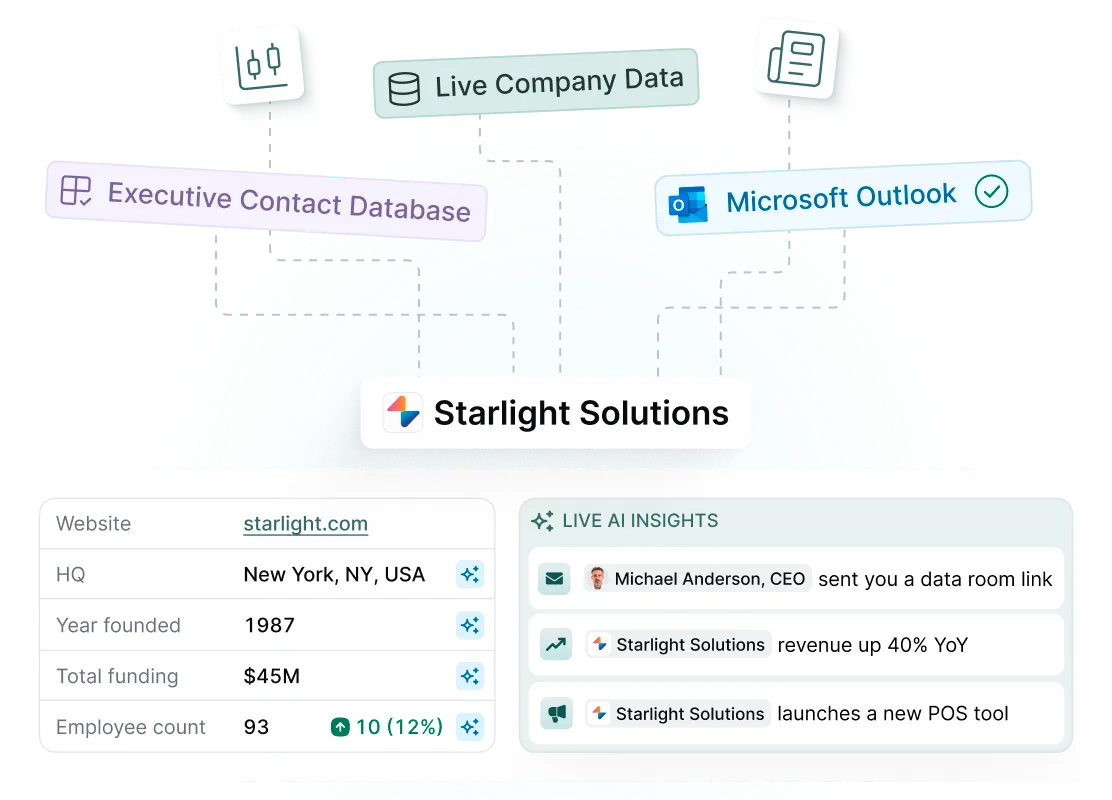
AI-native means the intelligence is built into the system of record, not bolted onto a legacy database as a separate layer. The distinction matters because a bolt-on feature reads a static database, while native intelligence updates as the firm's data changes, so the system gets sharper with use instead of running a chatbot over stale records.
The category is maturing fast enough that incumbents are buying their way into it. Carta entered the private markets CRM space in March 2026 by acquiring ListAlpha and launching an AI-powered CRM, a sign that relationship intelligence and deal intelligence are consolidating into single platforms. Ben Pfeffer wrote about what that consolidation means for buyers in this issue of the State of the Stack.
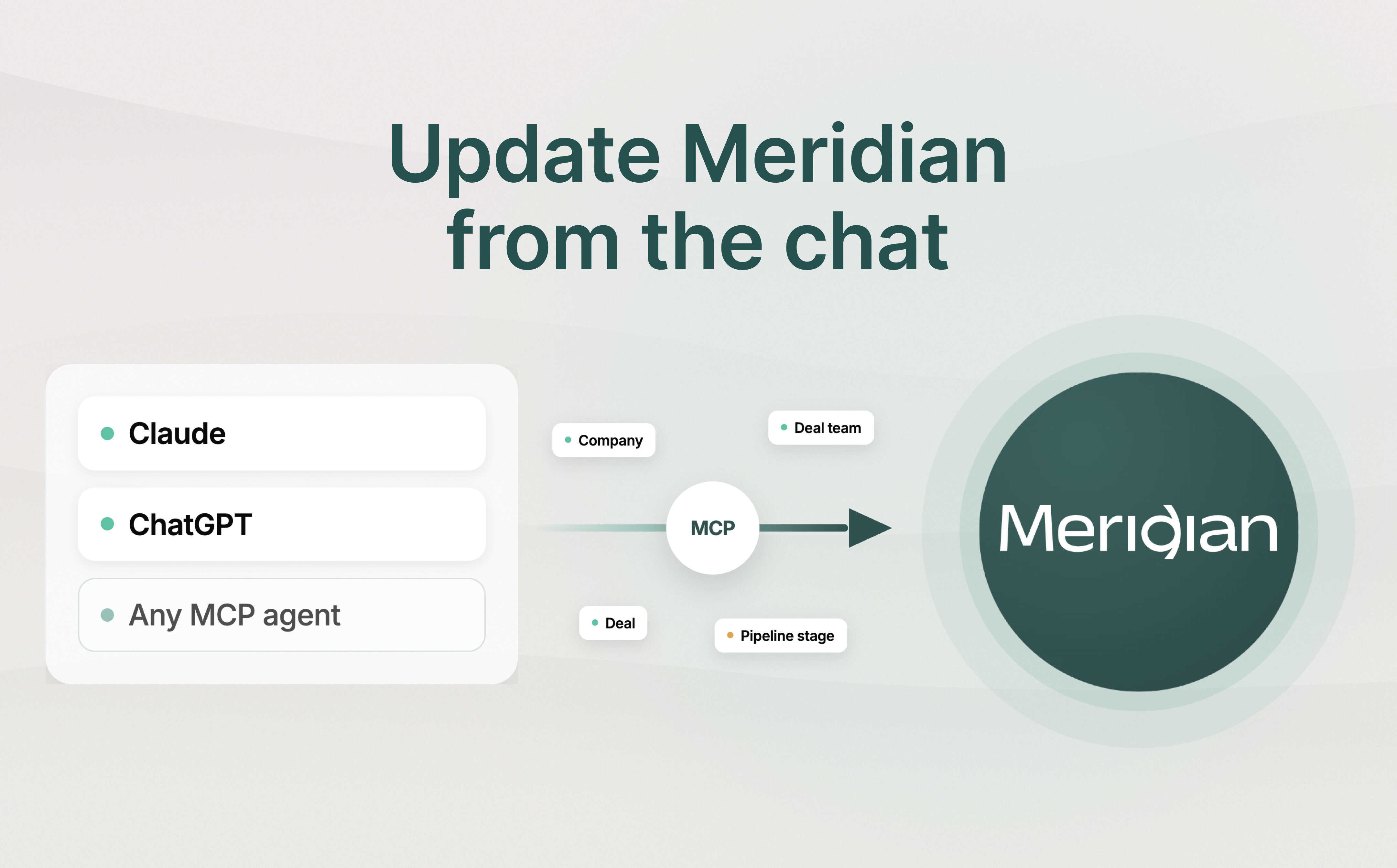
Meridian is standing against that consolidation wave as we have chosen to prioritize data portability and openness. The Meridian MCP lets a firm connect its deal data to Claude, ChatGPT, or any future model through a standard interface, so the system of record travels with the firm rather than locking its data inside one vendor. Combined with per-field source control and intelligence built into the core rather than layered on top, that is our AI-native position.
It’s true that Meridian is newer to market than the established incumbents. For a fuller side-by-side, our guide to the best private equity CRM tools lays the platforms out together, and our seven-workflow breakdown goes deeper on the individual use cases.
Discover how Meridian can streamline deal sourcing and enhance your decision-making

Find out how leading PE firms are using Meridian to enhance their deal workflows.
.webp)
How are private equity firms using AI right now?
Private equity firms use AI across the deal lifecycle, from sourcing and screening through diligence to portfolio monitoring. Deloitte found 86% of corporate and PE dealmakers already use generative AI in M&A work, and EY reports 84% of US PE firms have appointed a Chief AI Officer. The open question is operationalization: Bain finds only about 20% of portfolio companies have moved a use case into production with concrete results.
Is there AI that can extract data from a CIM automatically?
Yes. AI can summarize a CIM and pull key investment metrics in minutes, and Bain found early diligence adopters spend about one day summarizing data instead of about one week. Meridian's Scout AI does this and drafts tear-sheet memos, though non-standard documents still need a human check.
Can AI score or prioritize inbound deal flow?
Yes. AI can rank inbound opportunities against a firm's mandate before an analyst opens a file, benchmarking each against the firm's historical deals and market comparables. Any model trained on a firm's history reflects that history, so scoring works best with a periodic human review rather than on autopilot.
How does AI automate market mapping for private equity?
AI builds a map of a target market from a firm's deal history, market activity, and sourcing patterns, and keeps it current from live data rather than a one-time research push. That lets thesis-driven and buy-and-build teams treat market mapping as a standing view instead of a quarterly project.
How do firms verify or audit AI-extracted data?
Firms verify AI output through provenance: tracking the source of each field so any figure can be traced back to where it came from. Meridian uses waterfall enrichment with per-field source control for this, which matters because McKinsey found about 40% of the data points that decide a deal are missing from public-LLM answers. Without source tracking, fast output is not auditable output.
What is an AI-native CRM, and how is it different from a legacy CRM with an AI add-on?
An AI-native CRM builds intelligence into the system of record, so it updates as the firm's data changes. A legacy CRM with an AI add-on runs a model over a static database, which produces answers without making the underlying system smarter. The difference shows up over time, as the native system compounds while the bolt-on stays flat.
See How Meridian Puts AI To Work Across The Deal Lifecycle
AI is only as good as the data underneath it, and provenance is what turns speed into output an investment committee can trust. See how Meridian works.

Table of Contents

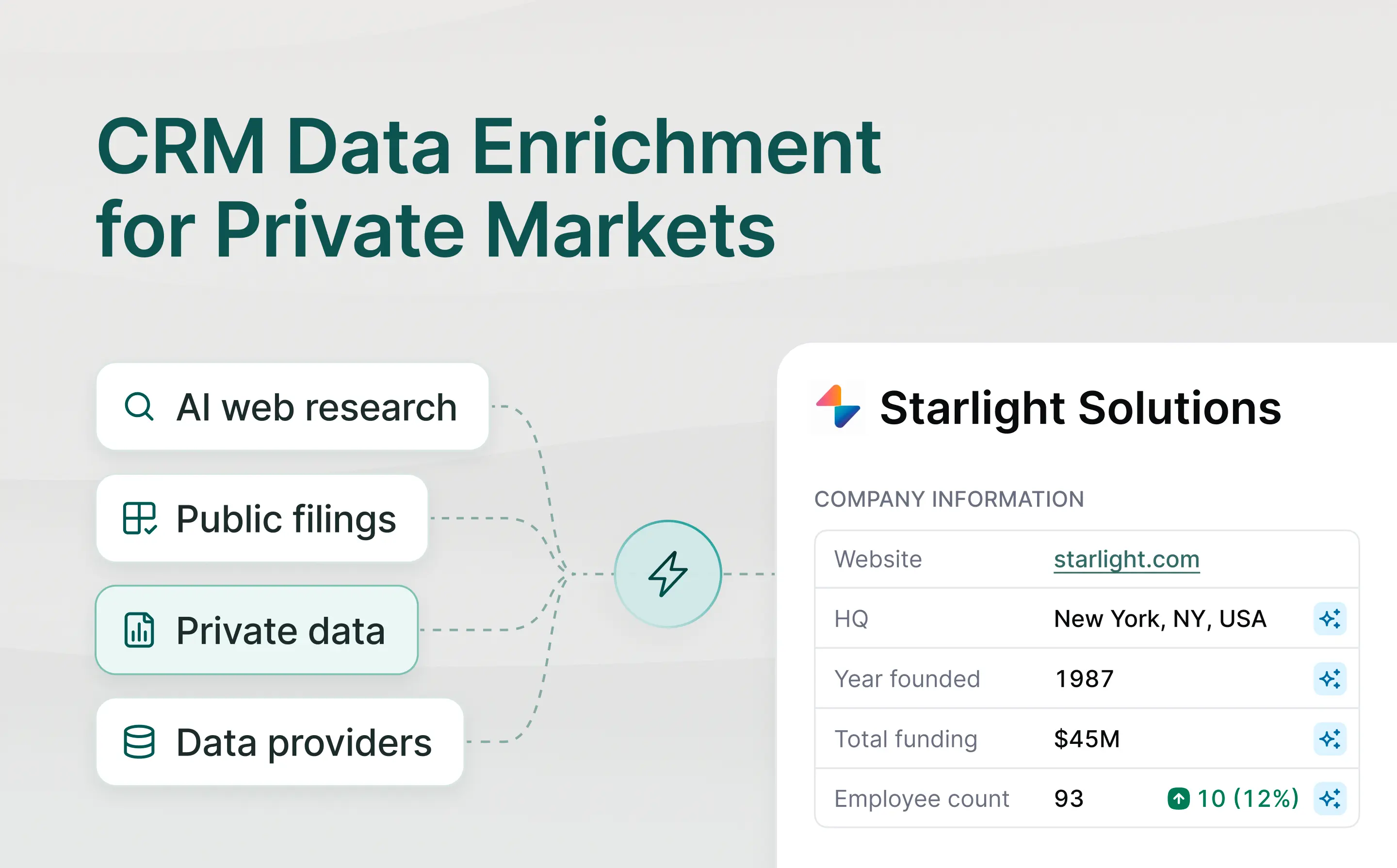
How deal teams keep company data clean and consolidate their vendors with built-in data.