
Meridian MCP is live!
Connect your deal sourcing data to any AI tool.
Learn More
Meridian raises $7M seed round led by 645 Ventures.
Read More
Sourcing and pipeline are one workflow, not two. How to run deal sourcing and pipeline management in one system and stop losing deals in the seam.
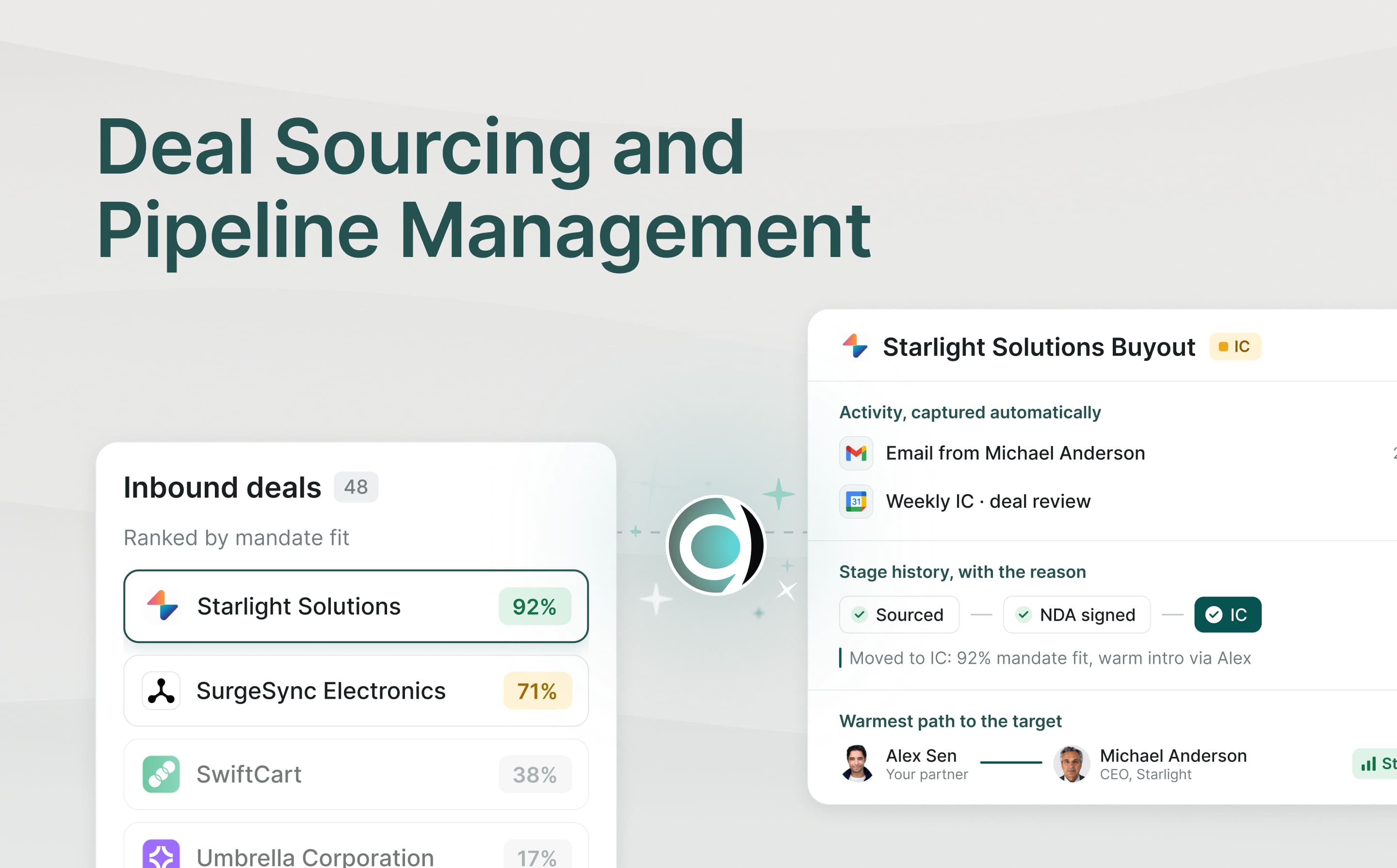
To track deals from sourcing to close in one system, you need discovery, enrichment, and pipeline tracking to share a single record, so a company that surfaces in sourcing becomes a tracked deal without anyone re-entering it by hand. Most firms cannot work that way yet. Sourcing lives in a company database or a discovery tool, the pipeline lives in a CRM, and the relationship context lives in someone’s inbox, so every handoff between them drops information that the deal team then has to rebuild by hand.
The cost of those gaps is measurable. Forrester’s 2024 State of Business Buying survey of more than 16,000 business buyers found that 86% of B2B purchases stall at some point in the process. While that figure spans all of B2B rather than private markets specifically, it describes the same failure a deal team lives with: opportunities that go quiet and are never picked back up.
Then there’s the admin drag that compounds the problem. Salesforce’s State of Sales report found that reps spend about 70% of their time on non-selling work such as data entry and internal coordination. A deal team re-keying a sourced company into the CRM is doing exactly that kind of work.
Leading firms are closing the gaps by collapsing sourcing and pipeline into one system of record, so a sourced target arrives in the pipeline with its coverage notes, enrichment, and relationship path already attached. This article covers how sourcing and pipeline actually work as a single workflow, from proactive market mapping through inbound triage to close, and why the system underneath decides whether deals leak or compound.
Origination in private markets is still driven by relationships and referrals, even as AI moves into the top of the funnel. S&P Global Market Intelligence reported that fund managers still prioritize personal networks and referrals for sourcing, while 54% of GP professionals expect AI to influence deal sourcing and target selection over time. Both things are true at once.
AI has entered at the front of the funnel. Deloitte’s GenAI in M&A survey of 1,000 corporate and PE leaders found 86% had integrated generative AI into their M&A work, with the heaviest use in strategy and market assessment (40%) and target identification and screening (35%). The activity is happening, but it sits on top of workflows that were built for a relationship business.
That combination is why bolting an AI tool onto a legacy CRM does not fix sourcing. Sourcing is a relationship problem and a data problem at the same time: knowing who at the firm has a path to a company, and knowing enough about the company to decide whether the path is worth using. A tool that solves one and ignores the other still leaves the deal team assembling the picture manually.
A sourcing tool and a separate CRM leave a seam, and deals leak through that seam. When a target surfaces in a discovery tool, someone has to re-enter it into a legacy CRM to make it a tracked deal. The enrichment, sector rationale, and notes on who found it and why rarely make the trip. The company arrives in the pipeline as a name and a stage, stripped of the context that made it worth pursuing.
Every one of those transfers is manual work of the kind that already dominates a deal professional’s week, the 70% of non-selling time that Salesforce documented. It’s also where information goes to die. The analyst who ran the screen and the associate writing the IC memo six months later start from different information because the reasoning behind the sourcing decision was never carried forward.
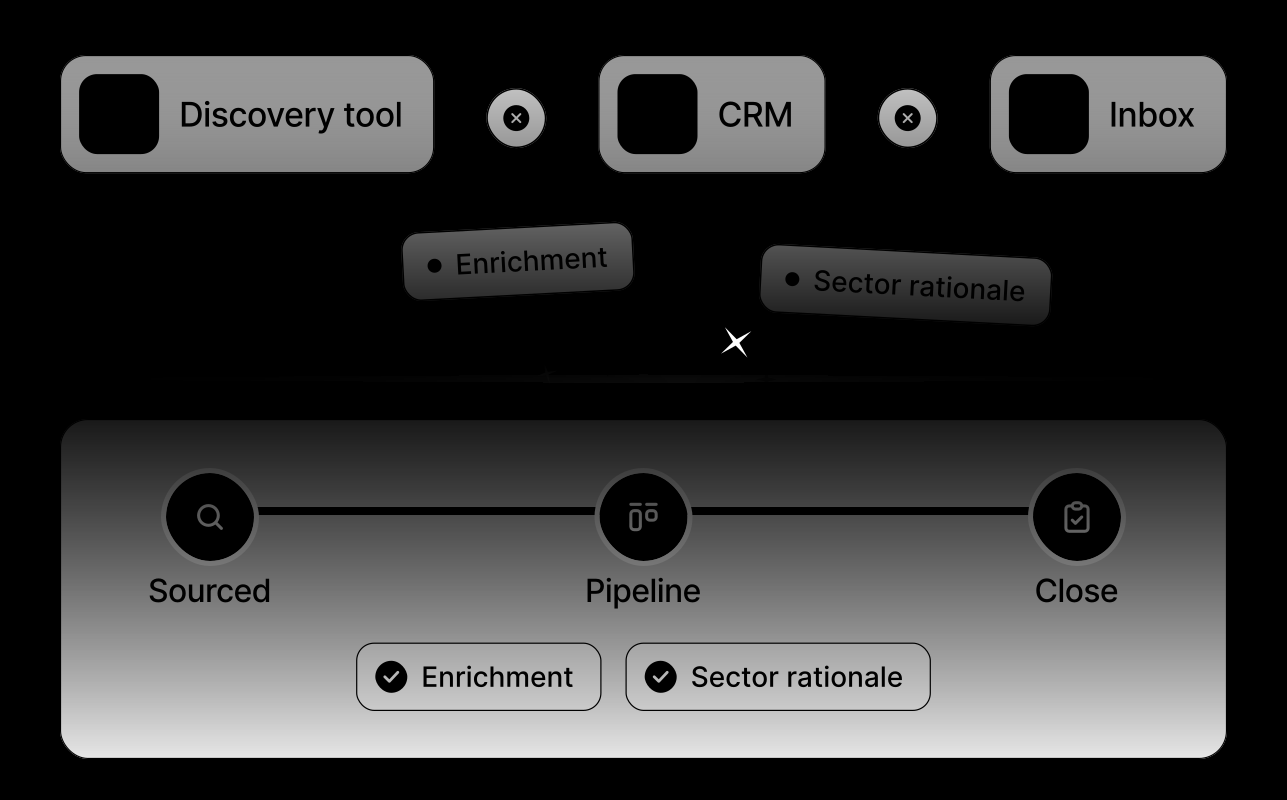
A stack of separate tools can be the right choice for some firms. A dedicated company database or discovery tool is often best-in-class at its one job, and some firms would rather assemble specialists than adopt one platform. The cost of that approach, though, is seams between the tools. Whether that cost is worth paying depends on how much a firm values depth in each layer over continuity across all of them. We walk through the mechanics of connecting those stages in our guide to deal flow management.
Firms win proprietary deals by mapping a market and building coverage before a company decides to run a process. The advantage comes from arriving early, when a conversation is direct rather than an auction, which means the intelligence has to sit in the sourcing system before the banker’s teaser lands. That is a discipline as much as a feature.
Meridian’s Scout AI builds market maps against a firm’s mandate and surfaces targets and add-ons by reading the firm’s historical deals, market activity, and sourcing patterns. It draws on a proprietary database of more than 26 million company records and waterfall enrichment. The waterfall enrichment which layers a firm’s existing data providers, Meridian’s own dataset, and deep research by AI agents into a single profile, so a match on the map is already enriched when it enters the pipeline. Defining themes, assigning coverage, and visualizing a sector as a live map is handled in the same place the deals are tracked, which is the thematic sourcing workflow rather than a separate research sprint.
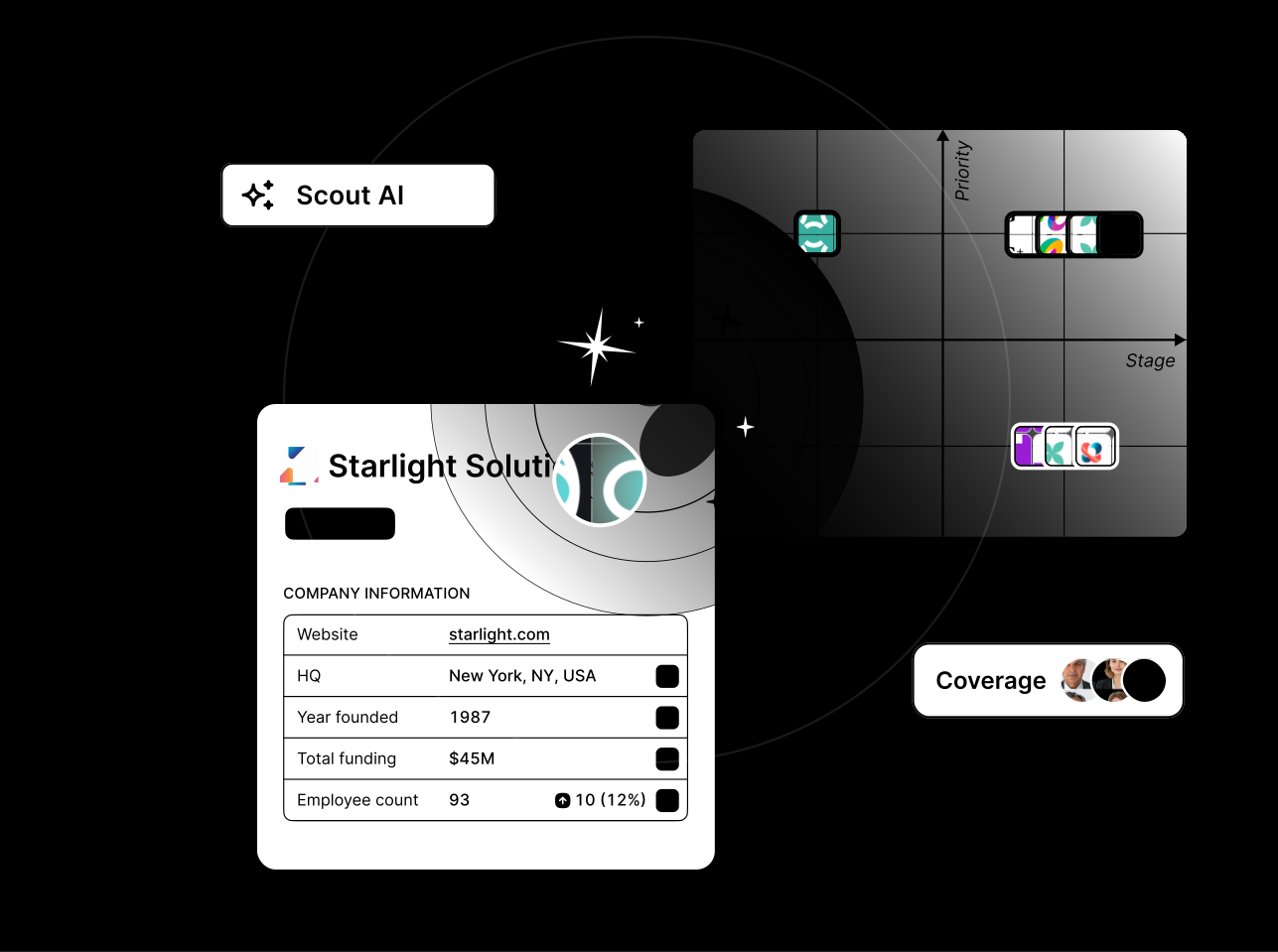
This means that proactive sourcing is coverage discipline. A market map keeps a sector in view, but a firm still has to work the relationships the map surfaces, and no tool substitutes for the calls. For how this connects to the wider tooling picture, our overview of the best deal sourcing software for investment teams lays out the categories side by side.
Today, AI can prioritize inbound opportunities against a firm’s mandate before an analyst opens the first file. For a fund seeing far more deals than it can review closely, the constraint is prioritization rather than volume, and a scoring pass puts the few worth attention at the top of the list. Meridian’s Scout AI, for example, benchmarks each opportunity against the firm’s own deal history and the universe of public comparables, and summarizes an incoming CIM so the first read is done before anyone opens it.
The credibility check matters here, because the market is skeptical for good reason. S&P Global Market Intelligence’s survey found that majorities of investors still rate AI ineffective for deal sourcing (64%), with due diligence the only area showing meaningful adoption (31%). We read that as a data problem, not an AI problem. Triage only produces trustworthy output when it runs on a clean, proprietary data layer, which is the case for AI built into the system of record rather than layered over a stale database.
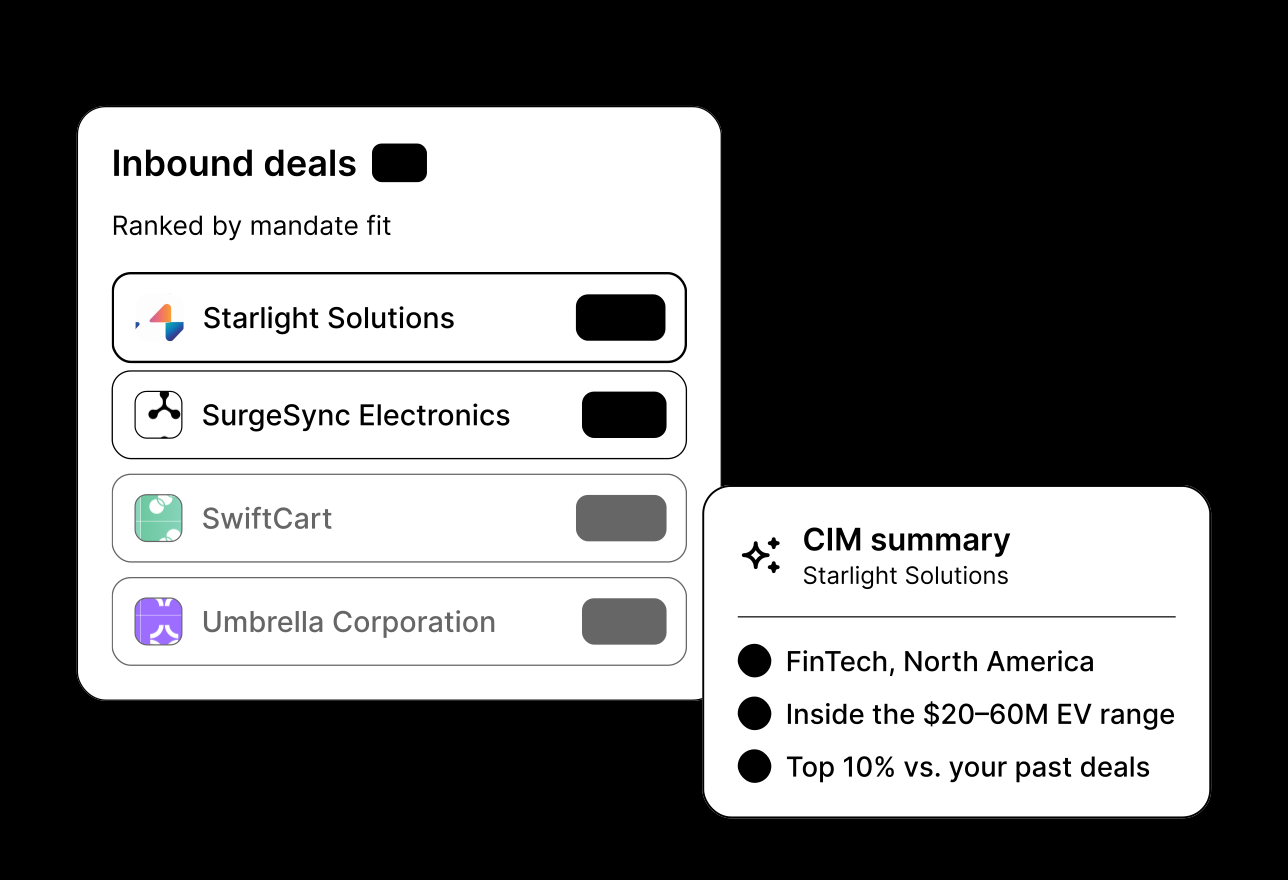
Of course, any AI model trained on a firm’s history reproduces that history, including its blind spots. If a firm has never looked at a category, a score built on its past will not champion one now. So prioritization deserves a periodic human review rather than standing on autopilot.
A single system of record carries a deal, its relationships, and its history from first contact through close. When the company that surfaced in sourcing is the same record the team advances through the pipeline, nothing has to be reconstructed at each stage, and the sourcing rationale is still visible when the IC memo is being written.
Three capabilities carry the deal, its relationships, and its history with full historical context in a system of record that will work for private markets investors:
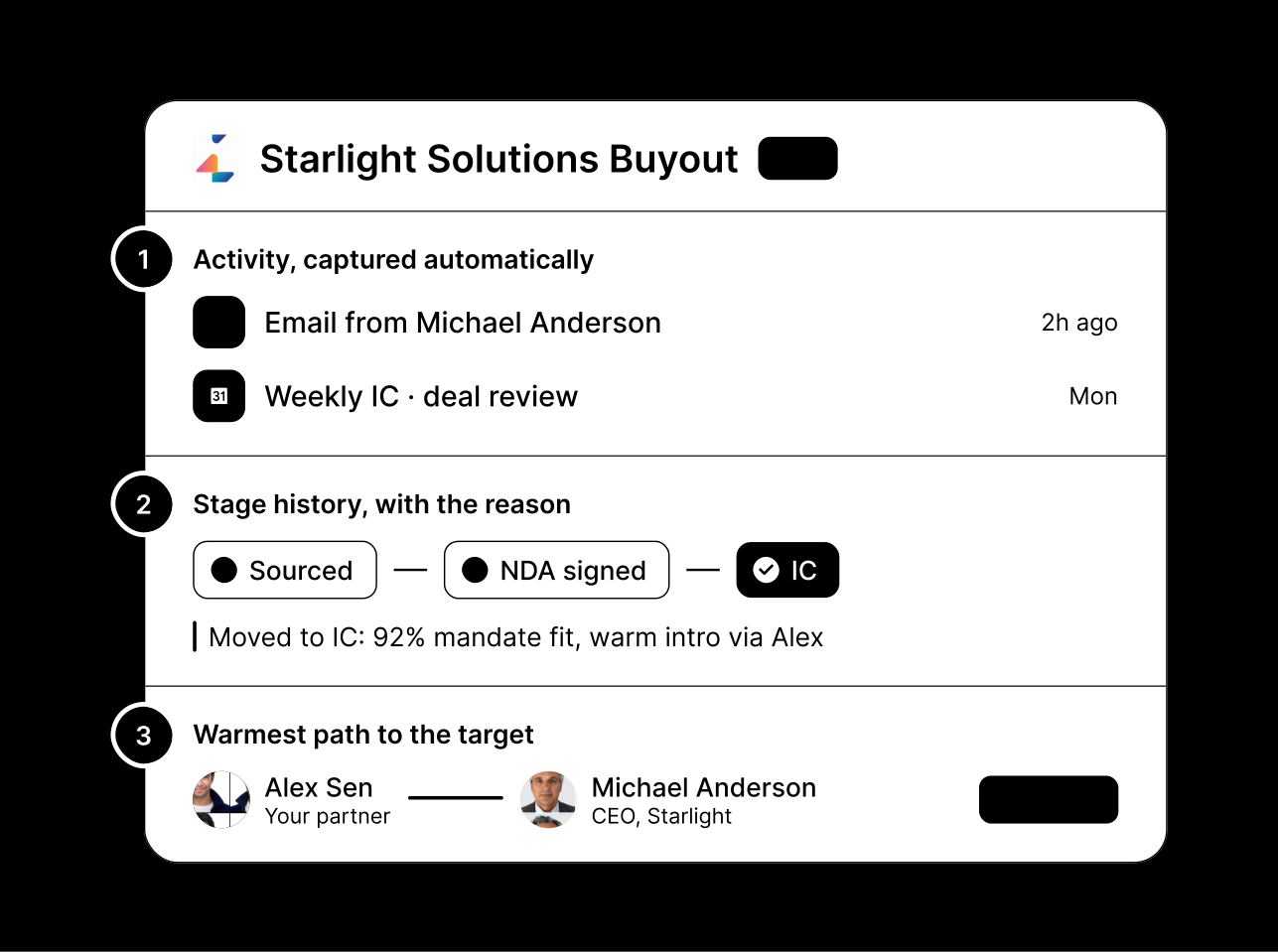
Together these features close the seam, because a deal cannot go quiet in a system that is watching every touch on it.
A system of record is only as good as the data teams connect to it, however. Partners who keep deal conversations on a channel the system does not read leave gaps in the record, and source tracking helps only where the underlying data is actually connected and maintained.
AI-native means the intelligence is built into the system of record, and open means the firm’s data stays portable rather than locked inside one vendor. Those two concepts should travel together, because a platform that owns your sourcing, your relationships, and your pipeline also owns the leverage if you ever want to leave.
The CRM category is consolidating fast enough to make the lock-in question urgent. In 2026, the major moves have all pointed the same way: acquisition and expansion. Carta entered the private markets CRM space through acquisition, Grata expanded its sourcing data through acquisition, and Affinity extended its CRM into outbound sourcing. Each is a step toward one platform that spans discovery through close, and each also asks the buyer to commit their data to a single suite. We wrote about what that consolidation means for the firms buying from these vendors in this State of the Stack analysis.
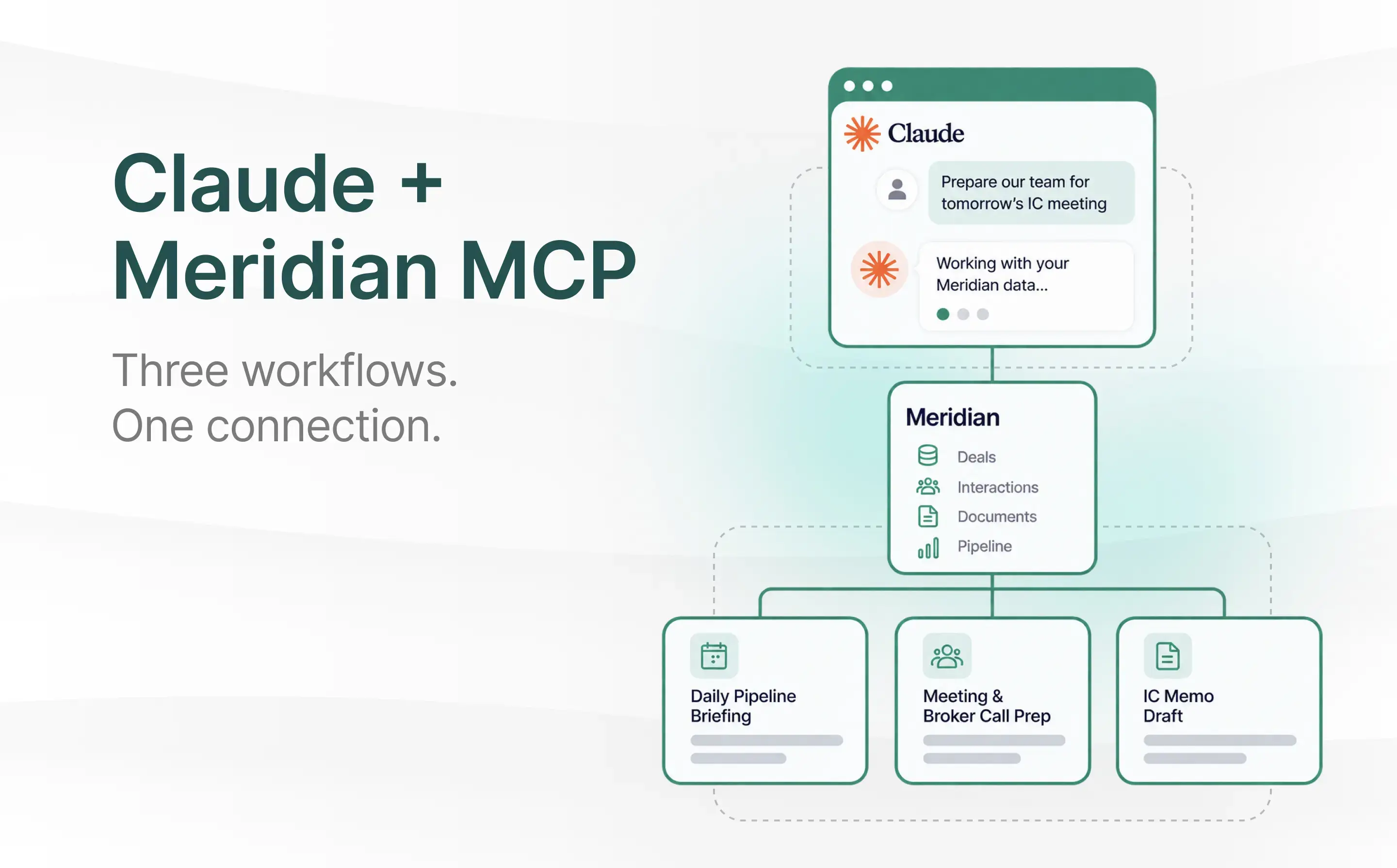
Meridian’s answer to the same trend is to unify the workflow without walling in the data. Meridian MCP connects a firm’s deal data, relationship history, and enrichment layer to Claude, ChatGPT, or any future model through a standard interface, so the system of record travels with the firm. For a full side-by-side, our guide to the best private equity CRM tools lays platforms out together.
See how Meridian runs sourcing and pipeline in one system
With Meridian, sourcing and pipeline are one workflow, and firms stop losing deals in the seam between tools. See how Meridian works and get a trial so you can experience the difference for yourself.
How do firms track deals from sourcing to close in one system?
They use a single system of record where the sourcing tool and the deal record are the same system, so a company enters the pipeline with its enrichment, relationship history, and sourcing rationale already attached. That removes the manual re-keying step where context is lost, which matters because a large share of B2B purchases stall somewhere in the process. The practical test is whether a sourced company becomes a tracked deal without an export step.
How do PE firms triage and prioritize inbound deal flow?
AI can rank inbound opportunities against a firm’s mandate before an analyst opens a file, benchmarking each against the firm’s own deal history and public comparables and summarizing the CIM for a fast first read. The catch is that scoring is only as good as the data underneath it, and S&P Global found most investors still rate AI ineffective for sourcing, which is a data-quality problem more than a model problem. Prioritization should get a periodic human review because a model trained on a firm’s history repeats its blind spots.
What is thematic sourcing?
Thematic sourcing is mapping a target market against a firm’s investment thesis and building coverage of the companies in it before any of them runs a process. It shifts sourcing from reacting to teasers toward getting in front of the right companies early, when conversations are direct rather than competitive. Done well, it turns market mapping from a quarterly project into a standing view of a sector.
Do you need both a sourcing tool and a CRM?
Not necessarily. A dedicated sourcing tool plus a separate CRM can work, and specialist databases often go deeper on raw coverage, but the two systems leave a seam where information is lost each time a company moves between them. An alternative is a platform where sourcing and pipeline are the same system, which removes the handoff at the cost of not having a best-in-class point tool for every layer.
What is pipeline leakage and how do you reduce it?
Pipeline leakage is opportunities losing momentum or context as they move between people and tools, until they stall or drop off entirely. Forrester found 86% of B2B purchases stall at some point, and the deal-team version is a sourced company that never becomes a tracked deal. Keeping sourcing, relationships, and pipeline in one record reduces it, because a deal cannot quietly disappear from a system that logs every interaction with it.
Does AI actually help with deal sourcing?
It helps at the front of the funnel, and the honest answer is that it depends on the data. Deloitte found 86% of dealmakers already use generative AI, with the most traction in strategy and target identification, yet a majority of investors still rate AI ineffective for sourcing specifically. The gap between those two facts is data quality: AI triage and market mapping work when they run on clean, proprietary data, and produce fast but untrustworthy answers when they do not.
Discover how Meridian can streamline deal sourcing and enhance your decision-making


Table of Contents