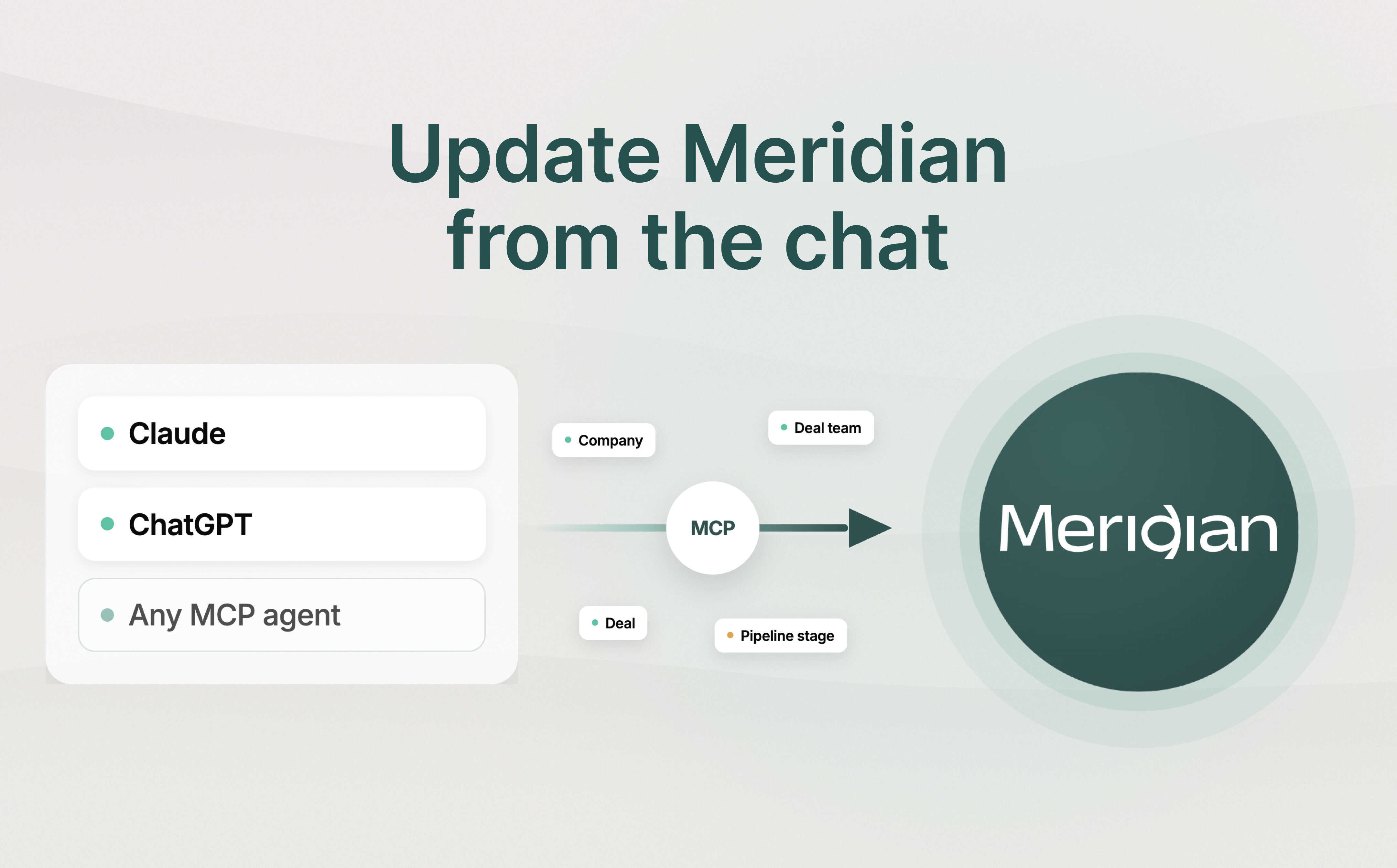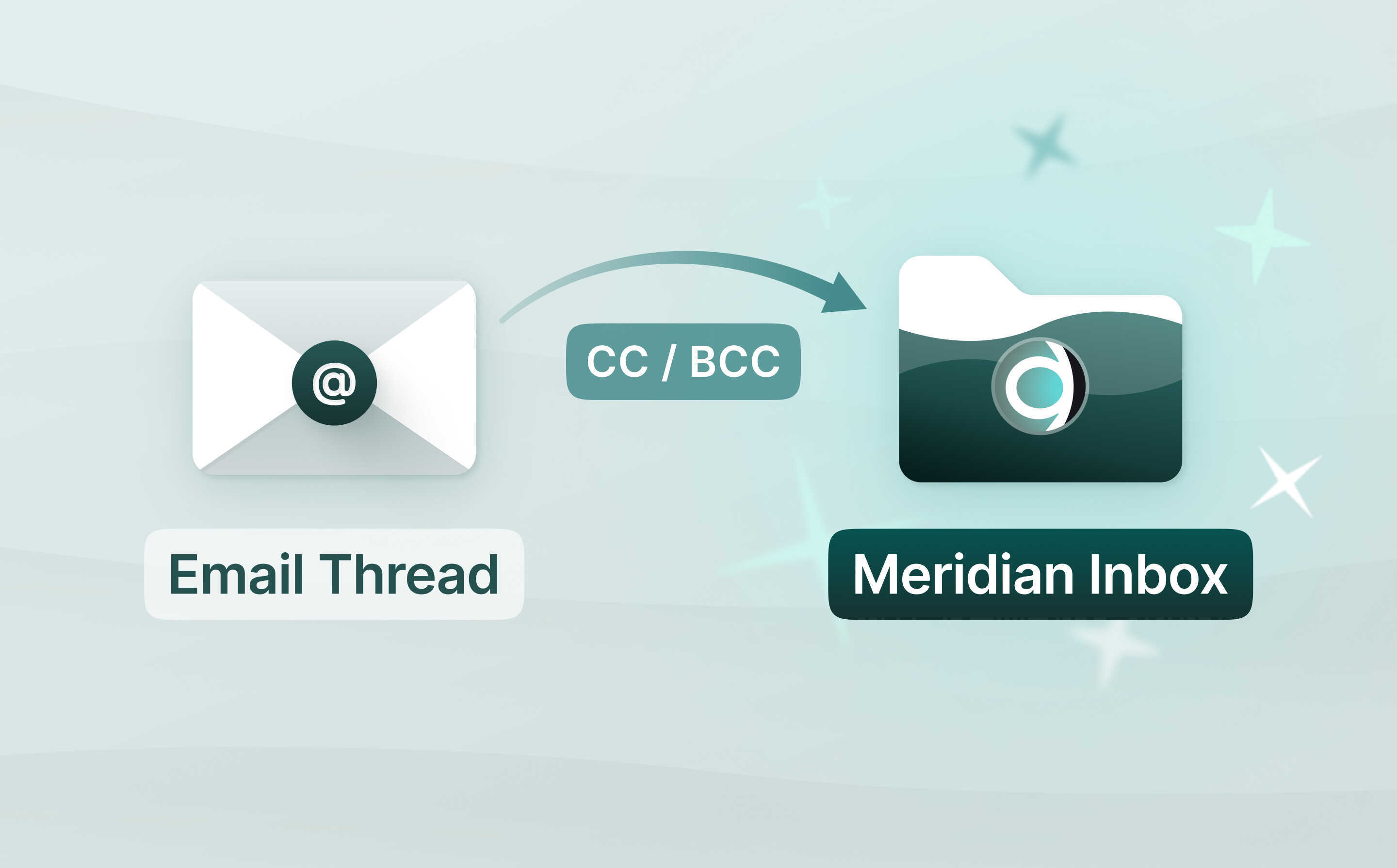

Meridian MCP is live!
Connect your deal sourcing data to any AI tool.
Learn More
Meridian raises $7M seed round led by 645 Ventures.
Read More
How deal teams keep company data clean and consolidate their vendors with built-in data.
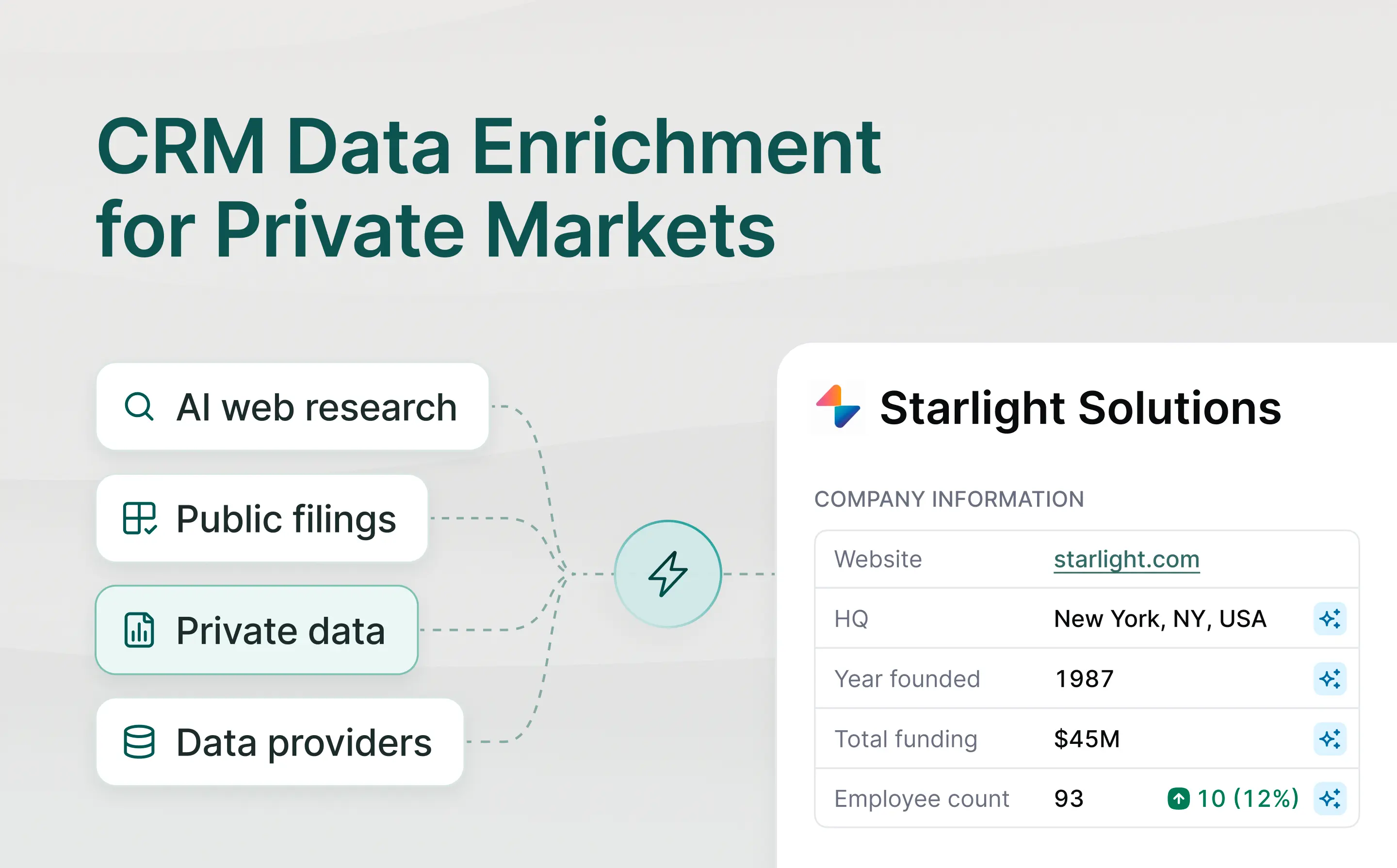
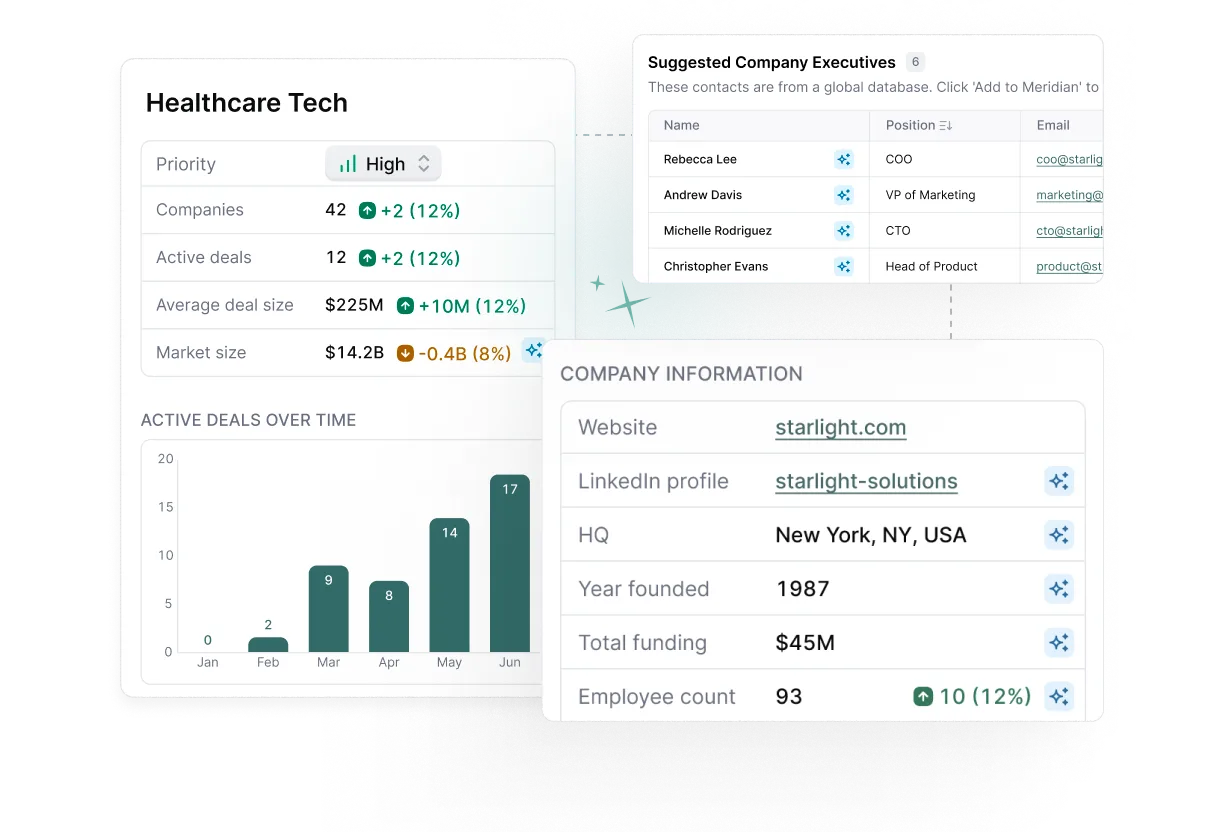
The highest-performing PE firms keep their CRM data clean automatically with enrichment that runs inside the system of record. This automated data enrichment pulls fresh financials, ownership, and leadership onto each company profile, so the record doesn’t decay between deals.
Most firms are not there yet. They paper over stale records by stacking external data subscriptions and re-keying companies by hand, which is slow, costly, and the first thing to slip when a live deal gets busy.
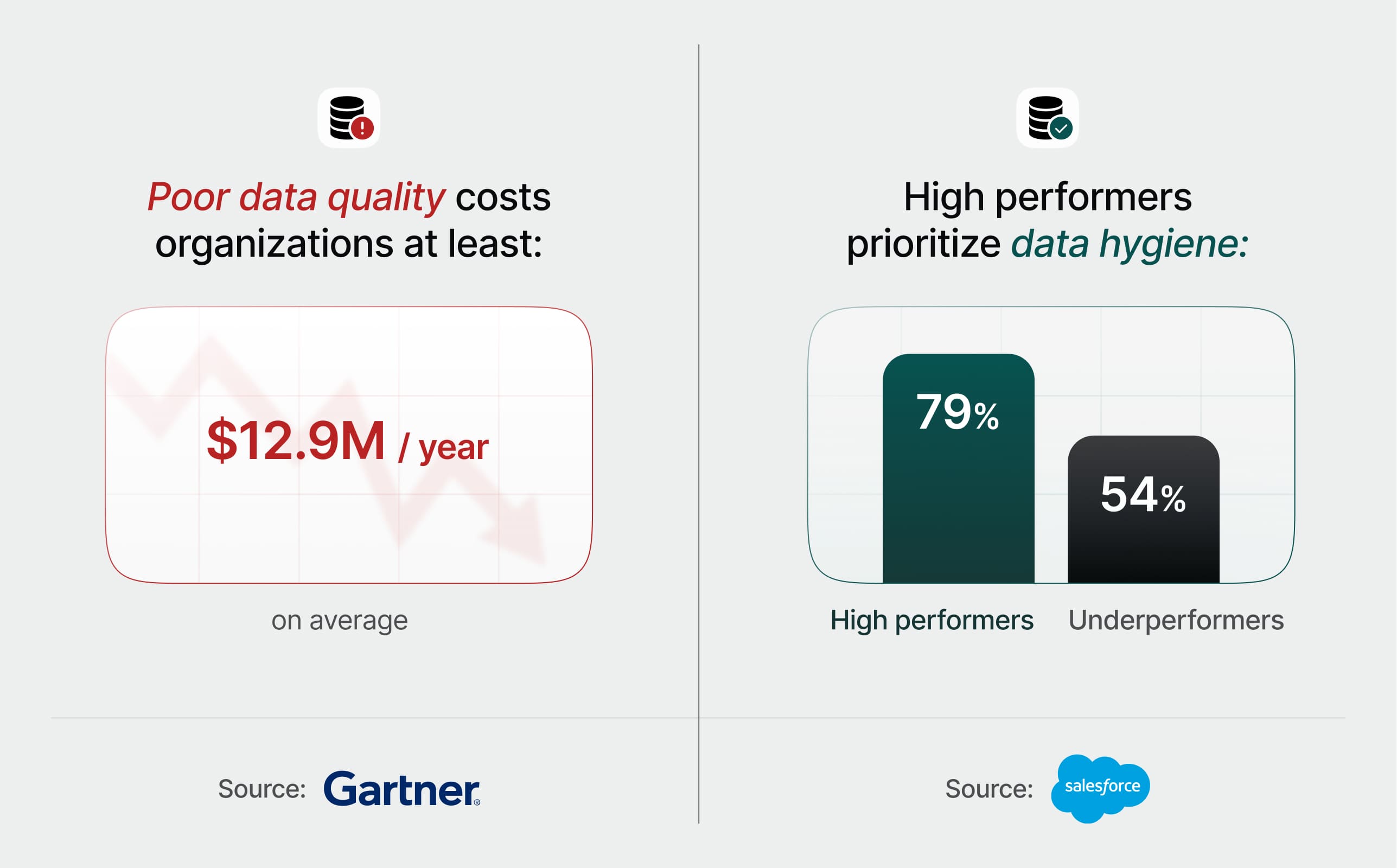
The cost of carrying bad data is measurable. Gartner estimates that poor data quality costs organizations at least $12.9 million a year on average. Salesforce found that 79% of high performers prioritize data hygiene, against 54% of underperformers. Clean data is not an IT housekeeping task. It’s what separates the teams that trust their own pipeline from the ones that don’t.
Leading firms are moving from manual upkeep and subscription-stacking toward automatic enrichment built into the system of record. This article covers what enrichment actually means for a deal team, how waterfall enrichment works across three source layers, how the firm's own private data becomes an enrichment source, and how a bundled dataset consolidates the vendor stack. (We’re going deeper here on the cost of bad data, vendor consolidation, and provenance than our broader guide to CRM data enrichment, which is the better starting point if you want the overview first.)
Enrichment for a deal team means keeping financials, ownership, leadership, and deal history current on every company record, not just appending a contact's email address. A sales team enriches a lead to route it and email them. A deal team enriches a company to decide whether it fits the mandate, who owns it, how it is capitalized, and who at the firm has a path to the owner.
That distinction is why generic contact append falls short of what a deal record needs. The fields that matter for an investment decision — revenue, margin, ownership structure, prior transactions, board and management changes — are not the fields a B2B sales database is built to carry.
The stakes show up as cost. Gartner puts the average cost of poor data quality at $12.9 million a year, and reports that 59% of organizations do not measure data quality at all, so most firms cannot see the problem they are paying for.
Richer data is harder to keep current. A record with ownership, financials, and covenant terms has more fields that can go stale than a contact card does, which is exactly why the maintenance has to be automated rather than left to analysts.
For the underlying difference between a deal-team CRM and a general one, our article on private equity CRMs versus standard CRMs explores the gap.
Generic B2B enrichment tools append contact and firmographic data, but deal teams need financials, ownership structure, covenant terms, and signals that no sales-contact database carries. The tools are good at what they were built for, which is finding a title, a company size, and a verified email. Private markets ask for more than who to email. They ask about how a company is owned and financed.
The result is that the wrong tool leaves the deal team doing the work by hand. Salesforce found the average seller spends only 40% of their time selling, losing roughly two hours a week to manual data entry. For a deal team, that manual time is re-keying a company the enrichment tool could not complete.
Disconnected systems compound the problem once AI enters the picture. Among sales leaders using AI, Salesforce found that 51% say disconnected systems are slowing their AI initiatives, which is the same friction a deal team feels when enrichment lives in one tool and the deal record lives in another.
To be fair, generic enrichment tools are often cheaper and faster to deploy for pure contact data. For a team that only needs to reach a person, they do the job well. They were built for a different problem, not a smaller one.
Meridian was built by and for PE professionals, providing tools that keep your firm strategic, efficient, and ahead of the game.
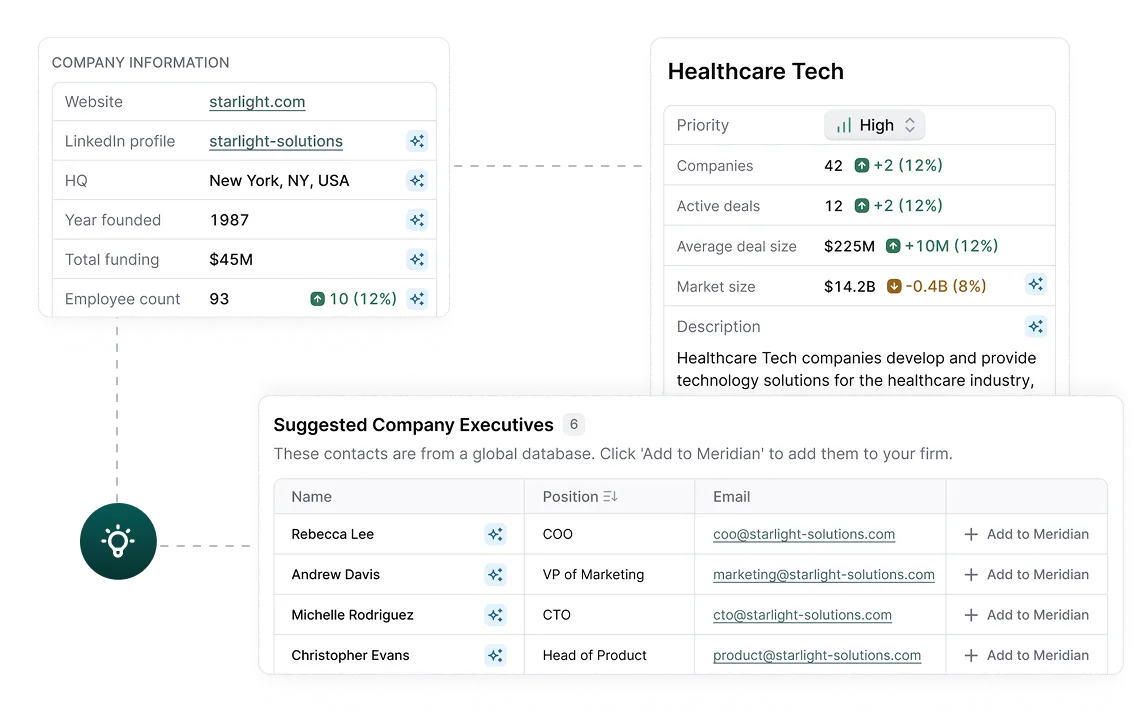
Waterfall enrichment (like what Meridian includes) fills each field from the best available source, layering multiple sources into a single profile. Rather than trusting one provider for everything, it takes the strongest value for each field and records where that value came from.
Meridian's waterfall data enrichment draws on multiple layers. AI agents crawl the open web for press, hiring boards, and public signals. Meridian’s built-in company database and/or our customer’s third-party providers supply structured firmographic and financial data. The firm's own approved private data, emails, documents, CIMs, and notes add what no external source has. All the sources resolve into one complete and accurate company profile.
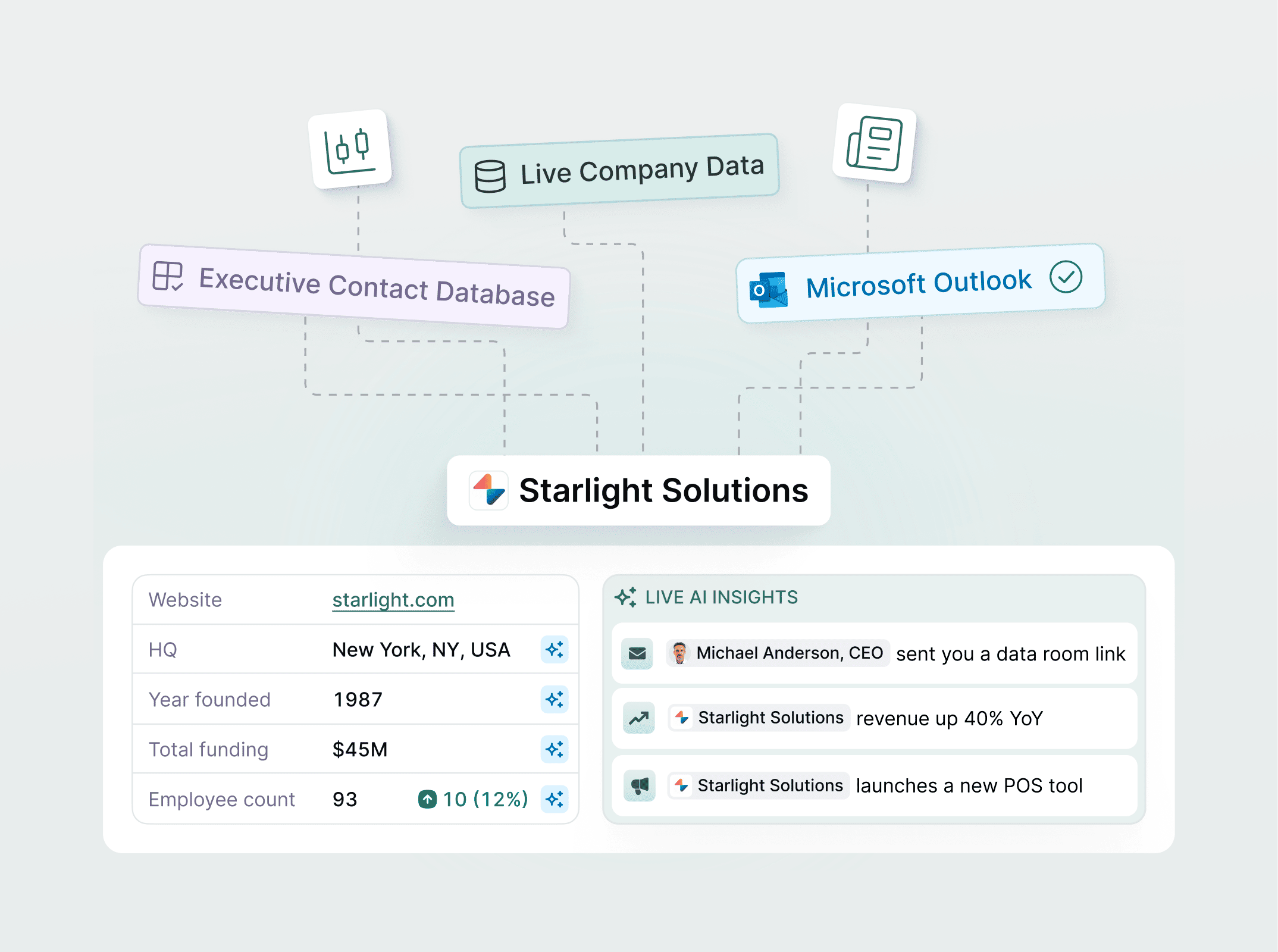
Provenance tracking is what makes a layered profile usable. Every field shows the source it came from, so an analyst can see whether a revenue figure originated in a filing, a provider, or a CIM, and decide how much to trust it. A number no one can trace does not make it into an IC memo, and it should not.
Meridian's Scout AI sits on top of these layers, enriching records in real time, filling gaps, and producing living profiles with deal scores and mandate flags.
The most valuable enrichment source is the firm's own private data, which no external vendor can sell. A provider can tell any firm the same public facts about a company. Only your firm knows what the founder said on last quarter's call, which partner has covered the sector for a decade, and what a CIM disclosed under NDA.
Private-data enrichment turns that material into structured fields on the deal record. Emails and meeting notes become interaction history; CIMs and IC memos become financials and deal terms; and the record stops being a name and a stage and becomes the firm's institutional memory of the company.
Provenance tracking matters most here, because private and public data mix on the same profile. When a revenue figure from a CIM sits next to one from a provider, the record has to show which is which, so the team knows what is confidential, what is public, and how current each one is.
Private-data enrichment is only as complete as what the firm connects and approves, however. Deal conversations kept on a channel the system does not read stay invisible to it. For how this private layer becomes a sourcing edge, our piece on relationship intelligence for deal teams goes further.
Inside Meridian, our bundled proprietary dataset lets a firm consolidate or replace separate PitchBook, Grata, and SourceScrub subscriptions rather than stacking and reconciling them. When the CRM carries its own company data, the firm stops paying several providers to describe the same company in three slightly different ways.
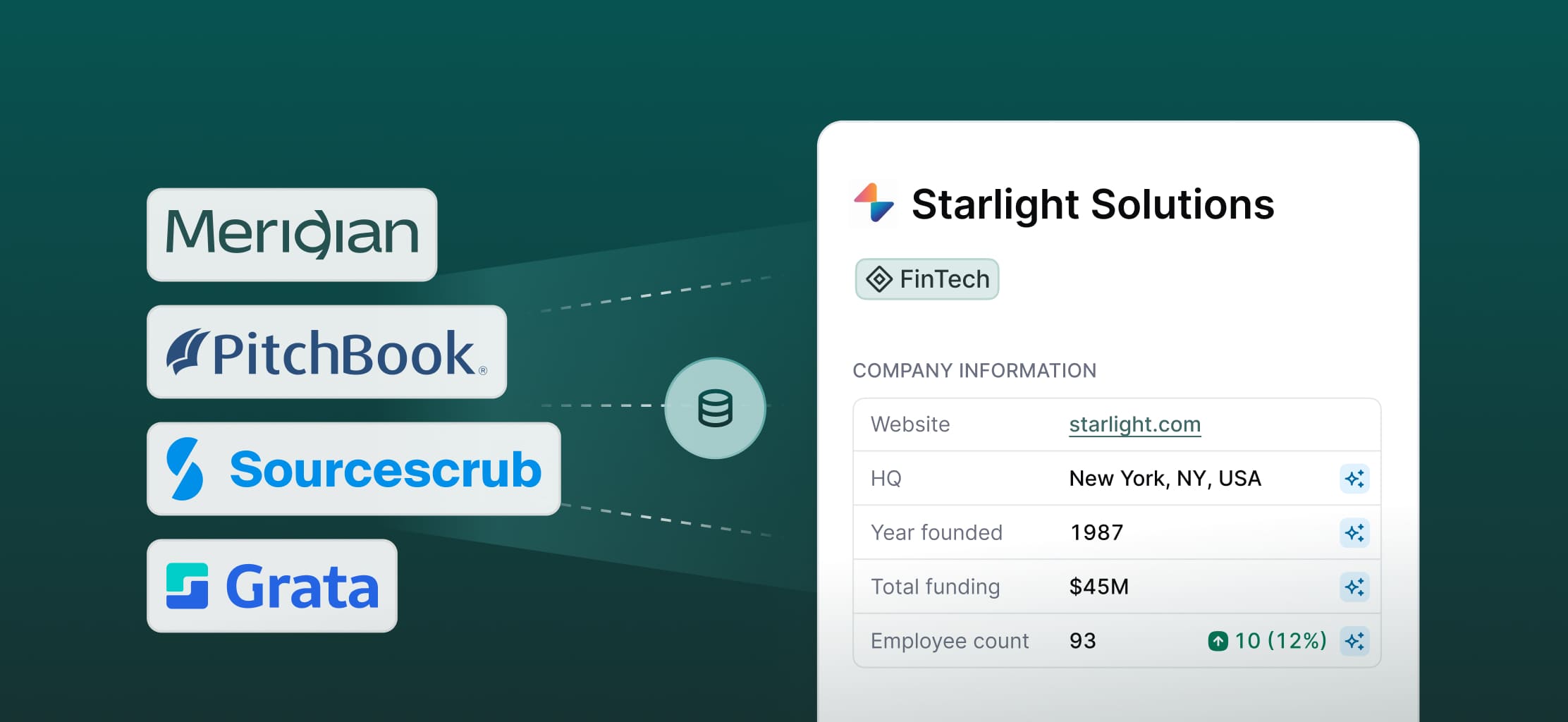
The operational cost of juggling vendors is the reconciliation work when two providers disagree, the conflicting records that force an analyst to decide who is right, and the per-seat fees that grow with the team. Every extra source is another thing to keep in sync.
Meridian bundles a proprietary dataset of more than 26 million company records, refreshed from filings, registries, hiring data, and news, directly into the CRM. Many of our customers cut their third-party data spend by up to 70% after consolidating.
However, consolidation is a spectrum, not an all-or-nothing switch. A firm deeply embedded in one data vendor may keep it as one of the many enrichment layers rather than dropping it. We wrote about the wider vendor-consolidation trend in this State of the Stack analysis.
AI is only as good as the data underneath it, so clean, connected records are the precondition for useful AI in a deal team. A model reading a stale or fragmented CRM produces fast answers that no one can trust, which is worse than no answer at all.
Adoption has already outrun the data layer. Salesforce found that 87% of sales organizations already use some form of AI, and 54% of sellers have used AI agents, yet 51% of sales leaders using AI say disconnected systems are slowing them down. The bottleneck is the data, not the model.
The data and CRM layers are converging in the market, which raises the stakes on where a firm's data lives. In 2026, the same acquirers folding data providers together are also folding that data into CRM and deal platforms, so choosing an enrichment approach now is also a choice about who controls the firm's data later.
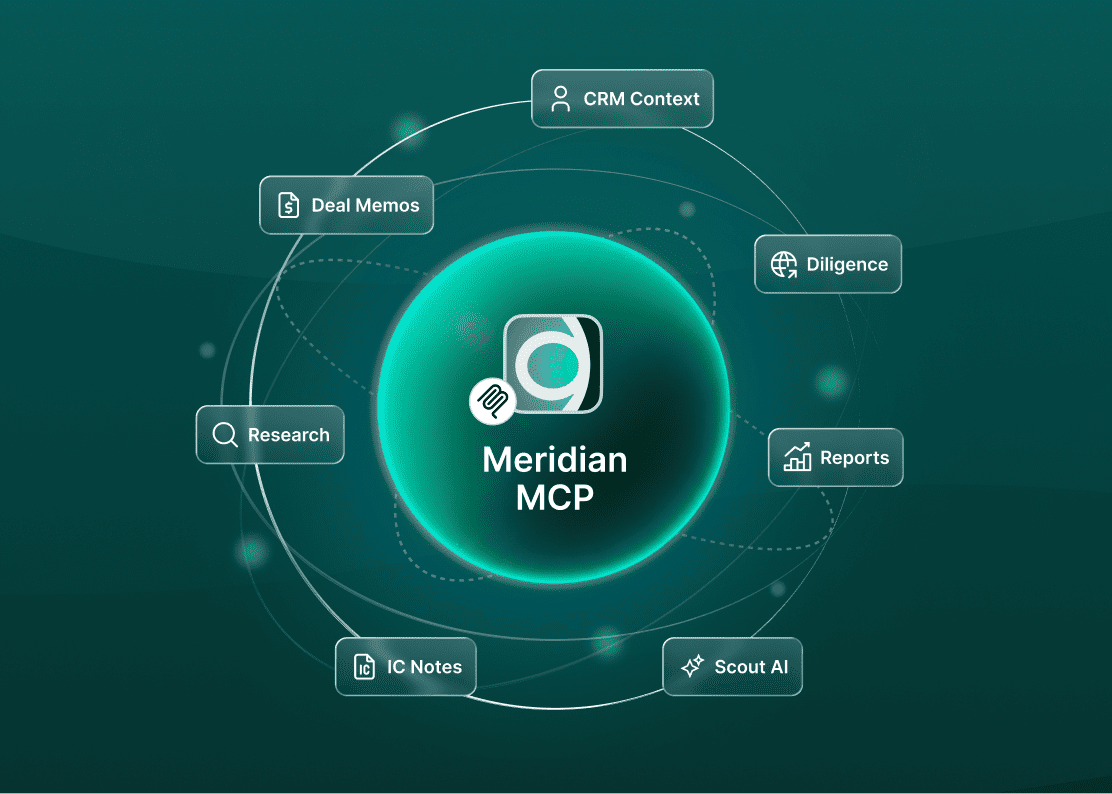
Meridian's answer is to be AI-native and open rather than creating a walled garden. Meridian MCP connects the firm's deal data, relationship history, and enrichment layer to any AI tool through a standard interface, so the system of record stays portable.
For the wider platform picture, our guide to the best private equity CRM tools lays the options out side by side.
Meridian enriches every company record automatically, tracks where each field came from, and bundles the data so you can retire the subscriptions you are stacking today. See how Meridian works and book a demo.
Discover how Meridian can streamline deal sourcing and enhance your decision-making

Meridian gives you the context and insights you need to nurture the connections that pay off.
How do PE firms keep their CRM data clean automatically?
They use enrichment that runs inside the system of record, pulling fresh financials, ownership, and leadership onto each company profile so records do not decay between deals. Waterfall enrichment fills each field from the best available source and tracks where it came from, which removes the manual re-keying where data goes stale. The practical test is whether a company record updates without an analyst editing it by hand.
What is waterfall enrichment?
Waterfall enrichment fills each field on a record from the best available source, layering several sources into one profile rather than trusting a single provider for everything. In Meridian's case the layers are AI web research, third-party data providers, and the firm's own approved private data. Every field carries provenance, so the team can see which source supplied each value.
Is there a PE CRM that can replace PitchBook or SourceScrub?
A CRM with a bundled proprietary dataset can reduce or replace separate database subscriptions for company data and enrichment, though it is not a full substitute for a database's depth on fund performance or benchmarking. The strongest setup often keeps one specialist source as a layer and consolidates the rest. Model the offset against your current contracts before assuming a clean swap.
How can PE firms cut data-vendor spend?
They consolidate overlapping subscriptions into one enrichment layer instead of paying several providers to describe the same companies. Meridian reports that many clients cut third-party data spend by 30 to 70% after consolidating, a client-reported figure rather than an independent benchmark. The savings depend on how many overlapping sources a firm carries today and how embedded each one is.
How do you enrich a CRM from CIMs and IC memos?
Documents like CIMs and IC memos are read into structured fields on the deal record, so financials, deal terms, and history become searchable data rather than files in a folder. Because that data mixes with public sources, provenance tracking shows which figures came from a confidential document and which from a provider. The record then holds the firm's own view of the company, not just what any vendor can sell.
How does source provenance work in CRM data?
Provenance tracking records where each enriched field came from, so a revenue figure shows whether it originated in a filing, a third-party provider, or a CIM. That matters when public and private data sit side by side on the same profile and a team has to decide how far to trust each value. A number no one can trace back to a source should not go into an IC memo.
How much does bad CRM data cost?
Gartner estimates poor data quality costs organizations at least $12.9 million a year on average across industries, and reports that 59% of organizations do not measure data quality at all. For a deal team the cost is more specific: missed signals on companies the firm already tracks, and hours spent re-keying records that enrichment could maintain. The figure most firms underweight is the deal that goes quiet because its record went stale.

Table of Contents

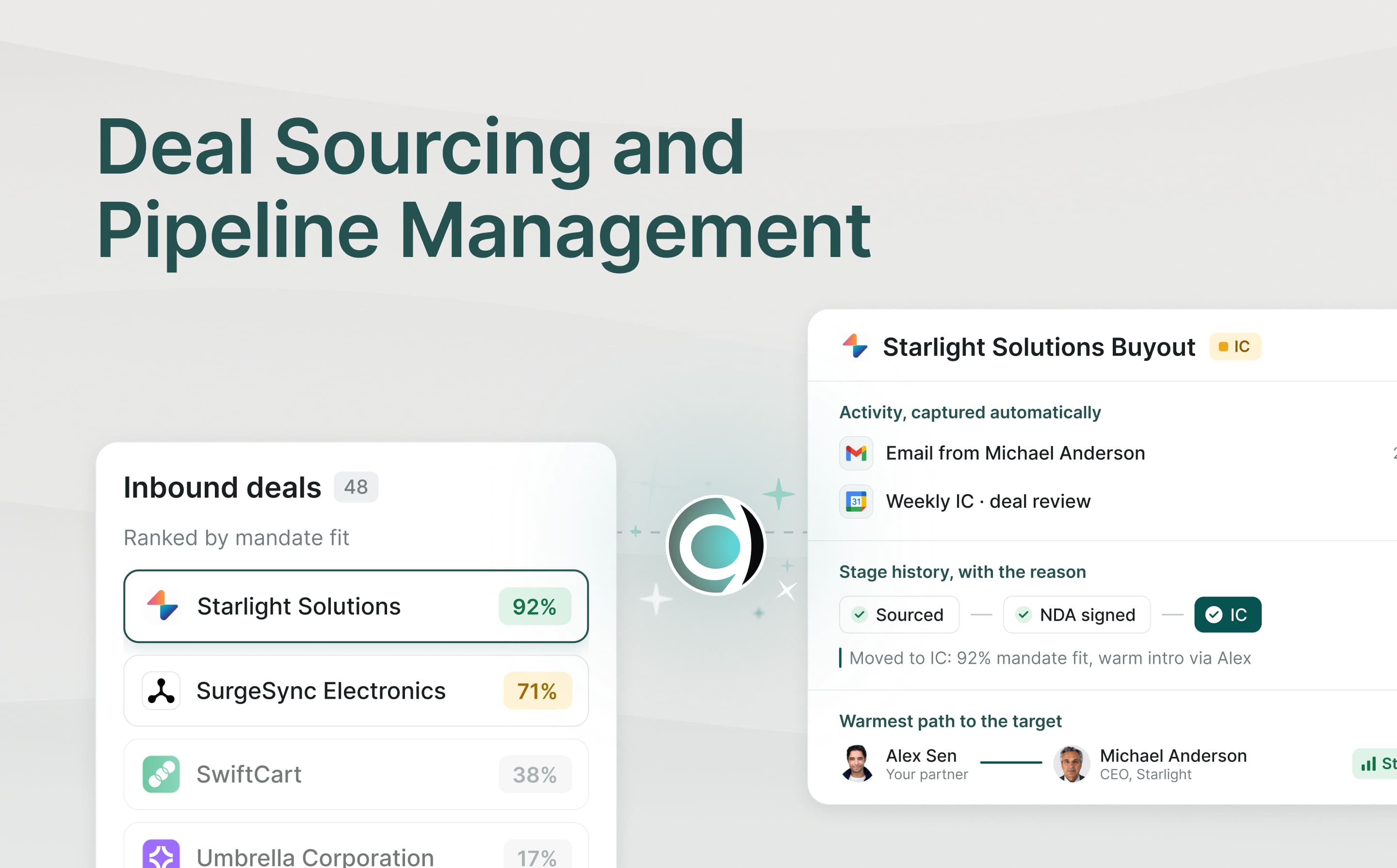
Why deal sourcing and pipeline management belong in one system, how proactive thematic sourcing wins proprietary deals, and how to stop pipeline leakage.