
Meridian MCP is live!
Connect your deal sourcing data to any AI tool.
Learn More
Meridian raises $7M seed round led by 645 Ventures.
Read More
A guide to CRM data enrichment for PE, VC, and private credit teams — covering enrichment architecture, waterfall logic, platform comparisons, and evaluation criteria.

TL;DR
Most private markets firms operate with a data architecture that nobody intentionally designed. A CRM (often Salesforce or DealCloud) sits at the center, surrounded by separate subscriptions to PitchBook, SourceScrub, Preqin, and Crunchbase. None of these systems sync natively with the CRM. Associates spend hours manually pulling fields from one tool into another. Data goes stale between sync cycles, sometimes within weeks of a record being created. A comprehensive private markets data stack now runs well into six figures a year…and most firms still cannot trust their CRM.
Senior dealmakers do not log meetings. Even when they do, the records they create lack the financial context that makes a CRM useful for IC prep. Salesforce's State of Sales report finds that sales reps spend 60 percent of their week on non-selling tasks like data entry and research. The number for PE deal teams is almost certainly worse, because the data they need is harder to find, more dispersed across vendors, and more expensive to license.
The shift underway is the convergence of the CRM and the data layer. AI-native platforms now bundle enrichment directly into the CRM, combining public structured data, AI web crawls, third-party integrations, and private firm data into continuously updated profiles. The manual sync goes away, and data is always current. The total cost of the data stack drops.
This guide explains what built-in data enrichment means for PE, VC, investment banking, and private credit deal teams. It walks through the five layers of a modern enrichment architecture, compares the bundled and multi-vendor approaches, and lays out an evaluation framework you can use whether or not you ever look at Meridian.
The associate searching for "CRM data enrichment" lands on dozens of articles about email verification and lead scoring. Those articles are not wrong, but they describe a different problem, and a different workflow entirely.
Generic B2B sales enrichment is about appending email addresses, phone numbers, job titles, and firmographic data to sales leads. It is optimized for outbound prospecting volume. The tools that dominate this category (ZoomInfo, Clearbit, Apollo, Cognism) are built for sales organizations that need to send the right cold email to the right prospect.
Private markets enrichment is a different problem. A deal team needs to know a company's trailing-twelve-month EBITDA. It needs the ownership structure, the deal history, the management team's prior exits, and which banker is running the process. It needs to know whether a partner at the firm has met the CEO before, and how recently. These data points come from different sources, require different validation logic, and serve different purposes. Investment decision quality is the goal.
"CRM data enrichment" means one thing for a sales org and something else entirely for a deal team. The platforms built for the first case are not the platforms you want for the second. This is also why a category designed around contact append misses what dealmakers actually need: deeper financial data, stronger relationship context, and a continuous link to private documents like CIMs and IC memos.
We covered the broader CRM mismatch in our piece on PE CRMs vs. standard CRMs; the data enrichment story is the same problem viewed from a different angle.
What enrichment looks like in practice depends on the asset class. The data points that matter for a PE deal team are not the same as the ones that matter for a VC partner or a private credit underwriter. Let’s explore the differences.
Mid-market and upper-mid-market PE firms care about company-level financials and ownership structure first. The data points that should populate a profile in a PE CRM include:
A profile that has all of these fields makes IC prep fast. A profile missing any of them sends an associate back to PitchBook, SourceScrub, or a Google search.
For more on how PE workflows shape data needs, see our private equity solutions page.
VCs care about a different data mix. Deal teams in VC need to see what a company is doing in real time, not what its filings looked like a quarter ago.
VC enrichment is signal-driven. A new VP of Sales hire often shows up on LinkedIn before it shows up on PitchBook, and that signal might be the difference between a warm intro and a missed round.
Our venture capital solutions page covers the workflow side of this.
Credit teams need a different lens entirely. Equity ownership structure matters less than borrower performance and covenant compliance.
The point of this taxonomy is that one-size enrichment does not work. A platform that gives a credit team only firmographic and revenue data is missing covenant tracking. A platform that gives a VC team only financials is missing the founder network signals. Enrichment has to be configurable by asset class, or it is not enrichment.
See our private credit solutions page for the credit-specific build.
A modern CRM does not pull data from a single source. It builds composite profiles by layering five different types of data, each filling gaps the others cannot. We use Meridian data enrichment as a working example throughout this section, but the architecture is generalizable.
.webp)
The foundation is filings, registries, and other publicly available structured data. SEC EDGAR for public companies and their subsidiaries. State corporate registries. Patent and trademark databases. Job postings on public boards. Federal Reserve Call Reports for lender financials.
What it provides:
Where this layer falls short: filings can be months old, coverage varies sharply by jurisdiction, and most privately held company financials never appear here at all.
Public structured data is the cheapest layer. It is also the stalest and the least complete. On its own, it is not enough.
.webp)
The real-time intelligence layer is AI agents that continuously crawl the open web for press releases, blogs, hiring boards, review sites, and social media. The signals here are fresher than any quarterly-updated database can match.
What it provides:
Most of these signals appear on LinkedIn, company blogs, or industry press long before they propagate to a structured database.
In Meridian, AI agents pull these signals and synthesize them into company profiles automatically. No analyst is doing the research by hand.
.webp)
The third layer is the structured data your firm already pays for: PitchBook, Preqin, SourceScrub, Grata, Crunchbase, etc. These providers spend significant resources curating clean data, and they remain best-in-class for specific use cases.
What it provides:
An architectural question is how to combine these first three layers. Waterfall enrichment is one answer: Rather than relying on a single source, the system queries multiple providers in priority order for every field. If PitchBook has the revenue figure, the platform uses that. If not, it checks SourceScrub, then its proprietary dataset, then AI-extracted web data. Each layer fills gaps from the previous one. The result is a profile more complete than any single source.
A per-field source hierarchy is how the firm controls this in practice. Each field on a company profile can be configured independently. Revenue might come from PitchBook. Headcount might come from AI web crawls. Management bios might come from CIM extraction. Different fields, different priority orders, different sources. The team gets the most accurate data from the best available source, field by field.
We cover the architectural details on our data enrichment page.
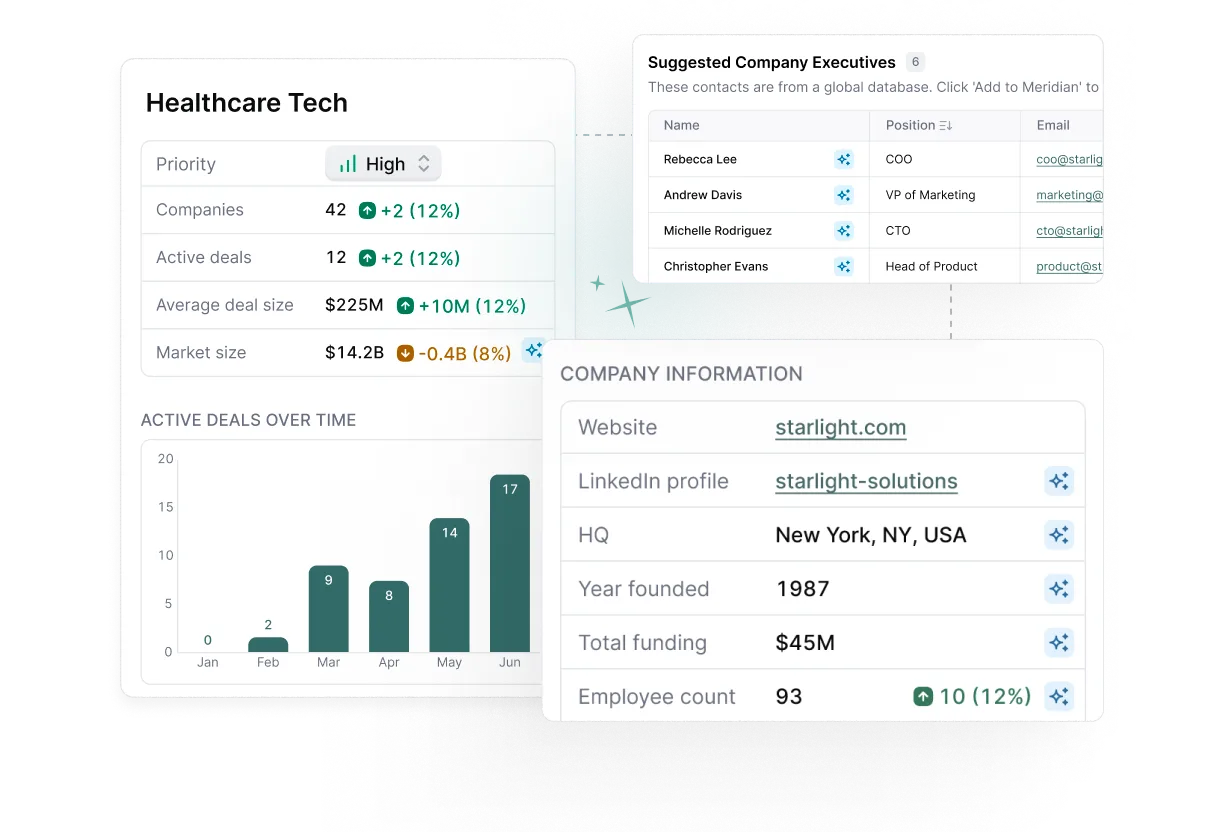
Meridian is your team’s ultimate context provider, driving better deals while minimizing manual data entry.
.webp)
Layer 4 is the most underrated. It is also the layer that separates institutional memory from a shared address book.
What it provides:
This is the data no external provider can sell you, because it lives in your inboxes, your shared drives, and your SharePoint. When privileged financial data from private documents is combined with publicly available third-party data and tied to your communication history, you get a knowledge layer that is exclusive to your firm. No competitor can buy this. No new hire can rebuild it from scratch.
In Meridian, the platform automatically scrapes financial data from CIMs, IC memos, and data rooms to enrich company profiles with this privileged information. As your team emails, takes meetings, or ingests documents, structured fields are extracted, linked to the right entities, and kept current. The work happens in the background.
.webp)
The fifth layer sits on top of the other four. It reads everything below it and produces actionable outputs.
What it provides:
Provenance tracking matters at this layer. For each enriched data point, the system needs to record where it came from and how it was calculated. If an EBITDA estimate was derived from Federal Reserve Call Reports cross-referenced with interest expense data, the platform should show that reasoning with source links. This transparency is not optional for IC prep and compliance. Deal teams need to know whether a number came from a filing, a CIM, or an AI estimate.
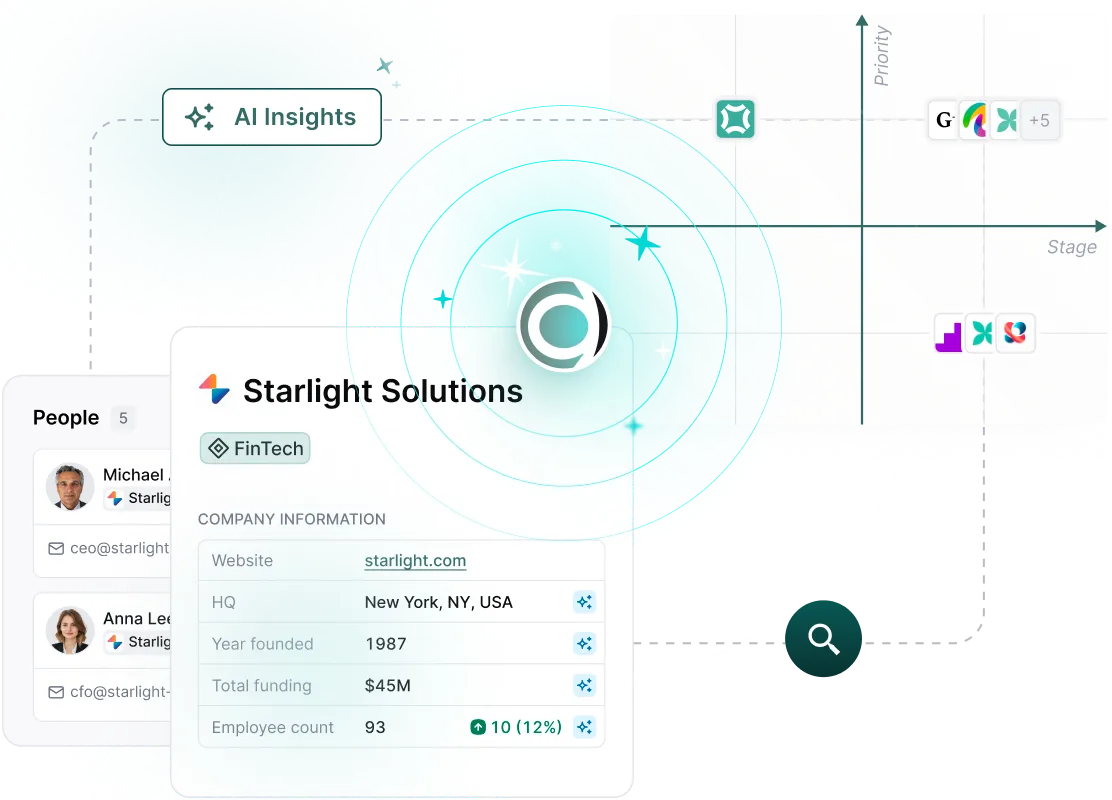
In Meridian, Scout AI continuously reads all five data layers and produces living profiles: dynamic company records that auto-update with deal scores, mandate-relevant flags, and provenance tracking for every enriched field. Enrichment can be triggered on any company record to pull fresh data across all layers on demand.
The question most firms eventually ask is whether to consolidate the data layer into the CRM or keep paying for multiple specialized providers. The honest answer is that it depends on what the firm needs. Both models have legitimate use cases.
The multi-vendor model is the traditional architecture. The firm pays separately for the CRM (Salesforce, DealCloud, Affinity) and for data subscriptions (PitchBook for deal data, SourceScrub for sourcing, Preqin for LP data). The CRM and the data tools live in different systems. Sync between them is manual or semi-automated. Records go stale between sync cycles. The advantage is depth in each specific tool. PitchBook's research team produces data quality you cannot easily replicate. Preqin's LP and fund-of-funds intelligence is genuinely deep. SourceScrub's conference attendee data is unique. Firms that rely on these specialized data sets for core workflows have good reason to keep paying for them.
The bundled model puts the CRM and the enrichment in one platform. The firm's existing data subscriptions can layer in via API or direct sync, supplemented by the platform's own dataset and AI enrichment. Records update continuously. Meridian customers report 30-70% reductions in third-party data spend because the platform's own dataset (26 million+ company records refreshed from filings, registries, hiring data, and news) covers many of the use cases that previously required separate licenses.
The bundled approach is not a wholesale replacement for every specialized tool. Firms with deep, specialized data needs usually keep their point solutions. The bundled model works best when it replaces the general-purpose data layer, not every niche tool. The right framing is: PitchBook for what only PitchBook does, Preqin for what only Preqin does, and the CRM-plus-dataset combo for everything else. SourceCodeals' rundown of 19 PE data providers is a useful reference if you want to map which providers cover which gaps.
A note on trade-offs: Meridian is newer to the market than a legacy CRM like DealCloud. Firms that need a multi-decade product record, or that have heavily customized DealCloud builds their team has used for years, may have legitimate reasons to wait or to keep their existing stack alongside a bundled CRM. The bundled model is the right answer for firms that want to consolidate spend and modernize their architecture. It is not the right answer in every case.
The criteria that matter when comparing platforms:
A short tour of the main platforms in the category. Strengths first, then trade-offs.

What it is. Meridian bundles CRM and data enrichment in one platform using a two-pronged approach. The external prong layers your existing data subscriptions (PitchBook, Grata, Crunchbase via API or direct sync); Meridian's proprietary 26 million+ company database refreshed from filings, registries, hiring data, and news; and AI research agents that crawl the open web when no structured data is available. The proprietary prong scrapes financial data from CIMs, IC memos, and data rooms to enrich profiles with privileged information only the firm has. Both prongs feed into living profiles that update continuously.
Why it matters. The manual sync between CRM and data providers goes away. Each field on a company profile can be configured independently, so the firm controls which source takes priority for each data point. Provenance tracking shows where every enriched field came from with source links and calculation logic, so IC reviewers can trust the numbers. Customers report 30-70% reductions in third-party data spend because the bundled dataset replaces some standalone subscriptions. Pricing is transparent and inclusive.
Trade-offs to be honest about. Meridian is newer than DealCloud or Affinity. A younger platform comes with a shorter track record, and that may matter for firms that prioritize tenure over architecture.
Proof. Enrichment can be triggered on any company record to pull fresh data across all layers on demand. White-glove data migration cleanses, enriches, and structures legacy CRM data at onboarding. A daily briefing surfaces real-time signals (revenue changes, product launches, competitive moves) without manual monitoring.
Our deal flow management write-up has more on how the enrichment layer connects to sourcing workflows.
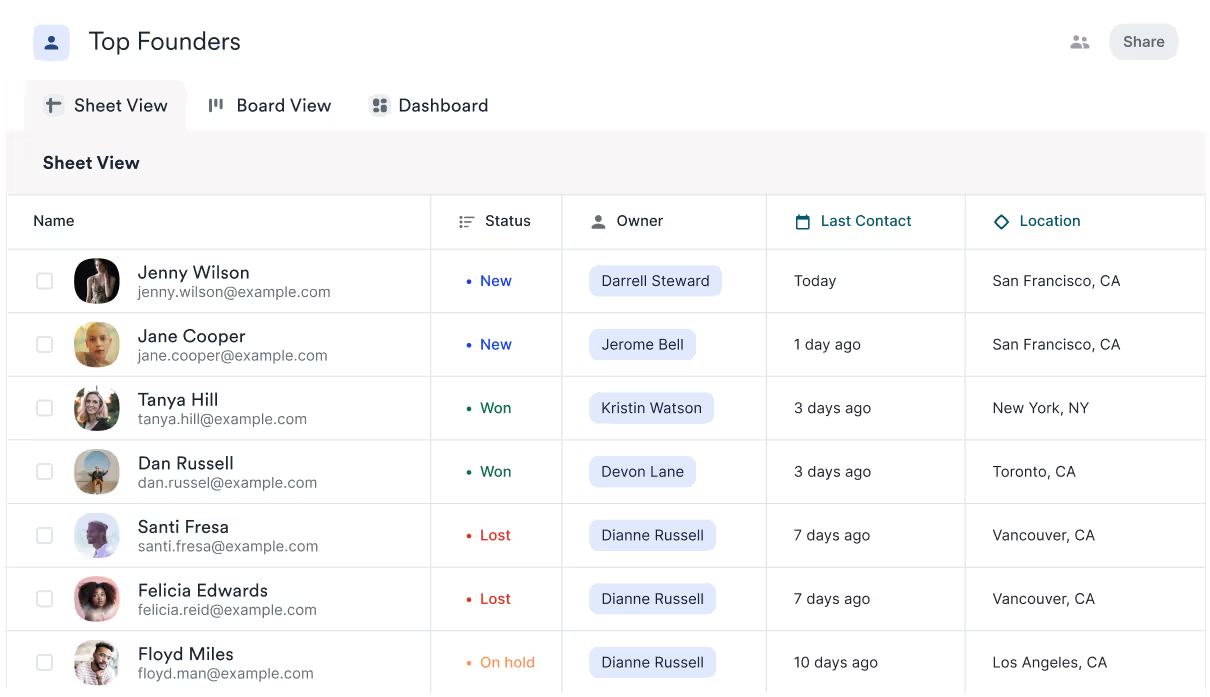
Affinity's strength is automated activity capture from email and calendar, paired with relationship scoring. The platform builds a network map automatically by reading interaction history, and assigns strength scores so deal teams can find warm introduction paths quickly. For VC firms whose primary need is relationship intelligence and warm-intro sourcing, Affinity is a natural fit.
Where Affinity differs in approach. Affinity’s enrichment leans toward relationship and firmographic data more than deep financial data like revenue, EBITDA, and deal history. PE firms that need CIM extraction or covenant data alongside relationship intelligence will need other tools to fill those gaps. Affinity uses a per-seat pricing model, which scales with firm size.
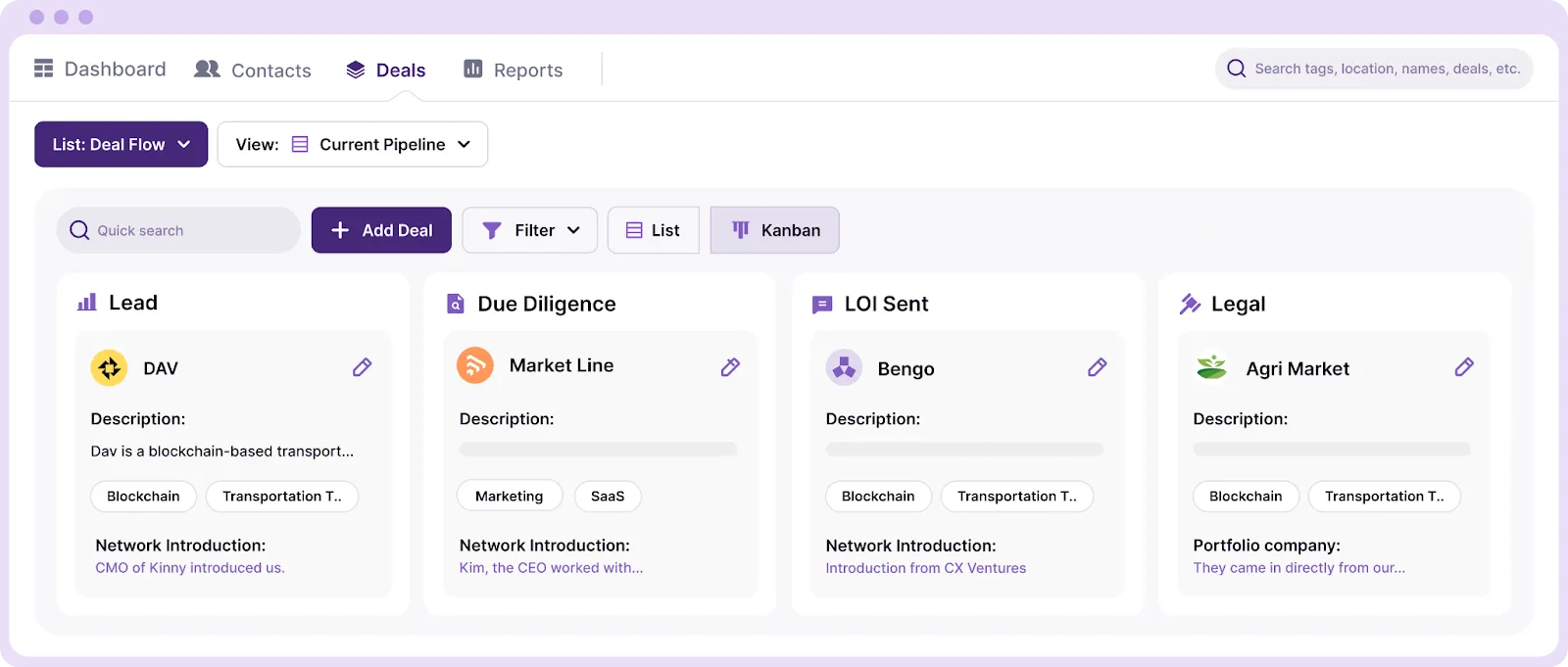
4Degrees is purpose-built for PE and VC. The platform syncs with Outlook and Gmail and enriches contacts using PitchBook data alongside its own relationship intelligence layer. It does relationship strength scoring and pushes real-time alerts for job transitions and news. Onboarding is fast.
Where 4Degrees differs in approach. The platform relies on third-party providers (primarily PitchBook) for the financial data layer rather than maintaining a proprietary dataset of its own. The depth of enrichment is bounded by the external sources you connect, which is a different architecture from a bundled-data approach.
These are unbundled alternatives. They are the data layer without a CRM attached, and each has genuine depth in its specific category.
PitchBook is the gold standard for PE and VC deal, fund, and company data. The research team is large and the data is comprehensively curated. Coverage is broad and the platform is the default reference for many firms. The trade-off is workflow integration: PitchBook does not sync natively with most CRMs, so the data has to be exported or reentered, and updates can lag real-time signals.
SourceScrub is strong for private company sourcing and conference attendee data, with broad coverage of bootstrapped and founder-owned companies that PitchBook may not track in depth. It is a sourcing tool, not a CRM.
Preqin is the leading source for LP data, fund performance benchmarks, and alternative assets intelligence. Essential for fundraising teams. It is not a CRM enrichment tool and does not try to be.
Grata uses AI-powered semantic search for middle-market deal sourcing and thematic screening. The dataset is growing but less mature than PitchBook for financial detail. Strong for thematic search workflows.
SourceCodeals has a side-by-side rundown of these and other providers if you want to map coverage gaps.
A note on what changed in 2026: Carta, the cap table and fund administration platform, entered the private markets CRM space in March 2026 by acquiring ListAlpha. The implication for the data enrichment category is that the line between fund administration data, deal data, and CRM is blurring further. We expect more consolidation moves over the next 18 months.
The firms that treat data enrichment as a CRM feature rather than a separate line item end up with the most accurate records, the fastest sourcing workflows, and the lowest aggregate data spend. The question is no longer whether your firm needs enrichment. It is whether you are paying for five disconnected tools to get what one platform can provide.
The bundled model is not the right answer for every firm. Some legitimately need deep specialized providers and the workflow cost of maintaining them. But for the general-purpose data layer, the architecture has shifted. Continuous enrichment, layered sources, per-field control, and provenance tracking are now table stakes. If your CRM does not give you all four, your data architecture is doing something the modern alternatives do not require.
See How Meridian Consolidates CRM and Data Enrichment for Private Markets. Book a Demo.
Discover how Meridian can streamline deal sourcing and enhance your decision-making

Meridian’s Scout AI agent surfaces and benchmarks new opportunities so you can find winning deals before the competition.
What is CRM data enrichment for private equity?
CRM data enrichment for private equity is the process of automatically appending financial data, ownership structures, deal history, management bios, banker coverage, and relationship context to company and contact records in your CRM. It differs from generic B2B enrichment, which focuses on email verification and contact append for sales leads. Private markets enrichment is optimized for investment decision quality, not outbound prospecting volume.
Can a CRM replace PitchBook for deal team data?
A bundled CRM with built-in enrichment can replace many PitchBook use cases, including company screening, basic financials, and ownership data, but not all of them. PitchBook remains best-in-class for deep fund performance data and curated transaction histories. Most firms use a waterfall approach: keep PitchBook for what only PitchBook does, and rely on the bundled CRM dataset for the rest.
How does waterfall data enrichment work?
Waterfall enrichment queries data sources sequentially in a configured priority order for every field. Existing subscriptions like PitchBook are queried first, then proprietary datasets, then AI web crawls, then private firm data extracted from CIMs and emails. Each layer fills gaps from the previous one, producing a composite profile more complete than any single source.
How much can bundled CRM enrichment save on data subscriptions?
Meridian clients report 30 to 70 percent reductions in third-party data spend after consolidating onto a bundled CRM platform. The savings come from cancelling overlapping data subscriptions and from unlimited-user pricing that does not scale with team size, unlike per-seat data licensing that penalizes firm growth.
What data points do PE deal teams need in their CRM?
PE deal teams need revenue, EBITDA, EBITDA margins, growth rates, ownership structure, deal history, management team bios, banker and advisor coverage, and portfolio company KPIs in their CRM. A profile with all of these fields makes IC prep fast. A profile missing any of them sends an associate back to PitchBook, SourceScrub, or a Google search.
What is a living profile vs. a static data snapshot?
A static data snapshot is a record that was last updated when an analyst pulled data into the CRM and is now stale. A living profile is a record that updates continuously as new information becomes available, whether from filings, hiring activity, press, or your team's own communications. Living profiles are powered by AI agents that read all available data layers and refresh records automatically.
How do private credit firms approach CRM data enrichment differently?
Private credit firms need leverage ratios, DSCR, interest coverage, debt structure, collateral data, covenant terms and compliance status, borrower financial performance, and sponsor relationship data tracked in the CRM. Equity ownership matters less than borrower performance and covenant compliance. A CRM that gives a credit team only firmographic data is missing the credit metrics that drive underwriting decisions.

Table of Contents