

Meridian MCP is live!
Connect your deal sourcing data to any AI tool.
Learn More
Meridian raises $7M seed round led by 645 Ventures.
Read More
PE firms are standing up internal AI teams. The hiring wave is real — the org design question is where most will get it wrong.
In the past thirty days, four job postings stopped me mid-scroll. H.I.G. Capital is hiring a Forward-Deployed AI Specialist. Updata Partners is hiring a VP of AI & Automation. Vista Equity Partners hired an SVP of AI Innovation to lead a team they’ve named the Agentic Factory. Ares Management acquired BootstrapLabs — an AI venture firm — and is now hiring a Principal/MD of AI Value Creation to deploy that capability across the portfolio.
These aren’t entry-level hires. They’re senior operators with real mandates. And they’re not anomalies. They’re the clearest signal yet that PE firms have moved from talking about AI to building internal delivery organizations around it.
Agentic AI is clearly happening in PE. The interesting question, though, is whether it's going to work.
Private equity firms have always operated with a particular kind of urgency — IC deadlines, closing timelines, LP reporting windows. The deal clock is real, and the deal team is calibrated to it. Everything gets evaluated against that rhythm.
As many of you know, however, tech buildouts run on a different clock. Hiring takes time. Scoping takes time. Building, testing, and iterating takes time. A good tech initiative at a PE firm might show meaningful results in six to 12 months. That’s not failure. That’s how software works.
The tension between those two clocks is the defining challenge for every firm now standing up an internal AI team or exploring AI-native software. And in most cases, it’s a tension nobody planned for.
The failure mode I see most often isn’t technical. It’s organizational.
A firm hires a strong operator for a role like the ones above. The mandate is broad: modernize the deal workflow, deploy AI across the team, build something that creates a competitive edge. Six months in, the deal team is still running their old process because nobody on the build side fully understood how the deal team actually works.
Here’s a concrete version of what that looks like. The tech team builds a diligence summarization tool. Clean UI, good output, integrates with the data room. The problem: the diligence memo at this firm gets drafted at 11 pm the night before IC, by a VP working from a mix of data room files, call notes from a Zoom that never got transcribed, and an email thread that’s been going for three weeks. The tool was built for the workflow that should exist. Not the one that does.
This plays out in three overlapping failure modes that compound on each other.
The first is misalignment. The tech hire doesn’t have enough deal workflow context to build the right thing. They’re smart, they’re capable, and they’re building for the wrong problem.
The second is adoption failure. The deal team doesn’t use what gets built. Not out of stubbornness but because the tool doesn’t fit how they work, and they’re too busy to adapt to it. When you’re running three live processes simultaneously, you’re not going to change your workflow for a tool that saves you twenty minutes on a good day.
The third is the root cause of both: org design. The tech role has the wrong reporting line, the wrong mandate, and the wrong success metric. They report to the COO or the CFO instead of someone with deal credibility. Their mandate is “build tools” rather than “embed in the workflow.” Their success gets measured by features shipped rather than hours saved per deal.
None of these are unsolvable alone, but you have to see them as design problems, not execution problems.
The firms I’ve seen get this right share a few patterns. None of them are complicated, and most of them are obvious in retrospect.
The tech hire has a deal team co-pilot. Not a stakeholder relationship. An actual embedded partner who can tell them, in real time, “that’s not how the IC process actually works” or “the bottleneck isn’t the memo, it’s the data room ingestion.” This person is usually a senior associate or VP who is genuinely interested in how the firm operates and has enough credibility with the deal team to translate between the two worlds. Without this person, the tech hire is building in the dark.
The reporting line runs through someone with deal credibility. When the SVP of AI Innovation reports to a partner who is also running deals, the feedback loop is tight, and the priorities stay grounded. When the role is three org chart layers away from anyone who’s been in a deal room recently, it drifts.
The firms getting this right are shipping small things quickly, watching how the deal team actually uses them, and adjusting. A tool that gets used imperfectly is more valuable than a tool that gets built perfectly and ignored. The goal in the first six months is to get something into the real workflow (even if it’s rough) so the team can tell you what’s wrong with it.
Success is measured by deal team adoption, not feature count. This sounds obvious, yet it almost never gets implemented. If the partners aren’t using the tool, nothing else matters. Full stop.
The same logic applies when firms evaluate external software. The platforms that work for deal teams are the ones built with deal workflow in mind from the start, not tools that require the firm to adapt their process to fit the software. That’s the translation problem the right tech hire is supposed to solve internally. It’s also why firms like Meridian exist externally — the integration between AI capability and deal workflow has to be built in, not bolted on.
The four job postings I mentioned at the top of this piece are genuinely exciting. They represent a real shift in how PE firms think about operational advantage. Building internal AI delivery capability is the right bet.
But the hiring question and the org design question are different questions. Most firms are asking the first one. Not enough are asking the second.
Where does this role sit in the firm? Who do they have direct access to? What does success look like in ninety days, and in twelve months? How do they stay connected to the deal team’s actual workflow rather than their idealized workflow? What’s the feedback loop?
The Vista Agentic Factory is a great name. It signals ambition and seriousness. Whether it delivers depends almost entirely on how that team is wired into the people doing deals.
Firms that get the org design right will build a genuine operational advantage. Firms that hire great people into a broken structure will spend the next two years wondering why nobody’s using what they built.
The hiring wave is real. The harder work is what comes next.
Discover how Meridian can streamline deal sourcing and enhance your decision-making


Table of Contents

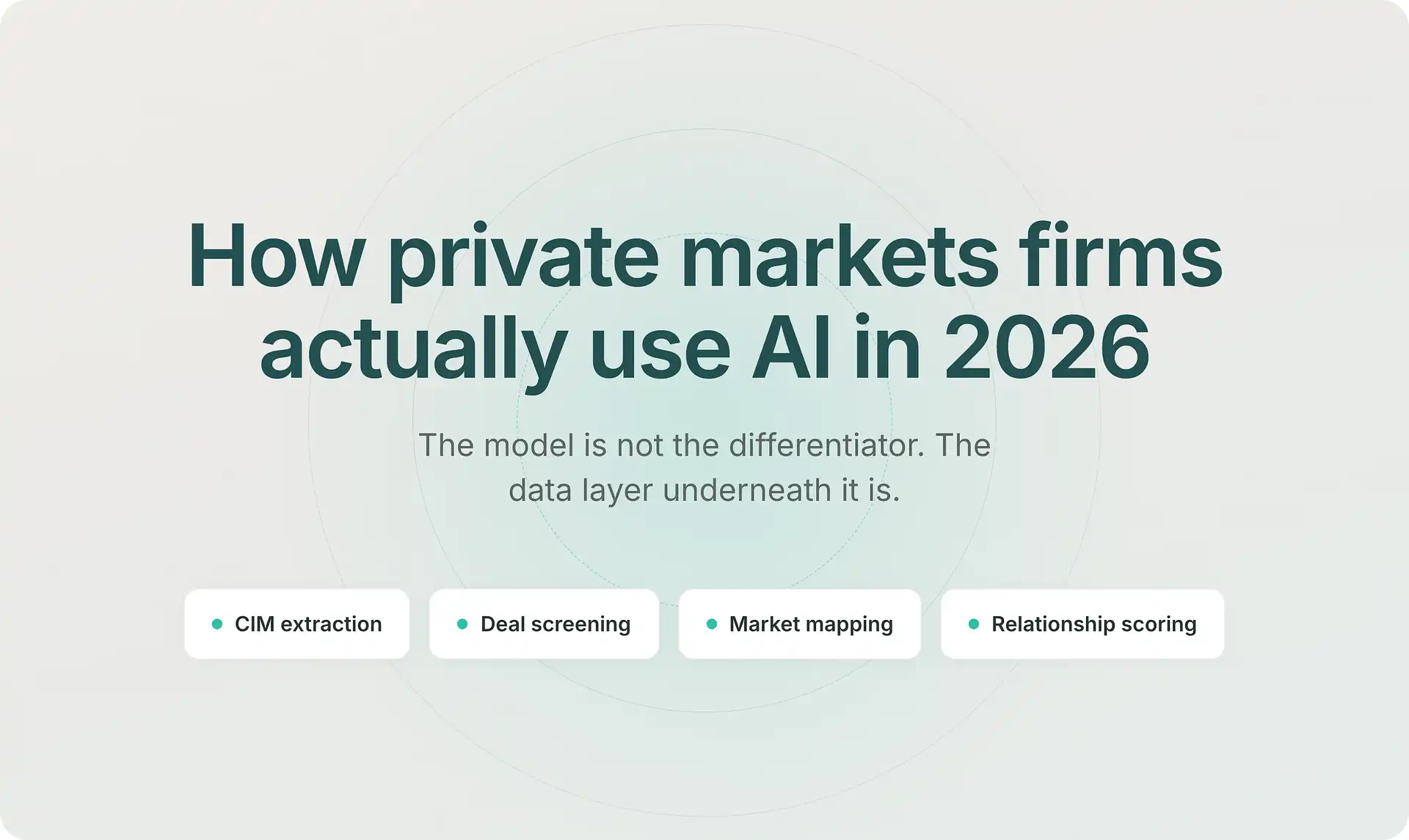
AI adoption has outpaced results in private markets. The four workflows that change deal-team output, and why the data layer matters more than the model.

.webp)