
Get the Meridian mobile app!
Your deal data travels with you.
Learn More

Meridian raises $7M seed round led by 645 Ventures.
Read More
Every piece of software your firm buys in the next 18 months will either support MCP or it won't. The architecture question isn't on most procurement checklists yet. Here's why it should be.
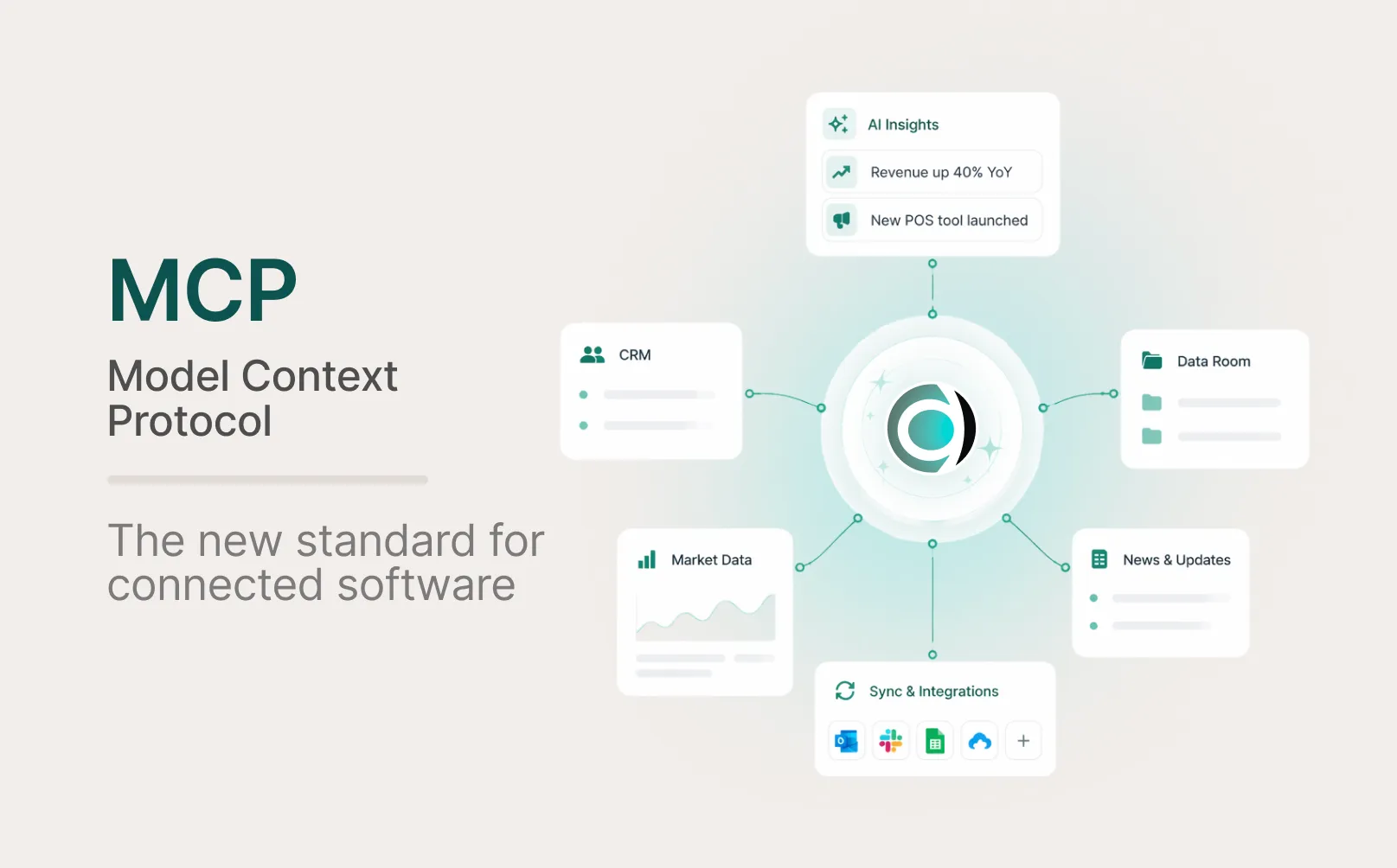
There is a new software standard called MCP (Model Context Protocol) that private markets investment firms need to know about. If you haven't heard that term before, or you want to better understand how it applies to your workflow, then this article is for you.
Anthropic released MCP in late 2024, and within a year, OpenAI, Google, and Microsoft all adopted it. It now has the backing of essentially every major AI platform in the market. As such, it’s a pretty big deal, but most folks have yet to grasp its full implications.
Here is what MCP does in plain terms.
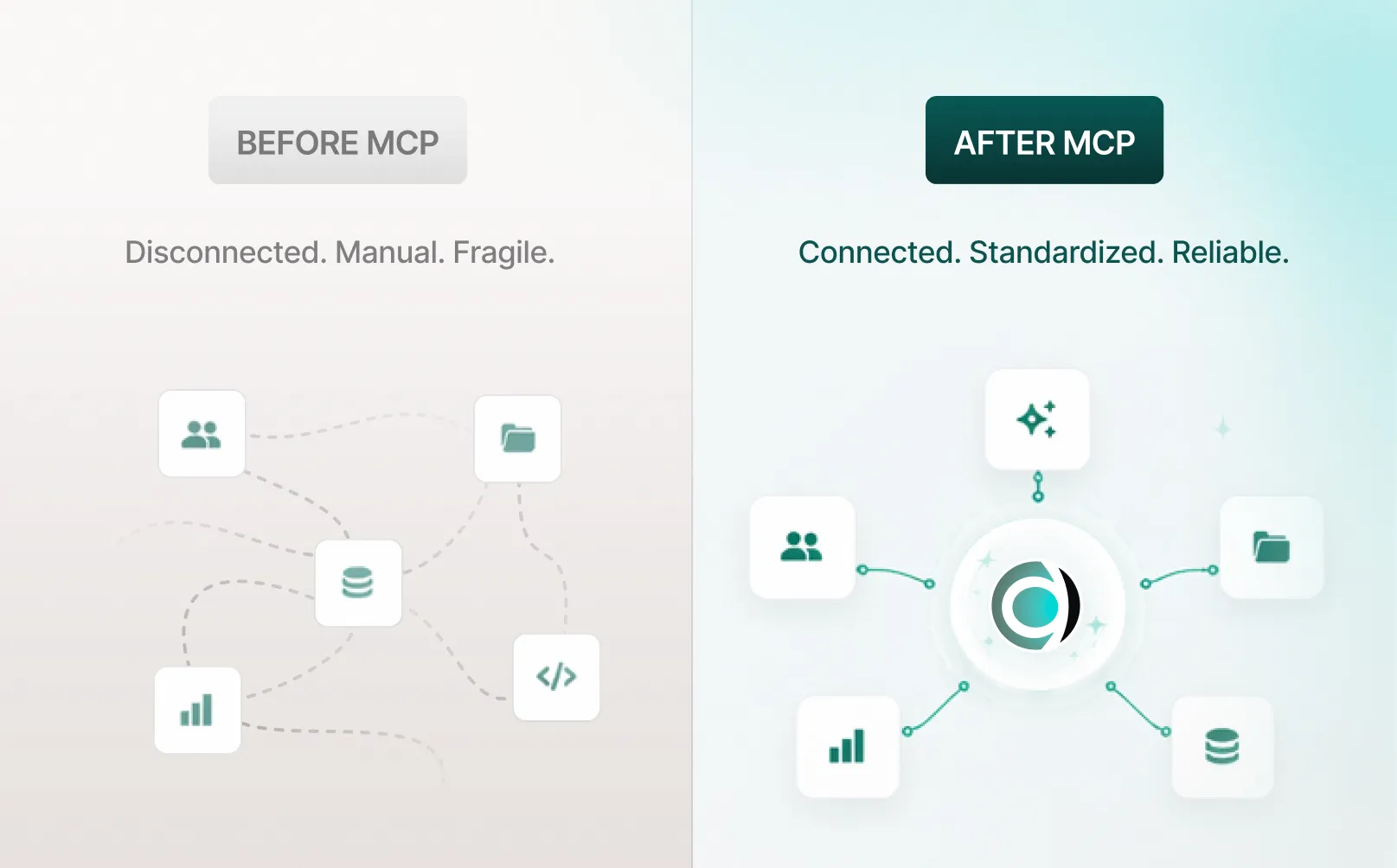
Before MCP existed, connecting two pieces of software required building a custom bridge between them (think API, Webhooks, Zapier, etc.). Every pair of tools needed its own connector. A firm running eight applications potentially needed dozens of custom integrations to make data flow between them, and every integration was a liability. It could break silently. It required maintenance. When a vendor updated their API, the bridge often broke without warning.
MCP changes the equation. Think of it as the USB standard for software. Once the standard exists and vendors build to it, things just plug in. With MCP, your CRM talks to your AI tool. Your AI tool talks to your data provider. Your data provider talks to your deal workflow. No custom connectors. No Zapier workflows held together with duct tape and hope. No copy-paste loops that eat forty-five minutes of an analyst's morning.
For private markets firms, the implication is direct. The tools you evaluate in the next 18 months will either support the MCP standard or they won't. The MCP question should be on every procurement checklist. Right now, it almost never is.
Here's what fragmented architecture actually costs, beyond the obvious SaaS line items.
Every time a deal professional manually moves information between systems, three things happen. First, time gets spent on work that isn't thinking. Second, the data degrades. Something gets left out, a field gets skipped, a note doesn't make it from the call to the CRM. Third, the chain of context breaks.
The reason you were excited about a company, what the banker said that changed your view, what the comp set looked like at first look — that all lives in the handoff gaps between tools.
The firms I talk to that are executing fastest right now aren't necessarily using better individual tools than everyone else. What they are actually doing is using tools that stay connected, ensuring that information flows from where it's captured to where it's needed without anyone playing traffic cop.
The gap between those firms and the ones still running on clipboard workflows is widening. One side is spending analyst hours on judgment, and the other is spending them on data entry.
Let me make this concrete, because "software connectivity" is easy to wave at without really landing.
Sourcing. Right now, most deal teams have their sourcing data in one place, their relationship context in another, and their AI tools running separately from both. A connected stack means your AI layer can pull company data, cross-reference it against your firm's historical deal activity, surface the warmest introduction path in your network, and draft an outreach note without anyone switching applications. That's not science fiction. With tools like Meridian, firms are doing versions of it today. The difference between those firms and everyone else is architecture, not budget.
Diligence. The typical due diligence workflow today: pull files from the data room, switch to Claude, draft a diligence summary, copy it into the memo template, update the CRM. Four applications, one task. A connected stack means the AI tool knows where the files live and where the output needs to go. The analyst's job becomes reviewing and refining, not copy-pasting and reformatting.
Institutional memory. This one's harder to solve, but architecture is a precondition for solving it. The reason tacit knowledge walks out the door when a senior person leaves isn't only culture. It's that the knowledge was never captured in a form that the system could use. It lived in email threads, Slack channels, and personal Notion pages that weren't connected to anything. A connected stack creates the conditions for that knowledge to stay in the firm. It doesn't solve the problem by itself, but without it, you're not solving the problem at all.
Most CRM evaluations I've been a part of on both sides of the table follow the same pattern: Demo the deal flow. Demo the LP reporting. Ask about Outlook integration. Talk about implementation timeline. Negotiate on seats.
What almost never gets asked:
These aren't technical questions. They're procurement questions. And they have significant long-term cost implications. If you aren't asking these questions, you need to be.
The closed-architecture CRM that looks cheaper up front often becomes the most expensive tool in the stack because of the integration debt it generates. Every new tool you add to the stack that can't talk to the CRM creates another manual process. Another Zapier workflow. Another thing that breaks silently and costs three weeks of bad data before anyone notices.
The DealCloud model is deeply embedded, highly customizable, and fundamentally built around a closed data model. That made sense in an era when AI wasn't a meaningful part of the workflow. That era is over. Customization that requires professional services is a different value proposition than a platform that connects natively to the tools your team is already using.
This isn't a knock on any specific vendor. It's a structural observation about where the market is heading. Open architecture is becoming a procurement criterion, not a technical preference. The firms evaluating software today who build that question into their process will spend a lot less time rebuilding their stack in four years.
Before you sign any new software contract, add these questions to your evaluation checklist:
The private markets software market is in the middle of a significant shift. The tools that will lead the next cycle are the ones that connect cleanly to the AI layer that's becoming central to how deal teams work.
Most firms are still buying on the old criteria. They're evaluating features, checking references, and negotiating on seats. The architecture question isn't on their checklist.
That's your window.
The firms that build connected stacks now, that make architecture a first-class procurement criterion before everyone else does, will have a genuine operational advantage in 18 months.
The stack is infrastructure. And right now, the infrastructure question that matters most is whether those tools are actually talking to each other.
Discover how Meridian can streamline deal sourcing and enhance your decision-making


Table of Contents