

Meridian MCP is live!
Connect your deal sourcing data to any AI tool.
Learn More
Meridian raises $7M seed round led by 645 Ventures.
Read More
86% of PE leaders now use GenAI in M&A, but most firms can't tell bolt-on AI from AI-native architecture. Here are the seven deal team workflows where the difference actually compounds.
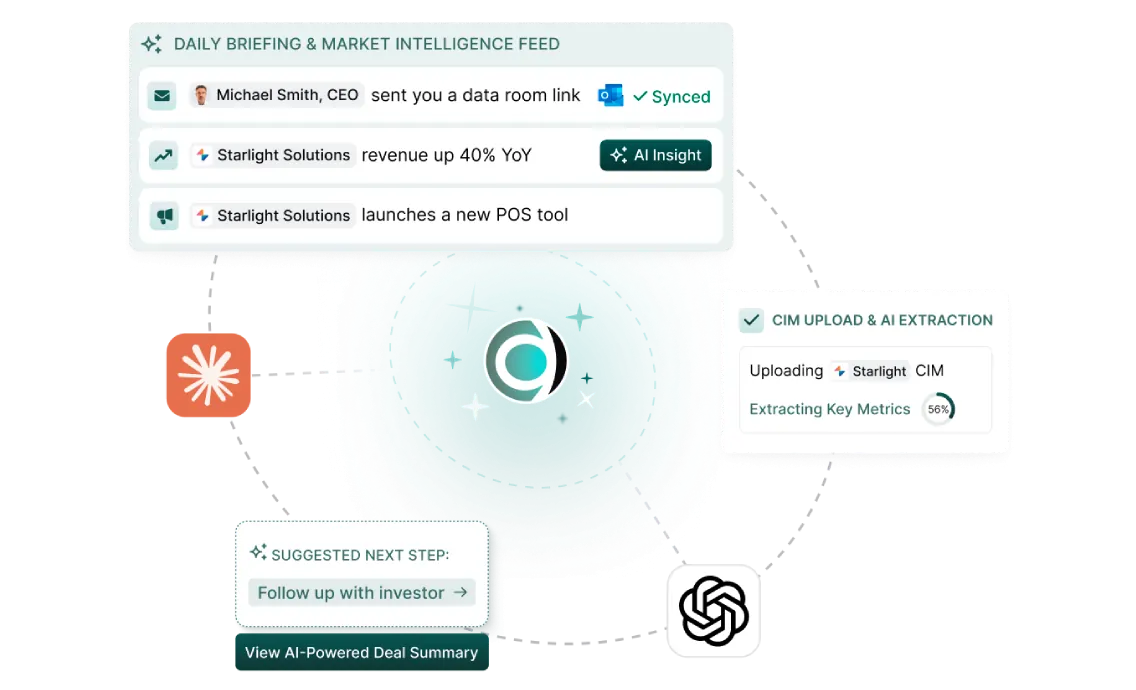
TL;DR
Most PE firms bolted on a chatbot in 2024 and called it AI. The tools could summarize emails. They couldn't parse a CIM, score a deal against the firm's mandate, or update a pipeline without someone telling them to.
That gap is closing. According to Deloitte's 2025 GenAI in M&A Study, 86% of corporate and PE leaders have integrated GenAI into their M&A workflows across a survey of 1,000 senior dealmakers. KPMG's 2025 M&A Deal Market Study found 77% of dealmakers were already using AI in their M&A processes, with another 19% planning to adopt soon. The shift in 2026 is from AI-assisted analysis to AI-orchestrated workflows: agents that watch data continuously, flag actions, and run processes with human approval.
For PE deal teams, this changes what "adopting AI" means. It's no longer about plugging a copilot into Outlook. It's about deciding which workflows benefit from automation, which tools actually deliver, and what architecture you're betting on for the next decade.
This guide walks through seven workflows where AI is changing how PE deals get sourced, screened, and managed. Each section covers what the work used to look like, what AI changes about it, the time savings firms are reporting, and the tools doing the work. We're honest about what's mature, what's still hype, and where the trade-offs sit. At the end, you’ll find an evaluation framework and a look at what's coming next, including Carta's recent entry into the PE CRM space. (For deeper context on why purpose-built systems matter for private markets, see our piece on PE CRMs vs. standard CRMs.)
Each workflow below covers what the work used to look like, what changes when AI is doing it, and which tools are doing it well. We've grouped tools by what they actually do, not by vendor category, so a name may appear in more than one section.

Building a market map used to be a 2-4 week project. An associate would pull lists from PitchBook, scrape LinkedIn, attend a conference, and try to assemble a coherent picture of a sector before the partner who asked for it moved on to the next theme. Mapping was a one-off output, not a continuous capability.
AI changes the cadence. Instead of a one-off project, the firm encodes its investment thesis as persistent search criteria and lets agents run continuously against company databases, hiring signals, regulatory filings, and press. New matches surface automatically, ranked by mandate fit. Sourcing moves from project-based to always-on.
EQT has been operating this way longer than most. Its Motherbrain platform, launched in 2016, combines external data with internal records and contributions from EQT employees to identify investment targets across the firm's investment teams. Most firms aren't building proprietary platforms with EQT's resources, which is where vendor tools come in. Grata maintains a searchable database of private companies focused on PE targets. SourceScrub specializes in conference-driven sourcing data. Meridian's Scout AI maps markets against a firm's specific thesis using more than 26 million enriched records and surfaces matches with real-time alerts. Bain's 2025 PE report covers the broader shift in how firms are using AI in sourcing.
Maturity: high for sourcing assistance, medium for fully autonomous discovery. The technology can find candidates that match criteria. Whether they fit the firm's actual mandate still requires human judgment. For more on how this fits into a broader sourcing process, see our pieces on deal sourcing software and market intelligence for PE.
.webp)
A typical PE firm sees 200 to 500 CIMs a year. Associates spend Sunday nights reading them and prepping one-pagers for Monday pipeline reviews. First-pass rejections still take days because every CIM needs at least a skim before someone can confidently say no.
AI compresses that work. The model extracts the financials, compares them against mandate criteria like revenue range, EBITDA margin, sector, and geography, and produces a pass/fail score with the supporting evidence cited. Deal teams can review thirty CIMs in the time it used to take to review three. The Deloitte 2025 study found that 35% of GenAI adopters in PE are using it for target screening and due diligence specifically.
Tools playing here include SESAMm, which monitors signals on private companies; WorkWise Solutions, which builds custom screening agents tailored to PE firms' criteria; and Meridian's Scout AI, which scores deals against a firm's mandate using historical deal data. Finsider and similar specialized vendors focus on narrow screening tasks like industry-specific scoring.
Maturity: high. This is one of the most mature use cases in PE. The models handle structured data well and unstructured data adequately when criteria are clearly defined. Where they struggle is judgment calls: deals that fail one screening criterion but have compelling qualitative reasons to look anyway. That's still a partner's call.
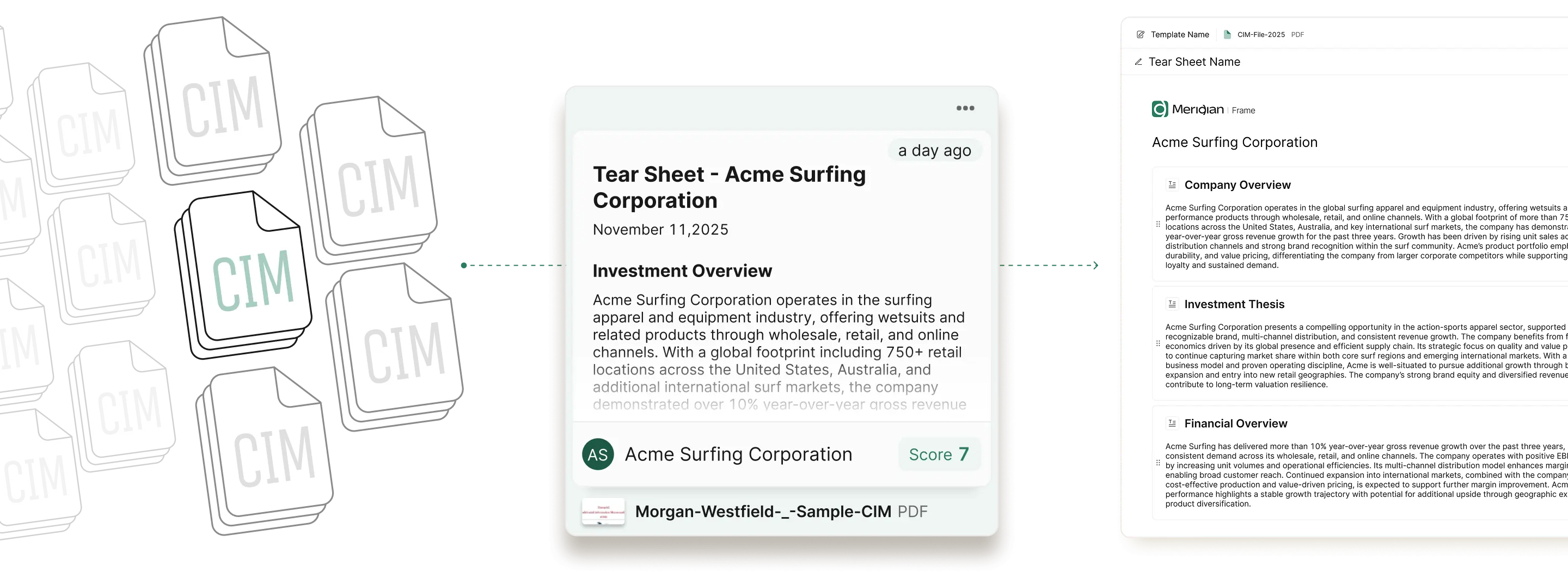
CIMs are messy. The financial summary might be on page 3 or page 47. Adjusted EBITDA add-backs are scattered through footnotes. Working capital normalizations sit in appendices. An analyst formatting a tear sheet from a single CIM typically spends 2 to 4 hours, and that's before any commentary.
This is the most mature AI use case in PE. The strongest tools use a two-stage process: layout analysis to understand the document's structure, then LLM reasoning to pull the right data from variable formats. V7 Labs reports CIM analysis time savings of up to 85% using this approach.
The PE-specific challenge is domain knowledge. Generic tools handle clean financials but miss the things that matter to deal teams. They don't reliably catch the difference between adjusted and reported EBITDA. They miss working capital normalizations. They flatten add-backs into the wrong categories. Tools built for PE workflows handle these conventions; tools built for general document AI usually don't.
Tools doing this work include Meridian and Meridian Frame, which converts CIMs into branded tear sheets and includes deal scoring against the firm's mandate; V7 Go, which uses visual grounding to cite the page and paragraph each data point came from; and Hebbia Matrix, which runs multi-agent document analysis across full data rooms rather than single CIMs.
Maturity: high for standard CIM review, medium for nuanced financial restatement. We'd recommend any deal team automate the first pass and keep humans on the second. For related thinking on extracting intelligence from diligence content, see hidden intelligence in due diligence.
![A network visualization on a dark background showing a central Meridian logo surrounded by orbiting company badges with relationship scores (numbers like 11, 13, 23). A central panel displays company information for a business with website starlight.com, LinkedIn profile, New York HQ, founded 1987, $45M funding, and 93 employees with 12% growth. To the right, "Live AI Insights" cards show a recent $420 funding round, key competitor Vertex, and meeting context noting "Michael Anderson has shared... indicating their readiness to mo[ve]." An Outlook synced indicator appears at the bottom.](https://cdn.prod.website-files.com/66a0cf2aaf4de533f920bad6/69fa7d8543501408b8353af5_Relationship%20intelligence%20and%20scoring%20(1).webp)
A firm's relationship capital sits in individual inboxes, mental rolodexes, and sporadic CRM entries. When a partner leaves, large parts of that capital walk out the door. When a target surfaces, no one is sure who at the firm has the strongest connection or the most recent context.
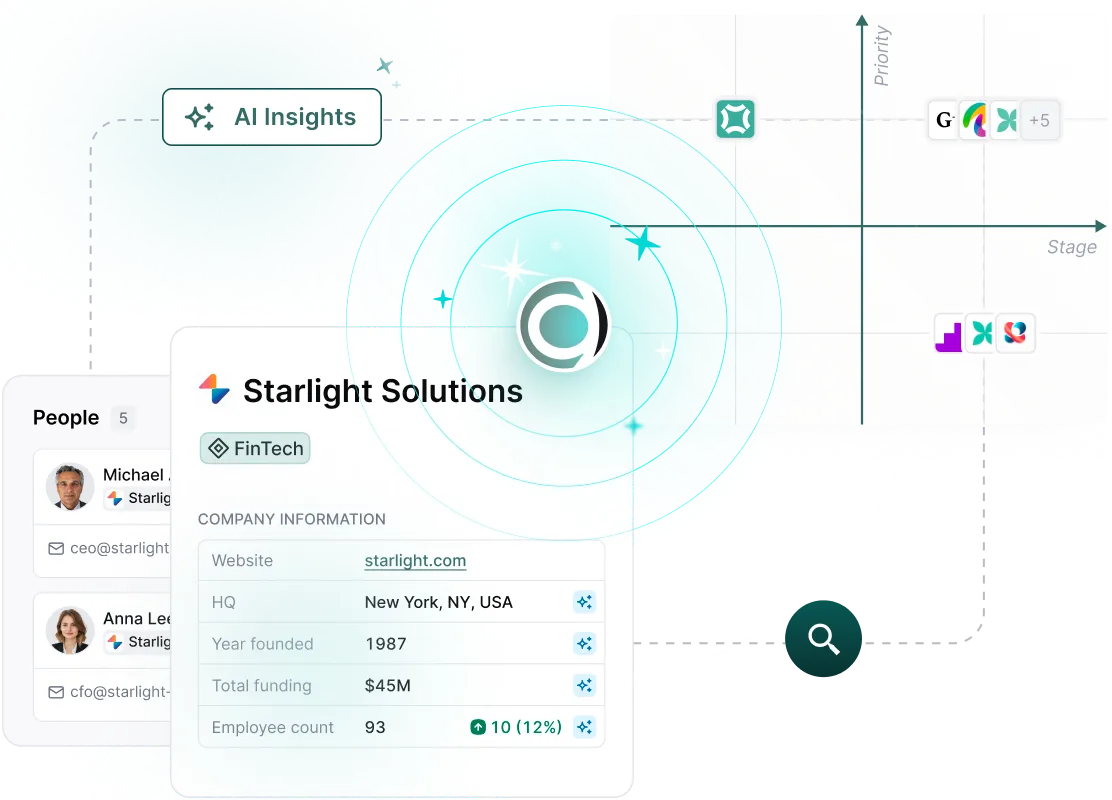
AI handles the connective tissue. The system reads emails, calendar invites, and meeting transcripts and builds a continuous relationship graph. When a new opportunity appears, it can map who at the firm has the deepest relationship, what was discussed, and when. The CRM stops being a system that depends on people remembering to log things.
Affinity has built its category here, with deep relationship automation features designed for VC firms that prioritize network-driven sourcing. 4Degrees takes a similar approach with relationship strength scoring and real-time alerts on connection activity. DealCloud's Intapp Assist sits inside Intapp's broader DealCloud product and supports firms already using the Intapp stack. Meridian takes a different approach: relationship intelligence is one layer of a broader platform that ties relationship data to deal flow, portfolio activity, and market intelligence in a single system.
The honest trade-off: If a firm's primary need is depth in relationship intelligence and they don't need an integrated deal pipeline, portfolio monitoring layer, or AI integration, a specialist tool may serve them better than a unified platform. If they want a single system of record across deals, relationships, and portfolio activity, a platform approach has different advantages. There's no universal right answer.
Maturity: high. This is one of the longer-running applications of AI in PE software, and the tools are mature. For a deeper look at why purpose-built CRMs differ from generic ones, see PE CRMs vs. standard CRMs.
Meridian is your team’s ultimate context provider, driving better deals while minimizing manual data entry.
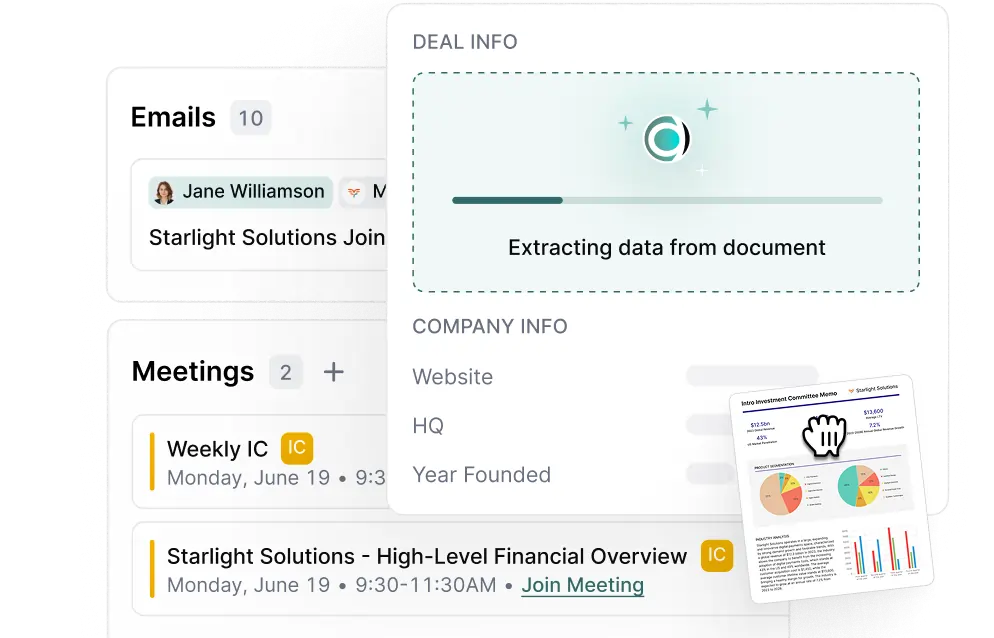
IC memo production is one of the most expensive workflows in PE. A typical memo takes 1 to 2 weeks of analyst time: gathering data, formatting in the document, reconciling conflicting numbers from different sources, and iterating through review rounds with the partner driving the deal. Multiply that by the number of memos per year and the cost is significant.
AI doesn't replace the investment thesis. It handles synthesis and formatting. The model aggregates CIM data, meeting transcripts, market research, and prior deal comparables into a structured memo draft. The analyst and partner spend their time editing, sharpening the thesis, and adding judgment rather than starting from a blank PowerPoint.
Brownloop's Kairos AI reported a private equity client reduced IC memo production time by more than 70% after deploying its IC memo automation, allowing the firm to handle a larger volume of opportunities without adding headcount. Other tools playing here include Jamie AI, which captures meeting content and produces structured summaries; Hebbia, which drafts financial models and memo sections from unstructured text; and Meridian, which generates initial deal packages and tear sheets that feed into the broader memo.
The boundary that matters: AI handles structure, formatting, and first-draft synthesis. Humans own the thesis, the critical analysis of what could go wrong, and the recommendation to invest or pass. Firms that try to push AI past that boundary get good-looking memos with weak underlying logic. For more on how the best firms structure their IC processes, see how the best firms run investment committee.
Maturity: high for first-draft generation, medium for analytical synthesis.
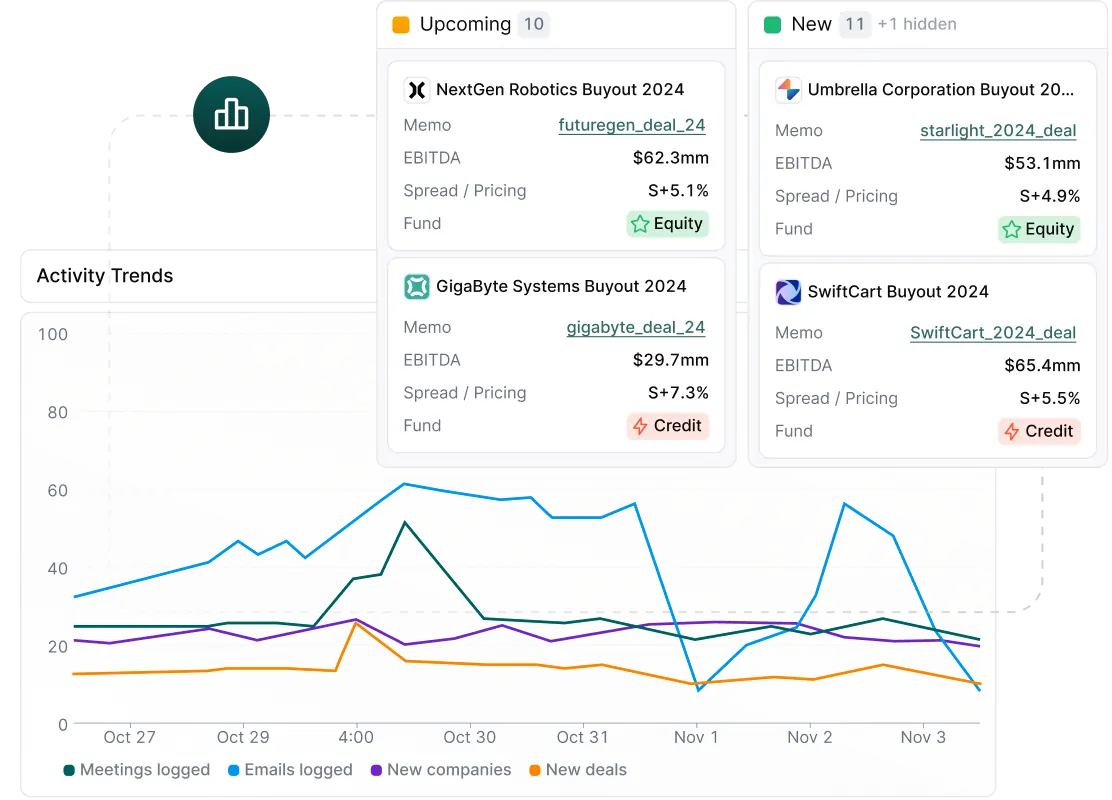
A typical PE fund has 10 to 30 portfolio companies, each with its own reporting format, accounting system, and reporting cadence. Pulling quarterly numbers into a consolidated view is a slog. The data often arrives two weeks after it would have been useful, which limits how proactively a fund can manage portfolio company performance.
AI changes the data normalization layer. Portfolio company reports come in any format: PDFs, Excel exports, accounting system pulls. The system parses them, normalizes the financials against a consistent schema, and flags trend exceptions or early warning signals. Operations teams move from compiling reports to acting on them.
EY documented a North American mid-cap fund that cut its reporting time from four person-days to under one hour using AI dashboards. Allvue Systems offers portfolio monitoring with its Andi AI agent built for fund-level oversight. Larger firms have built internal capability: Blackstone has more than 50 data scientists deployed across its portfolio; Vista Equity has set GenAI adoption goals across its portfolio companies. Meridian handles portfolio tracking inside the same platform as deal management, which keeps the data model unified across the lifecycle and makes it easier to compare new deals against historical portfolio performance.
Maturity: medium-high. The technology works for standard financial reporting. It struggles when portfolio companies deliver inconsistent or low-quality data, which is more common than vendors will admit and is often the rate-limiting step in any rollout.
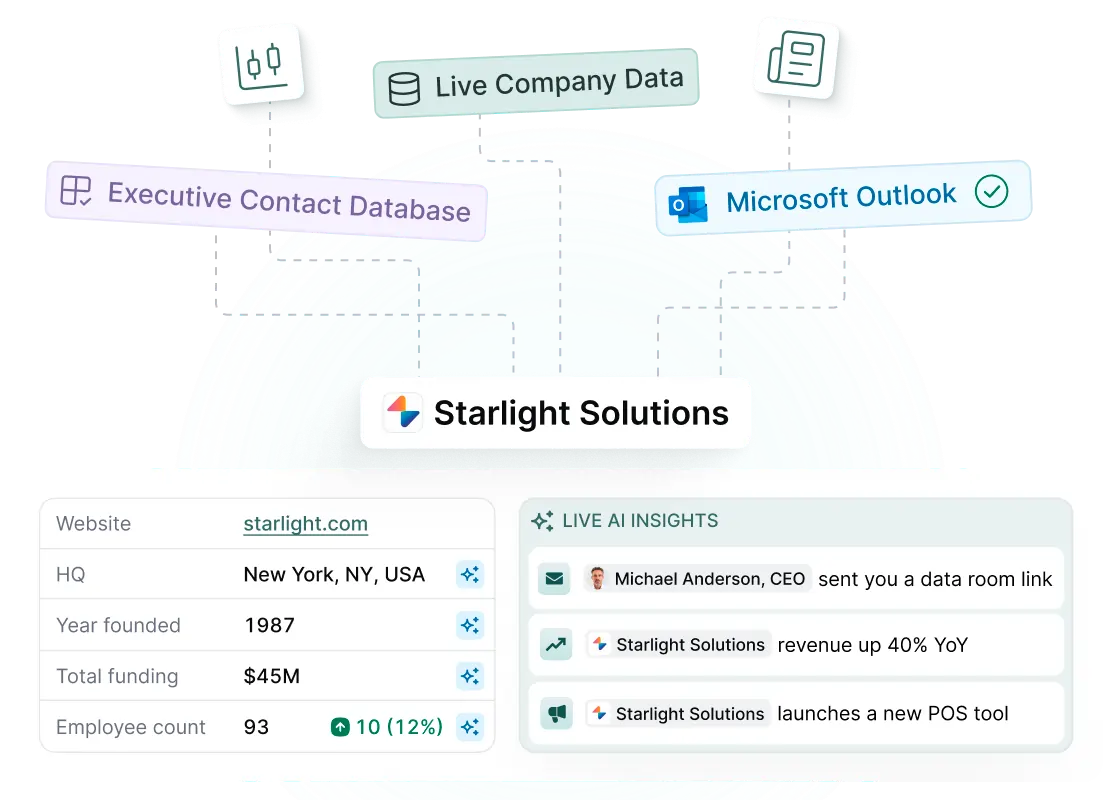
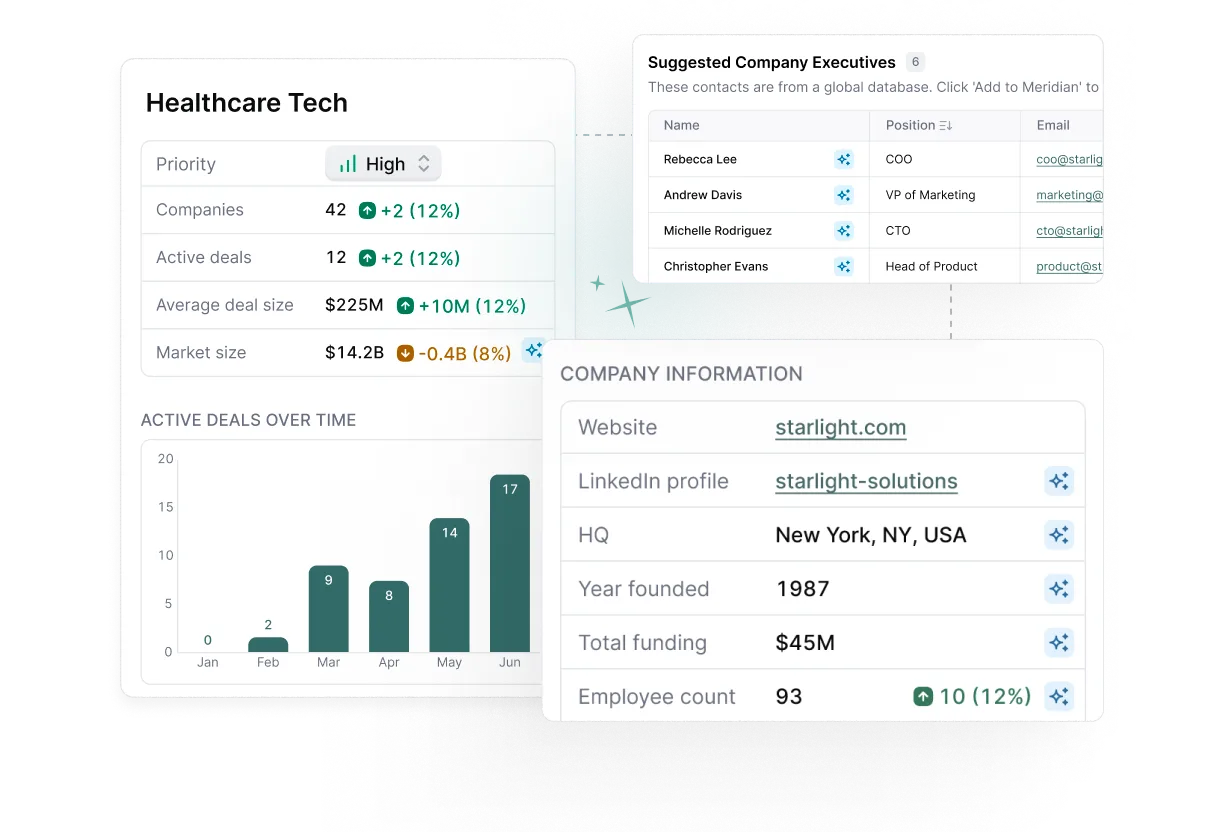
PE firms typically pay for several data subscriptions: PitchBook for company data, SourceScrub for sourcing signals, Preqin for fund research. Each one solves part of the problem and creates new gaps. Cross-referencing them and updating CRM records is hours of analyst time per week, and the data goes stale within weeks of the last update.
AI changes the enrichment pattern. Platforms with waterfall enrichment can layer data sources sequentially: the firm's existing third-party subscriptions, proprietary datasets, and private data from emails, CIMs, and meeting notes. Each layer fills gaps left by the previous one. Records update continuously rather than during quarterly cleanups.
Affinity offers extensive third-party data integrations and is widely used by firms that want a single tool for relationship data and enrichment. Grata maintains its own proprietary database of private companies, which is particularly useful for sourcing in fragmented sectors. Meridian takes a different approach: bundled data covering more than 26 million companies is included in the platform and merged with the firm's proprietary inputs through waterfall enrichment, producing what we call living profiles that update continuously. PitchBook and SourceScrub remain the most-used standalone data providers, and the trade-off with bundled approaches is depth in any single source versus integrated breadth across multiple sources.
Maturity: high. This is one of the workflows where the vendor differences matter most, because the underlying data model and refresh cadence shape every other workflow that depends on enriched records. For more on what differentiates enrichment for PE workflows specifically, see our data enrichment product page.
Most CRM vendors added a chat interface powered by a generic LLM in the past two years and called it AI. That's bolt-on AI. The model sits next to the data and answers questions when prompted, but it doesn't read, enrich, or act on the data on its own. The chatbot is the AI; the database underneath is the same one the vendor built five (or 25) years ago.
AI-native architecture is different. The AI layer is embedded in the data model itself. It reads new inputs continuously: emails, CIMs, press releases, meeting transcripts. It enriches records without being asked. It scores deals against the firm's mandate and surfaces them. It triggers workflows when conditions are met. The chat interface is one expression of the AI, not the whole product.
The difference matters because of how the systems behave over time. Bolt-on AI is roughly as good on day 365 as it was on day 1, because the database underneath stays the same. AI-native systems compound: every email captured, every meeting attended, every CIM processed makes the next interaction smarter, because the firm's institutional memory grows with the data. PwC's analysis of how PE survives AI and V7 Labs' write-up on machine learning in PE both walk through this distinction in more depth.
How to tell them apart in a vendor evaluation: Ask whether their AI updates a company profile without a user prompting it. Ask whether it can extract structured data from a CIM directly into the deal pipeline automatically. Ask whether it learns from your historical deal patterns, your closed deals, and your passes. If the answer to any of those is no, the AI is decorative.
Meridian's Scout AI is built into the data model. It powers market mapping, enrichment, CIM extraction, deal scoring, and meeting prep across the platform. It's pre-trained on PE workflows and adapts to each firm's proprietary data over time. The trade-off worth flagging: we're a newer entrant than some of the legacy CRM vendors, with a smaller installed base. Firms that prioritize a long operating history with a category leader will weigh that differently than firms prioritizing AI architecture. For more on where we think this category is heading, see our piece on the future of private equity CRMs and our AI for PE deal teams product page.
The other piece is open architecture. AI capability is moving fast, and locking yourself to one vendor's model is a bet that they'll keep up. Meridian supports MCP, APIs, and webhooks so deal data can connect to whatever foundation model performs best for a given task. The system of record stays stable while the AI landscape changes around it.
A practical set of questions worth asking every vendor:
Integration depth. Does the AI read and write to the CRM natively, or does it require copy-pasting data between systems? An AI that needs manual context every session adds friction even when the outputs are good.
Data portability. Can you export your enriched data, deal history, and relationship graph if you decide to switch platforms? Open APIs and MCP support are signals the vendor is confident in product stickiness without lock-in.
Implementation timeline. Modern AI-native platforms target 6-12 weeks. Older platforms quote 12+ weeks of customization, sometimes longer. Ask for real customer implementation timelines, not marketing claims, and ask to talk to the customer when a vendor cites a number.
Security posture. SOC 2 Type II, encryption at rest and in transit, role-based access control, and isolated AI processing environments are baseline expectations. If a vendor can't speak to any of these in detail, walk.
Vendor stability and category dynamics. Carta's March 2026 acquisition of ListAlpha signals that AI-native CRM for private markets is a category large platforms now want exposure to. The open question for buyers: will an acquisition-assembled stack integrate as smoothly as platforms built natively? The same question applies to any vendor that has bolted on AI through M&A rather than built it in.
A few specific shifts to watch over the next 18 months.
Multi-step orchestration. Today's tools handle one workflow at a time. The next wave chains them. An agent screens a CIM, enriches the company profile, maps the competitive landscape, drafts an initial memo, and schedules an intro call through the firm's relationship graph, all without a human prompting each step. Bank of America projects agentic AI spending will reach $155 billion by 2030, roughly three times the consensus forecast. Andre Retterath of Data Driven VC has flagged 2025 as the transition year from copilots to agents, and 2026 as the first year of multi-step orchestration in production at investment firms.
Open protocols and model portability. Model Context Protocol and similar standards let firms connect their CRM data to whatever foundation model performs best at any moment. The CRM becomes a stable data layer; the model becomes a swappable utility. This shifts buying criteria from "which AI is best today" to "which platform won't trap me when the AI landscape shifts again," which is a different question with different winners.
Audit trails as a compliance differentiator. As AI touches more deal decisions, regulators and LPs will start asking which data informed which recommendation, and which model produced which output. Platforms that log AI reasoning and source attribution will have an edge with institutional LPs who care about explainability and process documentation.
Making the right technology choice
The AI tools that matter for PE deal teams in 2026 are not the ones with the most impressive demos. They're the ones that fit the way your team actually works, from sourcing through IC through portfolio reporting, without forcing you to change your process to accommodate the software.
Architecture determines whether AI compounds your firm's intelligence over time or stays a novelty. Bolt-on AI gets stale. AI-native systems get sharper. The tools you buy now will shape how your firm operates for the next decade.
See How Meridian's AI Powers Leading PE Firms. Book a Demo.
Discover how Meridian can streamline deal sourcing and enhance your decision-making

Meridian’s Scout AI agent surfaces and benchmarks new opportunities so you can find winning deals before the competition.
How are private equity firms using AI in 2026?
86% of corporate and PE leaders have integrated generative AI into their M&A workflows (Deloitte 2025). The most common applications are deal sourcing, CIM extraction, deal screening, IC memo prep, relationship intelligence, and portfolio monitoring. Adoption has shifted from AI-assisted analysis to agentic workflows that run continuously with human approval.
What is the best AI tool for PE deal screening?
Tools that handle PE deal screening include SESAMm, WorkWise Solutions, and Meridian's Scout AI. The right choice depends on the firm's mandate, deal volume, and how much customization the screening criteria require. Tools designed specifically for PE workflows tend to outperform horizontal AI products on the unstructured aspects of CIMs and tear sheets.
Can AI extract data from CIMs automatically?
Yes. Tools like Meridian Frame, V7 Go, and Hebbia handle CIM extraction with up to 85% time reductions on standard reviews. The challenge is variable CIM structures: financial summaries can sit on different pages, add-backs are scattered through footnotes, and PE-specific conventions like adjusted EBITDA require domain-aware models to handle correctly.
What is the difference between AI-native and bolt-on AI in a CRM?
AI-native systems embed AI inside the data model: the AI continuously reads, enriches, and acts on records without being prompted. Bolt-on AI runs an LLM on top of whatever was manually entered, so the system is only as smart as the data already in it. AI-native systems get sharper over time as data accumulates; bolt-on AI does not.
How much time does AI save PE deal teams?
Reported time savings are concentrated in document-heavy workflows. Brownloop reports a 70%+ reduction in IC memo production time; CIM extraction tools report up to 85% reductions on standard reviews; EY documented a fund that cut portfolio reporting from four person-days to under one hour. Savings on workflows that require more judgment, like investment thesis development, are smaller and harder to quantify.
What is agentic AI for private markets?
Agentic AI refers to AI systems that perform multi-step workflows without continuous human prompting. In private markets, this looks like agents that screen deals, enrich profiles, build sector maps, and surface opportunities continuously rather than on demand. Bank of America projects agentic AI spending will reach $155 billion by 2030, with deal-team workflows among the use cases driving software spend.
How do PE firms automate IC memo preparation?
Firms automate IC memo prep using tools like Brownloop's Kairos, Hebbia, and Meridian Frame. These tools aggregate deal data, market research, and meeting content into structured memo drafts. Investment thesis development and critical analysis remain human work; the AI handles synthesis and formatting so analysts and partners spend their time on judgment rather than slide layout.

Table of Contents

AI adoption has outpaced results in private markets. The four workflows that change deal-team output, and why the data layer matters more than the model.

.webp)