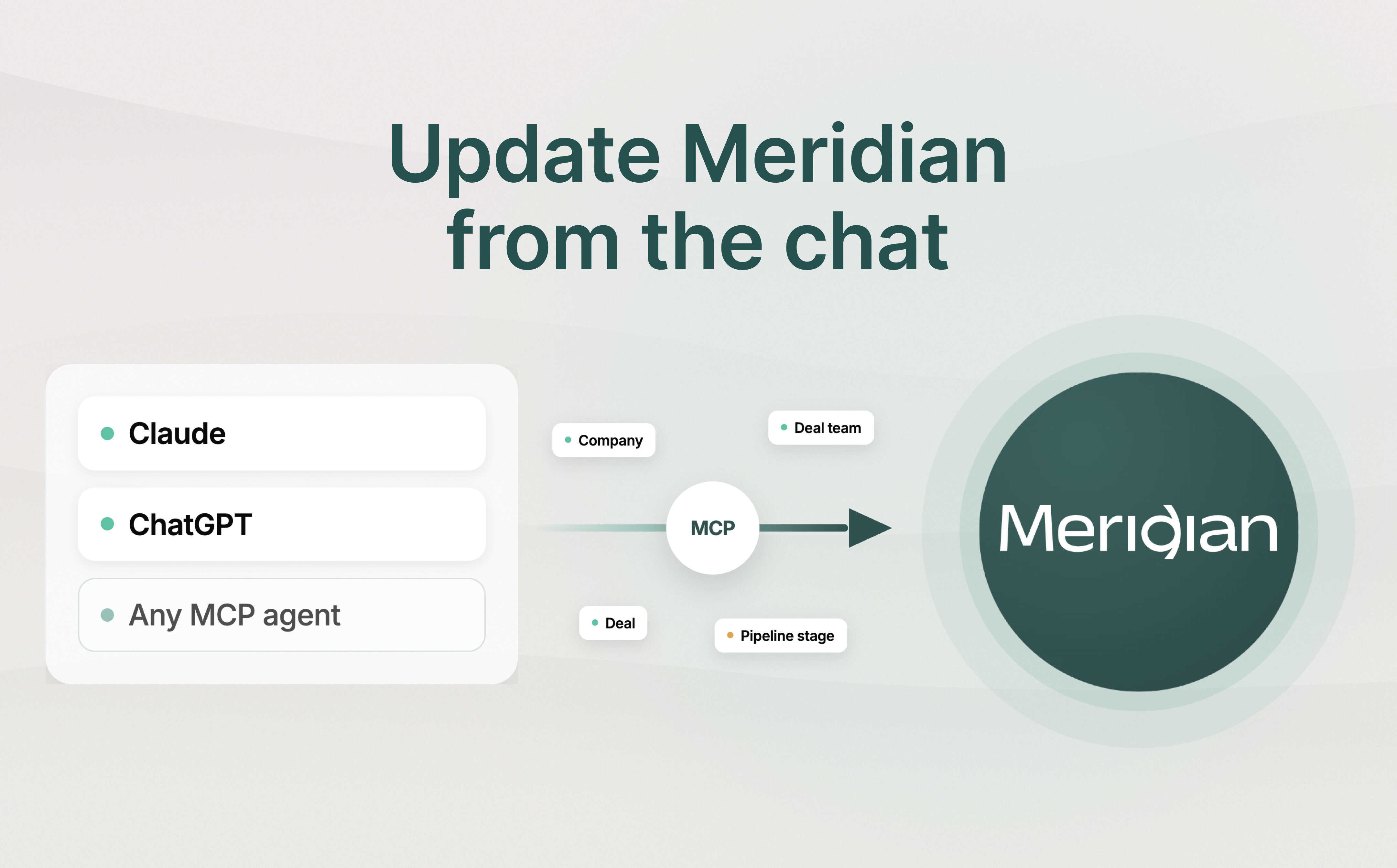

Meridian MCP is live!
Connect your deal sourcing data to any AI tool.
Learn More
Meridian raises $7M seed round led by 645 Ventures.
Read More
Discover the top five challenges private equity firms will face in 2025. Learn how AI-powered tools like Meridian AI can help firms overcome these obstacles.

2025 will be the year that separates the future-ready PE firms from those stuck in the past.
I’m sure of this because I talk to hundreds of PE firms every month, and I’m seeing patterns that are impossible to ignore.
Let's look at what really happened in 2024:
First, AI exposed the technology gap in PE. While everyone talked about AI, most firms just bolted chatbots onto their ancient systems and called it innovation. That's like putting a Ferrari engine in a golf cart - it just doesn't work.
Second, thematic investing became the industry's favorite buzzword. Every firm we talked to claimed they were thematic, but when we dug deeper, most couldn't explain what that actually meant beyond "our fintech guys are really good." Meanwhile, the firms with real thematic expertise and infrastructure outperformed everyone else.
Finally, private credit exploded, exposing how badly most firms' infrastructure fails to scale. We watched PE firms rapidly expand their teams only to discover their systems couldn't keep up. It's hard to look sophisticated when your deal teams run their pipelines out of Excel.
If you think 2024 was transformative, 2025 is going to be revolutionary. Here's what's coming:
The data science arms race is about to get serious. Blackstone isn't just hiring data scientists for fun - they're building the future of private equity. The gap between data-driven firms and everyone else is turning into a chasm. Mid-market firms face a critical choice: build expensive internal capabilities or partner with platforms that can help them catch up.
Proprietary deal flow is making a comeback, but not like you remember it. The days of relationship-based sourcing are evolving into systematic, data-driven approaches. If you have the right tools, it's never been easier to identify, track, and build relationships with potential targets before your competitors come sniffing.
Alternative data signals are becoming table stakes. Waiting for companies to tell you how they're doing? That's so 2023. Leading firms are already using alternative data signals - from app download trends to LinkedIn job postings - to spot opportunities before their competitors even know they exist.
Leading companies aren’t trying to improve incrementally. They’re completely reimagining how they operate.
The pioneers are building data science capabilities that would make tech companies jealous. They're combining their private data with public information to drive better sourcing and investment decisions. And here's the kicker: firms that don't have a handle on their proprietary data are already falling behind. You can't join the AI revolution if you can't trust your own data.
The technological revolution in private equity isn't just about automation - it's about fundamental transformation in how deals are sourced, evaluated, and executed:
The five big challenges threatening PE firms this year are: the data infrastructure gap, AI implementation failure, thematic expertise deficit, deal sourcing evolution, and scaling operations. Let’s dig into each one:
Your data should be your biggest asset. Instead, it's probably scattered across emails, shared drives, and that CRM nobody uses. Modern PE requires a single source of truth, not a collection of disconnected systems that don't talk to each other.
Symptoms
Fragmented data spread across legacy CRMs, spreadsheets, inboxes, and third-party tools, with no single source of truth for deals, relationships, or activity.
Impact
Slower decision making, duplicated work, missed signals, and deal sourcing teams spending more time reconciling data than sourcing deals.
What good looks like
A unified system of record where deal data, relationship history, activity, and external signals are structured, searchable, and continuously updated in one place.
First steps
1. Audit where critical deal, contact, and activity data actually lives today, not where it is supposed to live.
2. Eliminate manual data entry by using a CRM that automatically syncs emails, meetings, and notes.
3. Consolidate your tools with a CRM built for private equity so deal activity, enrichment, and reporting are one seamless workflow.
We see firms waste millions on point solutions that create more problems than they solve. Real AI transformation needs to be built into your foundation, not added as an afterthought.
Symptoms
AI tools are layered on top of broken data and workflows, producing shallow summaries, generic outputs, or dashboards that teams do not trust or use.
Impact
Firms burn time and budget on AI pilots that never reach production, while teams grow skeptical of AI and revert to manual processes and judgment calls unsupported by data.
What good looks like
AI that is embedded directly into core workflows and grounded in a firm’s proprietary data, producing outputs that are contextual, explainable, and immediately actionable for deal teams.
First steps
1. Fix the underlying data and workflow foundation before deploying AI tools.
2. Focus AI use cases on specific, high-value workflows rather than broad “AI everywhere” initiatives.
3. Deploy AI inside the system of record so it operates on live deal data, activity history, and firm-specific context, not static exports or disconnected datasets.
Everyone claims to be thematic, but few firms have built the infrastructure to back it up. You need systematic ways to:
Symptoms
Deal teams rely on broad sector coverage, and have limited institutional knowledge of specific sub-sectors, business models, or long-term trends.
Impact
Firms struggle to build conviction early, miss proprietary opportunities, and lose differentiation in competitive processes where depth of insight increasingly matters.
What good looks like
Institutionalized thematic expertise where firms proactively map markets, track companies over time, and build repeatable insight around specific theses rather than one-off deals.
First steps
1. Define a small number of priority themes tied to long-term structural trends, not short-term deal flow.
2. Use a CRM built for private equity to build and maintain living market maps that capture companies, sub-sectors, prior interactions, and internal perspectives over time.
3. Centralize thematic knowledge so insights, notes, and decisions compound across deals and team members instead of resetting with each new process.
The traditional sourcing playbook is dead. Top firms are building systematic approaches that combine relationship intelligence with alternative data signals. You're already behind if you're not using data to drive your sourcing strategy.
Symptoms
Sourcing remains largely reactive and banker-led, with firms relying on static lists and ad-hoc tracking rather than structured, proactive coverage.
Impact
Firms enter processes late, compete in crowded auctions, and struggle to generate proprietary opportunities or build differentiated deal pipelines.
What good looks like
A thematic sourcing engine where firms map markets in advance, track targets long before a process starts, and maintain continuous visibility into coverage, relationships, and sourcing signals.
First steps
1. Shift to a CRM that allows thematic sourcing so you can organize targets around sectors, sub-sectors, and investment theses.
2. Track companies long before they become active deals, including prior touchpoints, notes, and internal ownership.
3. Use structured sourcing workflows to maintain real-time visibility into which companies are covered, who owns the relationship, and where gaps exist.
Growth should be exciting, not painful. Yet we're watching firms struggle as they expand because their infrastructure wasn't built to scale. Every new hire shouldn't mean new operational headaches.
Symptoms
As a firm grows headcount, AUM, and strategy complexity, core workflows rely on manual processes, spreadsheets, and institutional knowledge that does not scale with the team.
Impact
Operational drag increases; senior professionals spend time on coordination and data cleanup; and execution quality becomes inconsistent across deals, funds, and teams.
What good looks like
Operational infrastructure that scales with the firm, where sourcing, diligence, IC prep, reporting, and portfolio workflows are standardized, repeatable, and supported by a single system of record.
First steps
1. Identify workflows that consistently break as volume and complexity increase, such as IC prep, reporting, or cross-team visibility.
2. Replace ad-hoc processes with structured workflows that capture decisions, context, and activity in real time.
3. Invest early in PE-specific systems that support multi-fund, multi-strategy operations without introducing additional manual overhead.
The path forward is clear, but it requires decisive action:
We built Meridian because we know what it’s like to work in PE without the right tools. We spent hours backlogging information into the CRMs just to cover our backs, and we experienced the pain of running modern deal processes on legacy systems.
Our platform isn't just another CRM - it's purpose-built for the future of private equity:
The gap between leaders and laggards is widening daily. In 2025, the firms that will thrive will be those that act now to modernize their infrastructure.
Don't wait for the future to arrive - shape it. Book a demo to see how Meridian can transform your firm's capabilities and position you for success in 2025 and beyond.
Private equity firms face five core challenges in 2025: fragmented data infrastructure, failed AI implementations, lack of real thematic expertise, outdated sourcing models, and operations that do not scale with growth.
The data infrastructure gap in PE refers to firm data being scattered across emails, shared drives, spreadsheets, and underused CRMs, instead of being housed in a CRM that is a single source of truth.
AI implementation failure occurs when PE firms bolt point solutions or chatbots onto broken systems, creating surface-level automation without fixing the underlying data and workflow foundation.
Thematic investing is organizing investing around specific sectors or theses. Real thematic infrastructure includes systematic ways to build and maintain knowledge bases, track and validate investment theories, share insights across teams, and turn expertise into actionable intelligence.
Alternative data signals, such as app usage trends or job postings, are used to identify and track opportunities earlier than traditional company-reported information allows.
Deal teams are slowed by manual processes, Excel-based pipelines, disconnected systems, and infrastructure that breaks as teams, strategies, and deal volume expand.
Mid-market firms must choose between building expensive internal data science capabilities or partnering with platforms that provide the data and infrastructure needed to compete.
Discover how Meridian can streamline deal sourcing and enhance your decision-making


Table of Contents

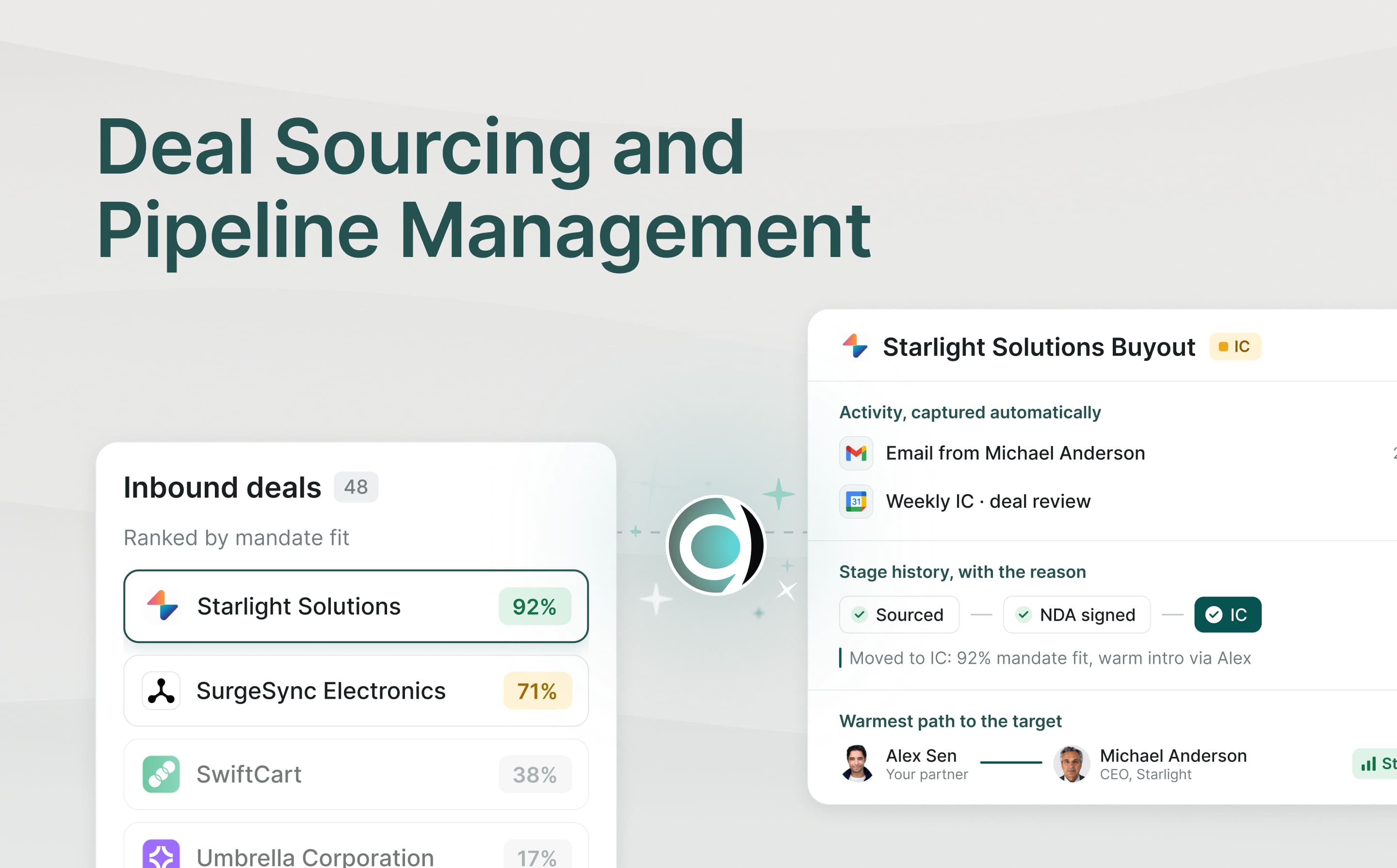
Why deal sourcing and pipeline management belong in one system, how proactive thematic sourcing wins proprietary deals, and how to stop pipeline leakage.