By using this website, you agree to the storing of cookies on your device to enhance site navigation, analyze site usage, and assist in our marketing efforts. View our Privacy Policy for more information.
Accept All
Deny
November 25, 2026
10
min read
Updated
A Practical Workflow for Measuring Conversion and Velocity in Deal Sourcing and Pipeline Management
A case for criteria before tooling: How to measure deal flow from first source to qualified opportunity, and quickly diagnose bottlenecks.
A Practical Workflow for Measuring Conversion and Velocity in Deal Sourcing and Pipeline Management
TL;DR
A deal pipeline is really only measurable when sourcing, qualification, relationships, and reporting live in one system of record.
Conversion is the share of opportunities that pass from one pipeline stage to the next, and velocity is the time an opportunity spends in each stage.
The measurable workflow has four steps: set sourcing criteria and build a target universe; capture and qualify every opportunity in a shared pipeline; keep relationship context attached to each deal; and measure conversion and velocity by stage.
Median conversion in private equity pipelines has fallen to roughly a quarter of logged deals, so reading the funnel stage by stage matters more than chasing raw deal volume.
The numbers only hold if the pipeline is used consistently, which means every opportunity needs an owner, a source, a stage, and a next action.
Investment firms measure deal pipeline conversion and velocity with two numbers: Conversion is the share of opportunities that advance from one stage to the next, and velocity is how long an opportunity spends in a stage before it moves. Most deal teams can recite last quarter's closings from memory, but far fewer can say what share of sourced companies reached qualification, which channel produced them, or where deals sat longest before moving. When sourcing notes live in one partner's inbox, and the pipeline lives in a spreadsheet updated the night before the Monday meeting, those questions aren’t quick to answer.
The market makes that blind spot expensive. McKinsey's Global Private Markets Report 2026 found that buyout and growth deals above $500 million rose 44% to more than $1 trillion in 2025, the highest year on record for deals of that size, while the median purchase multiple climbed from 11.3 times EBITDA in 2024 to 11.8 times. More competition and higher entry prices reward firms that can see their own funnel clearly and act on what it reveals.
However, a deal pipeline is only measurable once these four things are in one system of record: the criteria that define the target universe, the stages every opportunity moves through, the relationships behind each deal, and the numbers that track movement. This guide walks through that workflow and the two measures that prove it is working — conversion and velocity — from first source to qualified opportunity. (Which tools support the workflow is a separate question, which we cover in our guide to the best deal sourcing software for investment teams.)
Sourcing criteria and the target universe
A firm builds its target universe by turning its investment thesis into explicit criteria, then matching each criterion to the channels most likely to surface it. This is the line between opportunistic sourcing and data-driven deal sourcing. When the criteria live as structured fields rather than in a pitch deck, every company that enters the funnel is scored against the same bar, and the team can see which channels produce targets that actually fit.
Start by writing the thesis down as fields in your CRM. Enterprise value and EBITDA bands, ownership type, sector, geography, and a short list of required versus preferred attributes give the team a shared screen that any associate can apply the same way. The point is repeatability. A target universe anyone can audit beats a mandate that lives in two partners' heads.
Then map each criterion to a channel. Thesis-led outreach, intermediary flow, portfolio and advisor referrals, and conference coverage each surface different kinds of companies, so the right channel depends on what the criteria call for. Record the source on every opportunity, because that field is what later tells you where proprietary targets are actually coming from.
Separate the criteria that are non-negotiable from the ones that are merely preferred. A control-oriented buyout firm might treat a minimum EBITDA and majority availability as required, while founder-led ownership or a particular sub-sector stays preferred. Scoring the preferred attributes rather than filtering on them keeps good-but-imperfect companies in the funnel instead of discarding them at the door.
Judge the universe by relevance and sourcing visibility, not size. A target list of 2,000 companies is worse than a list of 300 if the team cannot see which channels surfaced the ones that later qualified. A channel scorecard that tracks targets sourced, targets qualified, and deals closed for each channel turns sourcing from a volume exercise into a question of which relationships and tools are worth the spend.
A target universe decays if no one maintains it. Companies change hands, cross size thresholds, and bring on new leadership, so a list built once and left alone is stale within a quarter. Continuous enrichment, where company and contact records update as the underlying facts change, is what keeps the universe worth sourcing from.
Selectivity has always defined this work. In their survey of institutional venture capitalists, Paul Gompers, Will Gornall, Steven Kaplan, and Ilya Strebulaev found the median firm considered about 100 opportunities for every one it funded, and that only around 10% arrived inbound from company management. The survey is several years old now, but the trend holds: Most of the funnel is self-generated, and the top of it has to be built on purpose.
This is where Scout AI fits in Meridian. It maps the market against a firm's mandate, surfaces companies that match the thesis, and records where each target came from, so sourcing channels can be compared on the quality of what they produce rather than the raw count. Thematic mapping is only as useful as the thesis behind it, though, which is why the criteria work comes first and the tooling second.
Opportunity capture and qualification in one pipeline
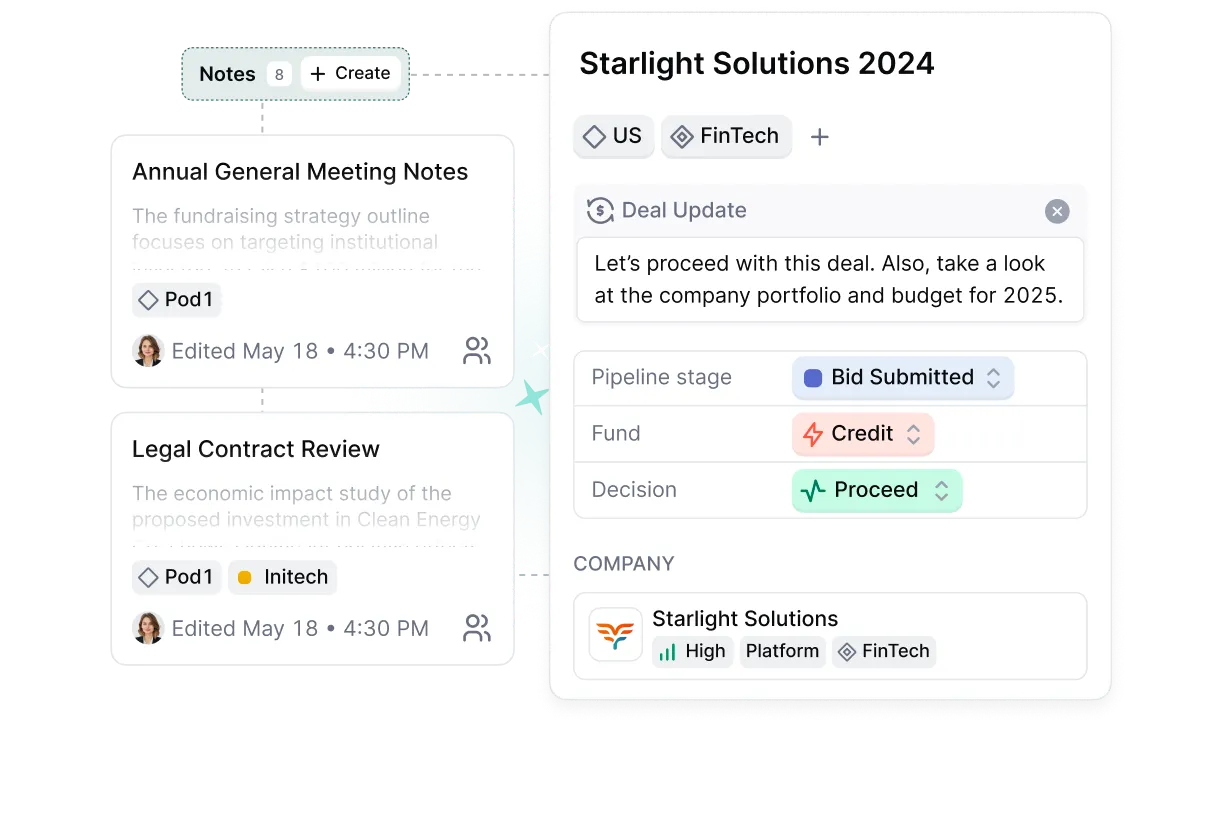
Every inbound and sourced opportunity should enter one shared pipeline with defined stages, required fields, an owner, and a next action, so qualification is consistent and nothing is lost between an inbox and a spreadsheet. One accountable workflow turns a pile of opportunities into a pipeline the whole team can read.
The cost of skipping this step is lost time. In deal management, the drag of updating systems manually means opportunities sit uncategorized, duplicate records pile up, and follow-ups slip past the point where they would have mattered.
Consistent deal management starts with a fixed stage sequence. For example, reviewed → qualified → deep diligence → LOI or term sheet → closed, each stage with a clear entry test so an opportunity only advances when it genuinely qualifies. The stages have to mirror the firm's own screening logic to be useful, so it’s worth getting right when you design pipeline stages for an investment process.
Write an entry test for each stage so advancement means something. Reviewed means the opportunity has been logged and screened against the criteria; qualified means it clears the required bar and has an owner; deep diligence means the firm has committed real analytical time; LOI or term sheet means an offer is on the table. When everyone applies the same tests, a deal in deep diligence on one partner's desk means the same thing as a deal in deep diligence on another's.
These four fields make the pipeline measurable: owner, source, stage-entry date, and next action. Without them, conversion and velocity cannot be computed, because there is no record of who is accountable, where a deal came from, or when it moved. Making those fields required is the single most important discipline in the whole workflow.
Because of this, a generic sales pipeline will not do the job. Sales CRMs assume a short cycle where the customer self-disqualifies by going quiet, but in private markets the firm does the disqualifying, often across a cycle that runs months or years. The stages, fields, and entry tests have to be built around an investment process rather than borrowed from a sales funnel.
Give every opportunity one owner and one record. Duplicate entries (the same company logged by two associates under slightly different names) are what corrupt a pipeline's numbers and erode trust in the data. A shared system that flags duplicates and assigns a single owner keeps the record clean enough that the measurement downstream can be trusted.
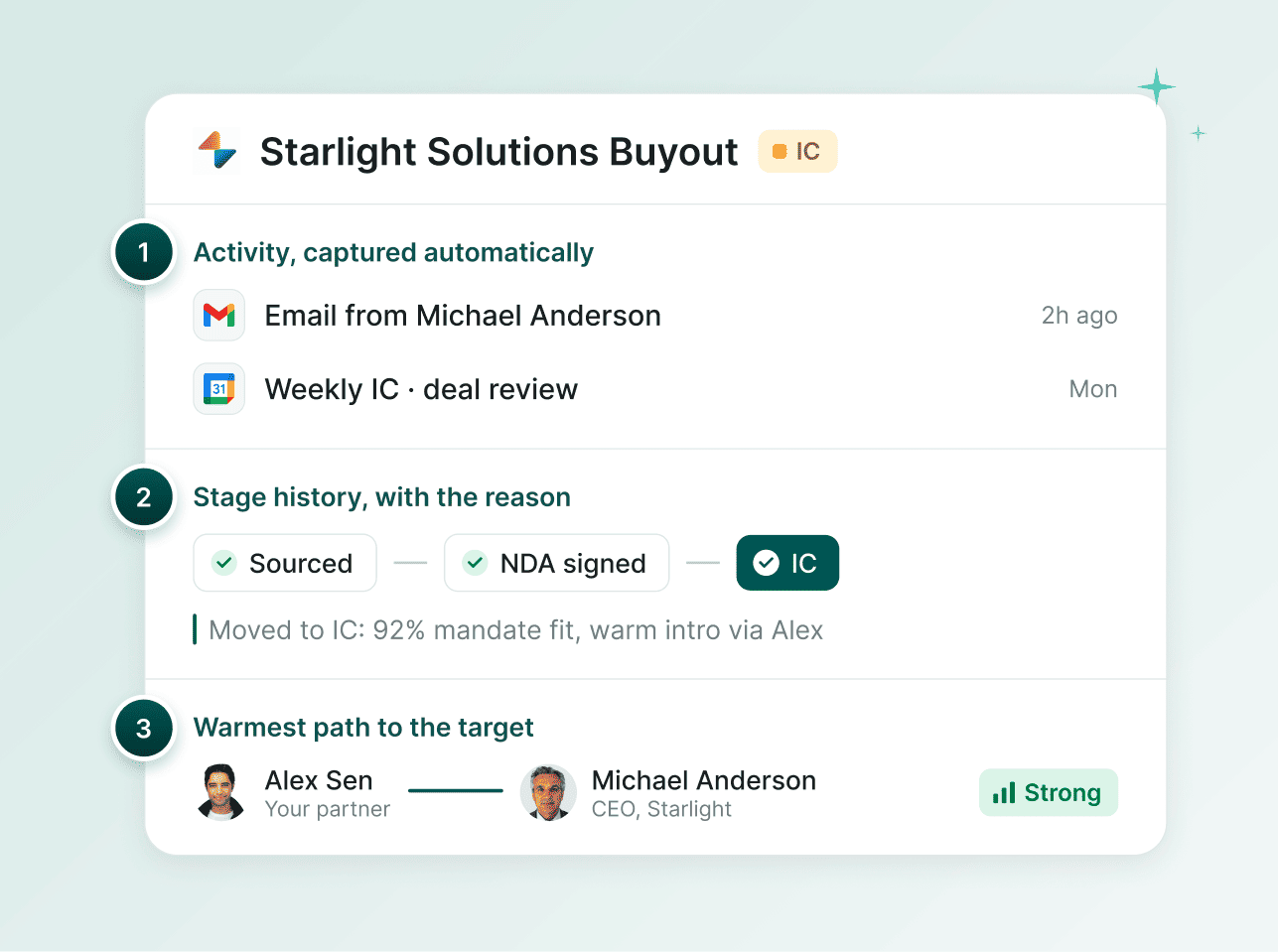
Automated capture is becoming the default way to keep that pipeline current. Meridian auto-tags banker emails, syncs Outlook, and pulls calendar activity into the record, so the pipeline builds itself and the fields that drive measurement stay populated without re-keying. AI and automation cut the manual entry, but a human still owns each opportunity and decides when it advances.
Keep the deals that matter moving with Meridian
Make confident, data-driven decisions to close the right deals and improve investment outcomes.
Each opportunity should carry its relationship record, who introduced it, every logged interaction, the relationship owner, and the next follow-up, attached directly to the deal rather than held in someone's memory. When the context travels with the opportunity, coverage and follow-up responsibility are visible at a glance.
Most deals come through the network, which is why the context matters. The same survey of venture capitalists by Gompers and co-authors found only about 10% of deals arrived inbound, with the rest generated through the firm's own outreach and referrals. If most of the funnel runs on relationships, those relationships belong in the system of record, not in a dozen separate contact lists.
Attached relationship context surfaces the coverage gap, the target a firm should own but has not spoken to in months, or the intermediary two partners are each working without realizing it. Logging introductions, interactions, and the relationship owner also settles origination credit, which keeps the team honest about which channels and which people actually produce deals.
For firms that source through bankers and intermediaries, coverage is its own metric. Track which bankers the firm has active relationships with, when each was last engaged, and which sectors they cover, so the gaps are visible before a process the firm should have seen goes to a competitor. Relationship strength scored from real interactions, rather than guessed, is what makes coverage manageable across a large network.
An AI-powered CRM that captures email and calendar interactions into living profiles shows who already holds a relationship before the team spends effort rebuilding one. Meridian's waterfall data enrichment adds another powerful layer, pulling company and contact data from multiple sources with provenance on each field, so a user can see where a figure came from rather than trusting it blind.
Measuring pipeline conversion and velocity
Conversion is the pass-through rate between each pipeline stage, and velocity is the time an opportunity spends in each stage; read together, they show where deals stall and which criteria and channels produce qualified opportunities. These are the two numbers that tell a team whether the workflow above is working.
Conversion rate: the share of opportunities that advance from one stage to the next, measured per stage and end to end, so a single weak stage is visible instead of hidden inside an overall close rate.
Time-in-stage (velocity): the median number of days an opportunity spends in a stage before it advances, stalls, or is passed, which turns a vague sense that deals are slow into a specific bottleneck you can locate.
Benchmarks have been moving. Sutton Place Strategies' Origination Benchmark, drawn from the deal activity of 176 private equity firms, reported that median pipeline conversion fell to roughly 24% of logged deals, down from a historical range closer to 30% to 40%. The comparison that matters most, though, is a firm's own conversion, by stage and by channel, tracked over time.
Map each stage to its two metrics and the picture becomes clear:
Pipeline stage
Conversion metric
Velocity metric
Reviewed to qualified
% of reviewed opportunities that meet the criteria
Median days from source to qualification
Qualified to diligence
% of qualified deals entering deep diligence
Median days in qualification
Diligence to LOI or term sheet
% advancing to an offer
Median days in diligence
LOI or term sheet to close
% of offers that close
Median days from offer to close
End to end
Closed deals as a share of reviewed opportunities
Total days from first source to close
Read the two columns together, and you have your diagnosis. A high stage conversion paired with slow velocity points to a capacity bottleneck, often too few people to run diligence. Fast velocity paired with low conversion points the other way, to loose qualification upstream that lets in weak deals and burns time before they are passed.
Here is an example to make this more concrete. If a firm reviews 500 opportunities in a year, qualifies 120, takes 30 into deep diligence, submits 12 offers, and closes 5, its end-to-end conversion is 1%, while stage rates of 24% from reviewed to qualified, 25% from qualified to diligence, and 40% from diligence to an offer show where the funnel narrows most sharply. Add velocity on top, say a median of 45 days in diligence against 12 in qualification, and the stage that is both narrow and slow is the one to fix first.
Slice the numbers instead of reading one blended total. Conversion and velocity by sourcing channel show which origination efforts pay off:
By sector or deal size, they show where the firm's screening is sharpest
By quarter, they show whether a process change actually worked
A single blended close rate hides all of that, which is why the measurement has to be sliceable in the first place.
Of course, numbers are only worth collecting if they change what the team does. A monthly pipeline review that opens with stage conversion and time-in-stage, rather than a deal-by-deal status walk, puts attention on the stage that is leaking or stalling. From there, the fixes are clearer: tighten the qualification bar, add diligence capacity, or retire a channel that produces volume but few qualified deals.
Velocity matters on the way out as well as the way in. McKinsey's Global Private Markets Report 2026 put the typical holding period for a general partner's portfolio company at more than six and a half years, and Bain & Company's Global Private Equity Report 2026 found buyout exit value rose 47% to $717 billion in 2025 even as distributions stayed below 15% of net asset value for a fourth straight year. When capital takes longer to come back, the speed of the front of the funnel is one of the few levers a team fully controls.
In Meridian, the full funnel lives in one record, so conversion and time-in-stage are automatically calculated. This surfaces predictive investment insights about which opportunities are most likely to progress. It’s the same live data our reporting and dashboards run on. Meridian Frame takes this to the diligence step, reading CIMs and deal documents, extracting financials, KPIs, and risks, and scoring them into the deal record, so qualification speed becomes measurable too.
These numbers are only as reliable as the discipline behind them, so stages and dates have to be kept current for the measurement to mean anything.
Measuring the whole funnel from source to close
The firms that improve from here can read the whole funnel from first source to qualified opportunity, where most teams can still only report what closed. Conversion and velocity become legible once sourcing criteria, a shared pipeline, relationship context, and reporting sit in one system of record rather than four disconnected tools.
None of this replaces human judgment, and the measurement is only as good as the pipeline discipline underneath it. The payoff is a funnel the team can actually see: which criteria produce qualified deals, which channels are worth the effort, and where opportunities stall long enough to lose them. That visibility is what Meridian is built to give private-markets firms, from the first sourced company to the signed deal.
Discover how Meridian can streamline deal sourcing and enhance your decision-making
How do investment firms measure deal pipeline conversion and velocity?
Conversion is the pass-through rate between pipeline stages, and velocity is the time an opportunity spends in each stage. Firms compute both from one system of record that stamps a source, owner, and stage-entry date on every deal, then review conversion and time-in-stage by stage and by channel rather than as a single overall rate.
What is a good deal pipeline conversion rate?
It varies by strategy and stage, so any benchmark is directional. Sutton Place Strategies' Origination Benchmark put median private equity pipeline conversion near a quarter of logged deals, down from a historical 30% to 40%. The comparison that matters is a firm's own trend over time, broken out by stage and sourcing channel.
What pipeline stages should an investment firm track?
A workable default is reviewed, qualified, deep diligence, LOI or term sheet, and closed, each with an entry test and a stage-entry date. Consistent stages are what make conversion and velocity comparable across deals and channels, because a private markets firm disqualifies from the inside rather than waiting for a counterparty to drop out.
How is deal velocity different from conversion?
Conversion measures how many opportunities advance; velocity measures how long they take. A pipeline can convert well and still move slowly, so reading the two together separates a qualification problem from a capacity bottleneck.
author
Alex Sen
Founder and CEO
Alex Sen is the Founder and CEO of Meridian. With nearly a decade of experience at top firms like Blackstone, Thoma Bravo, and CVC, Alex knows the challenges that hold dealmakers back.