

Meridian MCP is live!
Connect your deal sourcing data to any AI tool.
Learn More
Meridian raises $7M seed round led by 645 Ventures.
Read More
Learn why effective pipeline management is central to PE firm success and how the right CRM can help you track and close deals better.
.webp)
Pipeline management in private equity differs significantly from traditional sales cycles. Because of this, PE firms need specialized software to help them move opportunities through their pipeline efficiently and focus their energy on the deals that matter.
Generic CRMs assume a typical sales pipeline with short-cycle deals, individual account executives, and linear movement from first call to signed contract.
Private equity doesn’t work that way. Investment pipelines span months or years, move through formal IC gates, gather diligence documents, and depend on long-term relationship context with founders and bankers.
A deal can pause, restart, reprice, or reappear under a different structure. Treating that process like a standard sales funnel sets you up for failure right out of the gate.
This guide explains the nuances that set PE pipelines apart from sales pipelines, underlines why you need a specialized CRM, and reveals which features it should come with. It also introduces two key pipeline metrics every firm should be tracking.
Sales and private equity pipelines differ significantly, and understanding this difference is central to effective pipeline management.
In a sales process, you’re only able to lose deals. As opportunities move through the pipeline, customers decide whether or not they want to purchase a product or sign up for a service.
But in a private equity pipeline, the firm does the disqualifying, not the customer. Deal teams have to keep track of factors that point towards the potential success of an opportunity and are responsible for proactively culling deals to avoid overwhelm in late pipeline stages.
That means doing diligence on a company once they enter the pipeline, comparing benchmarks to prior deals to gauge the attractiveness of the opportunity, and compiling all this intel for IC.
What’s more, PE pipelines have significantly longer timelines than traditional sales cycles. A B2B SaaS sales process, for example, probably wouldn’t exceed a few months, but private equity deal cycles can easily stretch over years.
A pipeline with unambiguous stages, standardized definitions, and reliable metrics can help you wean out deals that won’t bring value and home in on opportunities that are more likely to close.
This is important because if there’s one tip I could give for PE pipeline management, it would be to kill deals early.
The investors with the best results are the ones with the steepest pipeline. If you have as many live opportunities in final IC as you do at the desktop research stage, your people aren’t spending their time as effectively as they could.
Killing deals early requires deal teams to balance attractiveness and actionability and focus on the opportunities with the highest likelihood of closing. This means not getting distracted by a constant influx of deals; only lean into the few that matter.
When you aggressively filter through each stage, the farther along down your pipeline you go, the fewer deals you see. This approach enables you to invest more time and energy into the most resource-intensive phases of the cycle, like in-depth diligence work and final IC.
Pipeline management software for private equity has stages tailored to the PE deal flow process, supports extended deal cycles, adapts to IC workflows, and serves as one source of truth your whole firm can rely on.
If associates, VPs, and principals all track their pipelines in Excel sheets, you don’t get the full picture of how effectively your firm manages pipeline. And even if you do use a CRM, one that’s designed for a traditional sales funnel won’t help you build that steep pipeline that enables your team to focus more energy on the most valuable opportunities.
That’s why PE firms need a specialized pipeline management tool. Take a closer look at how private equity CRM tools can help you develop a steeper pipeline and spend more time on the opportunities that deliver the best returns.
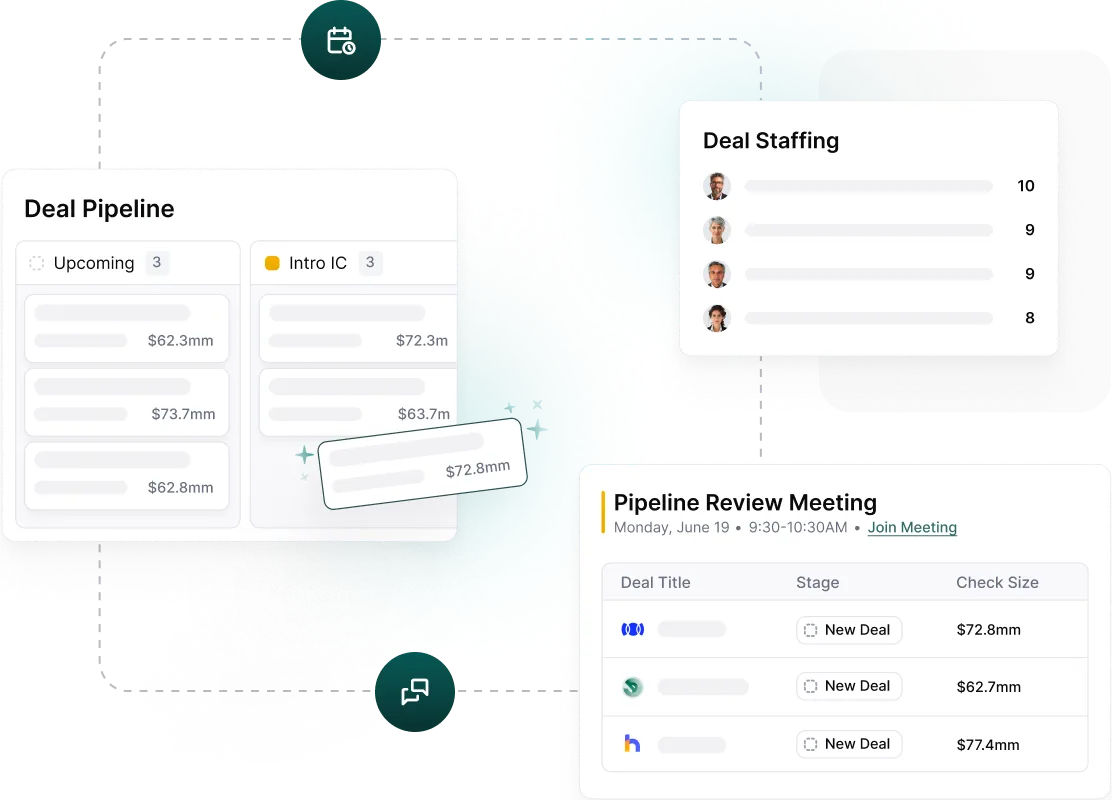
Private equity pipelines don’t follow generic sales logic. They move through IC gates, evolving diligence depth, and clearly defined decision-making processes.
A strong CRM enables custom deal stages that mirror their investment process, from sourcing and IOI to confirmatory diligence and final IC approval.
How firms benefit: Clearer governance and standardized stages that lead to fewer deals slipping through the cracks or sitting in one stage for too long.
A purpose-built pipeline management system separates the companies and targets (the long-lived relationship and communication history) from the opportunities and deals (the time-bound investment process with its own stages and outcomes).
That structure supports PE-specific fields like process type (proprietary vs auction), IC decisions and dates, and diligence artifacts. It also reflects reality: firms take multiple bites at the same company over years, often across entry points or via distinct contacts.
How firms benefit: Cleaner taxonomy and better institutional memory make it easier to track opportunities through multi-year deal cycles.
Without reliable activity data, even well-designed pipelines degrade. CRM automation features can capture context from emails, meetings, and notes to reduce manual upkeep and remove the friction that causes data decay.
And when activity logging automatically happens in the background, CRM adoption rises, because the system reflects how teams already work rather than forcing them to shoehorn it into their daily tasks.
How firms benefit: Higher data integrity, stronger reporting, and a CRM that deal teams actually use.
A strong CRM centralizes IC discussions and memorializes decisions in one system of record to give you one source of truth. And by capturing historical notes, the platform builds a predictive dataset to identify deals likely to gain approval.
These platforms also offer submission deadlines, pre-meeting Q&A, and auto-generated memo summaries speed up reviews and help you develop repeatable, efficient IC workflows.
How firms benefit: Faster IC prep, clearer decision-making criteria, and fewer breakdowns between partners and deal teams.
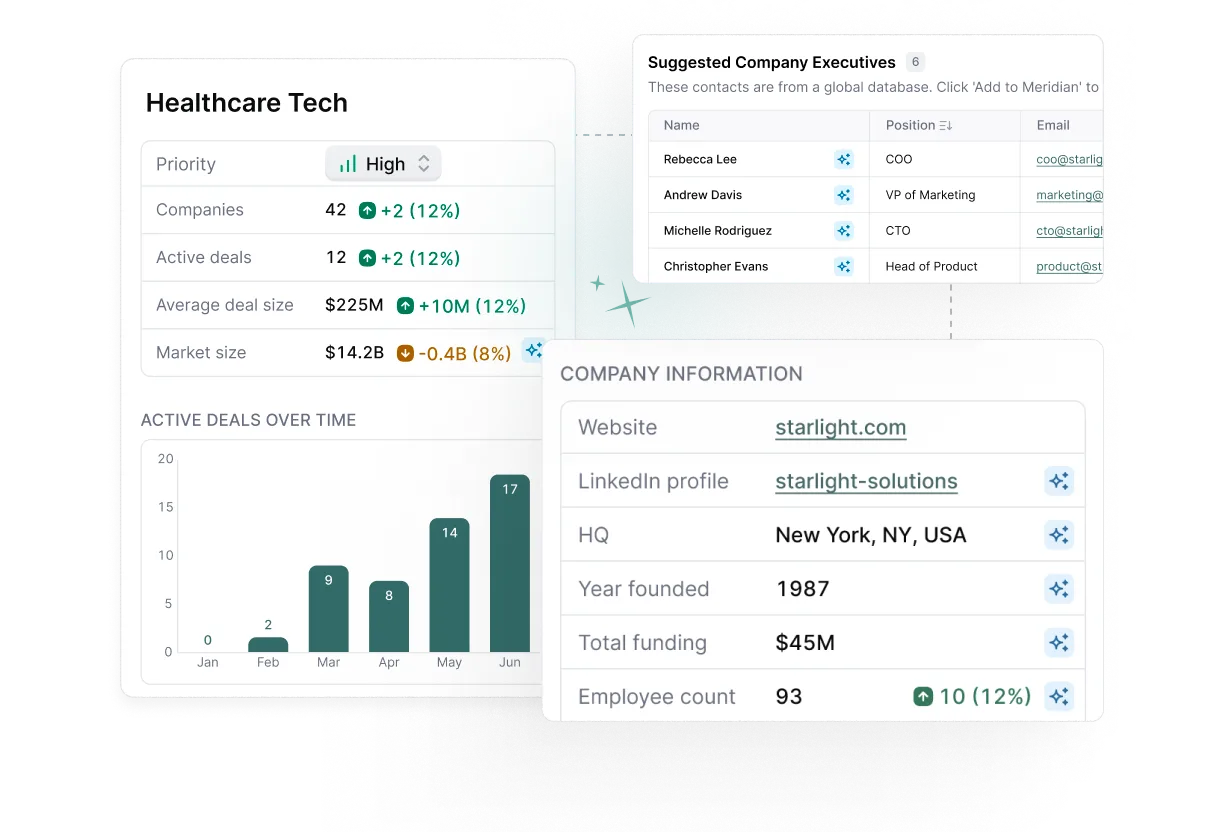
The best PE CRMs can provide instant market analysis and visualization based on specific investment interests. This enables you to systematically map companies by sector and theme, which can help you identify opportunities that fit your firm’s thesis.
In terms of pipeline management, this structured approach is most valuable at the sourcing stage, as it helps teams preempt auctions and speed up the process by finding and tracking proprietary deals long before they reach intermediaries.
How firms benefit: A quick view of the relative attractiveness of a company within a defined market for more efficient sourcing and evaluation.
There are often companies in your CRM that don’t fit cleanly into your pipeline because they aren’t ready to sell.
Signal tracking monitors and alerts you of specific changes like headcount growth, leadership hiring, new funding rounds, and new job openings. You can set triggers for these events to receive real-time alerts that let you know exactly the right time to reach out to a company.
How firms benefit: Intel about which companies you should be investing time into and which you should let simmer for a bit.
A strong CRM is a good start for firms, but you also need to consistently monitor and evaluate pipeline performance to ensure that your deal teams are running as efficiently as possible.
Two key metrics can tell you more about deal team execution than raw deal volume.
The first metric is how steep your pipeline is.
A steep pipeline shows selectivity. If you aggressively trim from stage to stage, you’re forcing clarity early: what fits the thesis, what has momentum, and what’s worth diligence time.
When the drop-off is minimal, your pipeline becomes bloated. Teams stay busy, but conviction is low, and IC time gets spent debating deals that should have been filtered out weeks earlier.
The second metric is days in stage.
This is the simplest signal of whether deals are moving or stalling. As a rule of thumb, if a deal has been in the same stage for more than 30 days, it usually needs a hard decision: revive it with a clear next step or kill it.
The more deals you have sitting in one place for over a month, the more your pipeline efficiency drops, and the less reliable your planning and projections become.
A CRM for private equity can help you track these pipeline metrics. Meridian, for example, lets you customize clear pipeline stages that fit your firm’s workflow, so it’s easy to see how many deals you have in initial IC vs diligence vs negotiation.
Meridian also provides metrics on exactly how long a deal has sat in each stage, which makes bottlenecks obvious and highlights which deals need immediate attention.
A generic CRM can display a pipeline board, but it can’t support the processes PE firms rely on for smart, informed decision-making. Only a CRM designed for private equity can do that.
Meridian’s purpose-built pipeline management CRM gives firms the insights they need to source, evaluate, and close the right deals more effectively.
PE-native objects separate companies from time-bound deals, and automated activity capture keeps data current without adding administrative burden. The CRM’s embedded workflows reflect IC reality, with features to support both pre-meeting prep and post-meeting takeaways.
And market mapping and signal tracking help you find the deals that fit your firm’s thesis quicker, then ensure you get in front of them at exactly the right moment.
The result is a transparent, durable pipeline system that teams actually use, partners can trust, and the whole firm turns to as a single source of truth.
Meridian is your team’s ultimate context provider, driving better deals while minimizing manual data entry.
Pipeline management in a CRM is the structured process of tracking opportunities as they move through defined stages, from initial sourcing to final outcome. In private equity, this means mapping deals to clear investment stages, logging activity automatically, and providing insights into pipeline performance and efficiency.
Managing an investment pipeline starts with defining stages that mirror your firm’s unique process. Each stage should have clear entry and exit criteria, required data fields, and ownership accountability.
From there, discipline matters. Track how steep your pipeline is from sourcing to close, and monitor how long deals sit in each stage. Stalled deals require action: advance with conviction or formally pass with a reason code.
Finally, automate activity capture and reporting wherever possible. The less manual upkeep required, the more accurate and sustainable your pipeline becomes.
Discover how Meridian can streamline deal sourcing and enhance your decision-making


Table of Contents

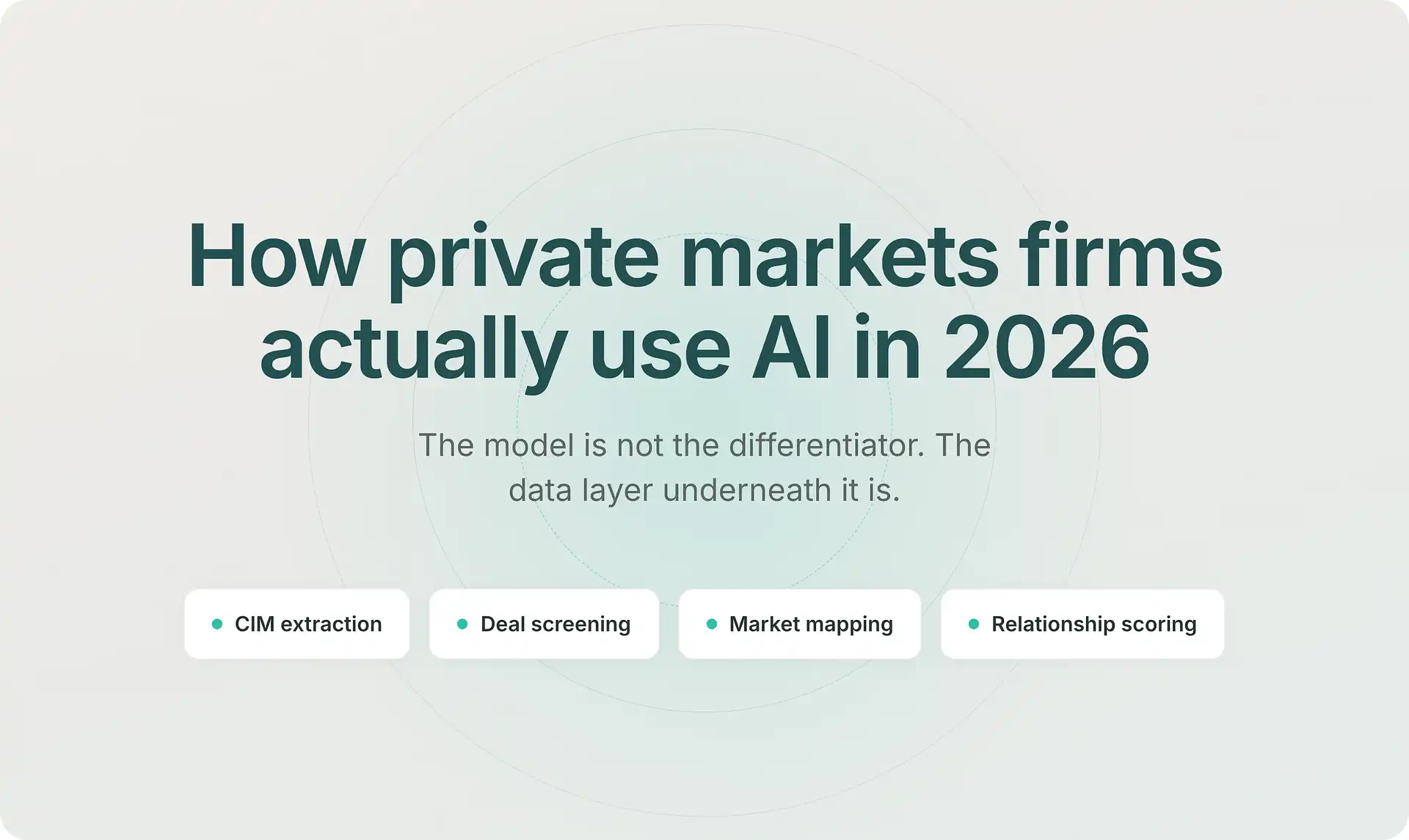
AI adoption has outpaced results in private markets. The four workflows that change deal-team output, and why the data layer matters more than the model.

.webp)