By using this website, you agree to the storing of cookies on your device to enhance site navigation, analyze site usage, and assist in our marketing efforts. View our Privacy Policy for more information.
Accept All
Deny
November 3, 2026
10
min read
Updated
Integrations and workflow for private markets investment firms
What integration and workflow automation actually mean for a deal team, and why AI agents need a system of record they can reach directly.
Integrations and workflow for private markets investment firms
TL;DR
Most investment firms run on a patchwork of disconnected applications, and the gaps between those tools are where deal context gets lost.
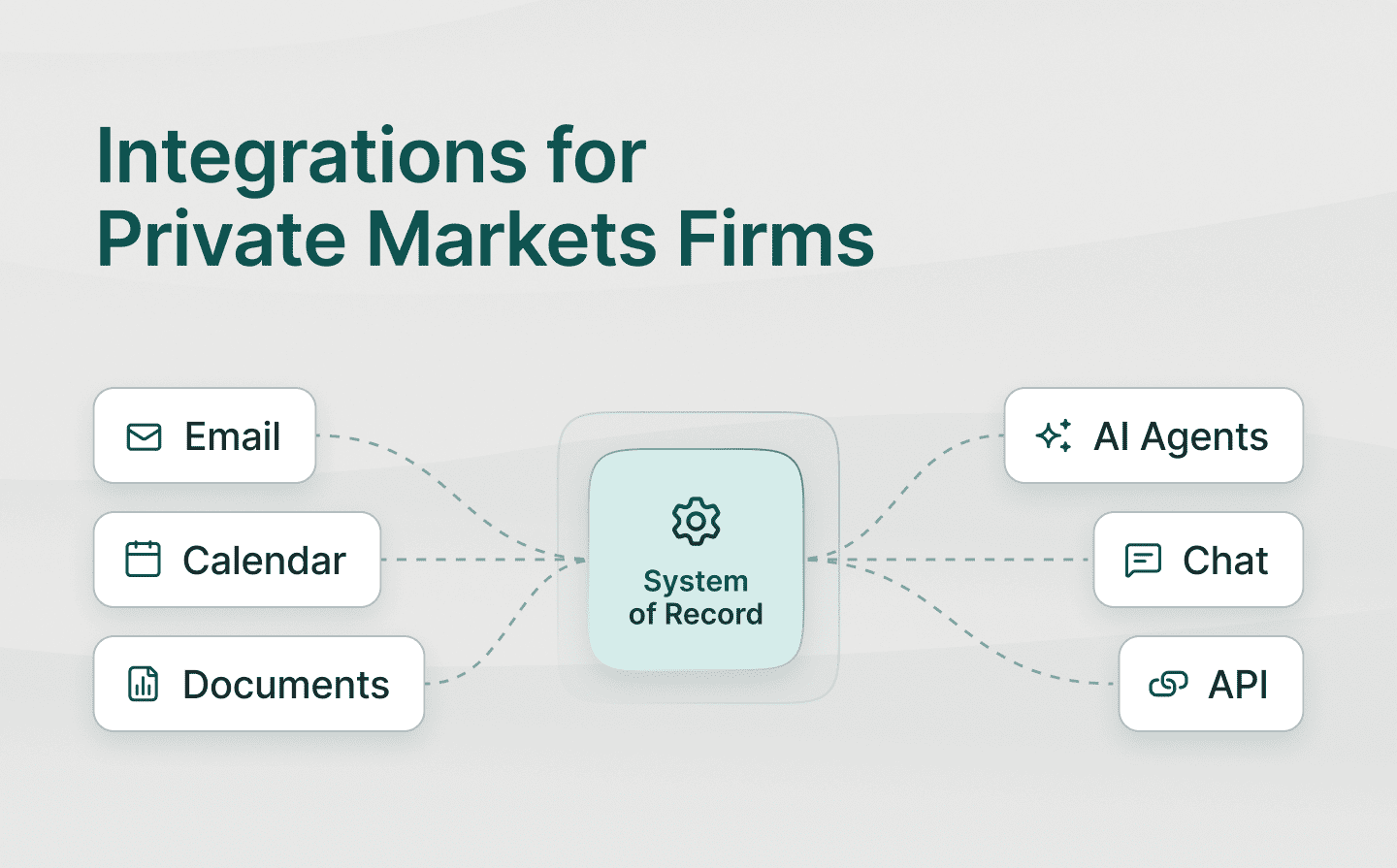
For a deal team, integration means email, calendar, and documents flow into the deal record on their own, and workflow automation means that capture and tagging happen without anyone logging anything.
An open system of record exposes its data securely through MCP, API, and webhooks, so other systems can read from it and write to it in real time.
AI agents are only useful when they can reach the system of record directly, which is what a hosted MCP server makes possible.
Open architecture keeps a firm’s deal data portable across whatever tools it adopts, so the firm keeps control of its own data.
Some private equity CRMs integrate with other tools and AI through first-party connectors for email, calendar, and documents; but today all private-markets investment firms need it. Unfortunately, many firms are still stuck with a legacy CRM, without MCP, webhook, or API connections that link their deal record to their other workflow tools, and these firms are rapidly getting outcompeted.
The problem underneath the legacy CRM problem is that it results in the firm running on a patchwork of disconnected software. On a deal team, that shows up as an analyst exporting deal history into a spreadsheet to query it in an AI tool, or a partner pasting a decision into a chatbot that has no way to write back.
AI makes those gaps more expensive. In 2026 alone, 96% of IT leaders said the success of AI agents depends on integration across systems, and most deal-team AI still runs on data moved by hand. The shift leading firms are making is toward an open, agent-ready system of record that connects the deal record to email, documents, and any AI tool the firm uses.
This article covers why disconnected tools break deal-team workflow, what integration and workflow automation actually mean for a deal team, and how an open architecture with a hosted MCP server, APIs, and webhooks lets any AI tool read from and write to the record.
Why disconnected tools break deal-team workflow
Deal-team workflow breaks when tools don’t talk to each other, because the same information has to be re-keyed across systems that cannot see one another. A sourcing tool, a CRM, an inbox, and document storage each hold part of a deal, and a person is left copying between them. Just 2% of organizations have integrated more than half of their applications, so it makes sense that for most firms the disconnected state is simply the default.
There are real, measurable costs to this default, though. The first cost is time that never reaches a deal. Think of the time an associate spends reconciling the same company across three tools while the next introduction waits. Multiply that across a pipeline, and the integration tax comes due in deals the team never reached, well beyond the hours on a timesheet.
The second cost is the data itself. When a record lives in four places and syncs in none, the pipeline reflects whatever someone had time to update, and the rest of the firm stops trusting what it sees. Every unconnected application is another place a deal detail can go stale, and a deal that goes silent in the gulf between two systems is rarely picked back up.
No firm runs on a single tool, and the goal of this article is not to force your firm onto one. The point is that when you have a connected record that other systems feed, the deal team works from one current record and stops rebuilding it by hand at each stage. (For more on this, check out this article where we covered the shift toward consolidated platforms and what it means for the firms buying in.)
What integration and workflow automation mean for a deal team
For a deal team, effective integration means email, calendar, and documents flow into the deal record automatically, and workflow automation means that capture and tagging happen without anyone logging anything. The test of effectiveness is whether a record updates after a meeting because the meeting happened, not because someone remembered to type it in.
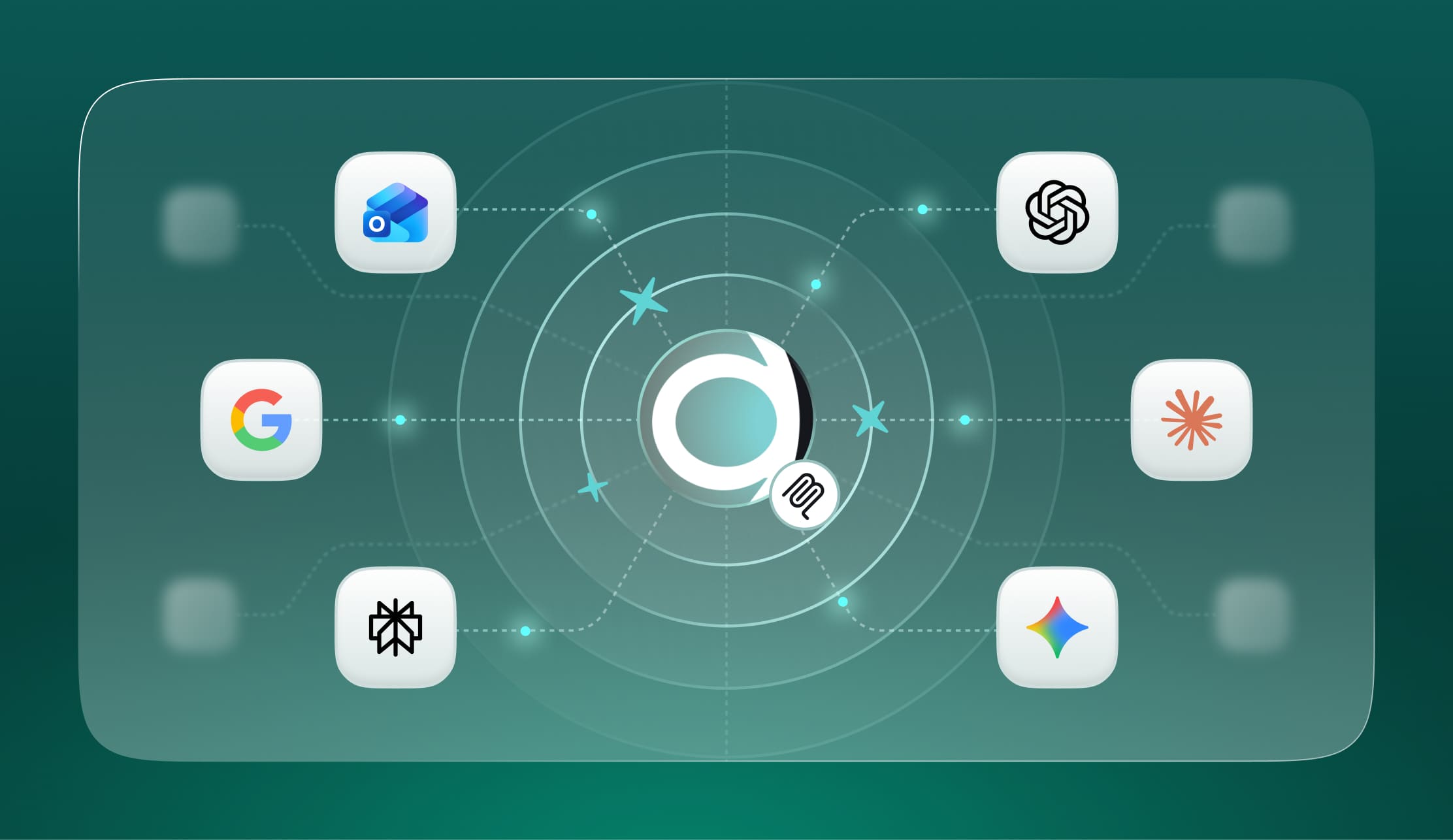
In Meridian, that starts with Outlook and Google Workspace sync for email and calendar, so interactions route to the right deal on their own. Additionally, the Meridian Chrome extension captures company data from any website, and emails, meetings, NDAs, and CIMs are auto-tagged to the deal they belong to in the background.
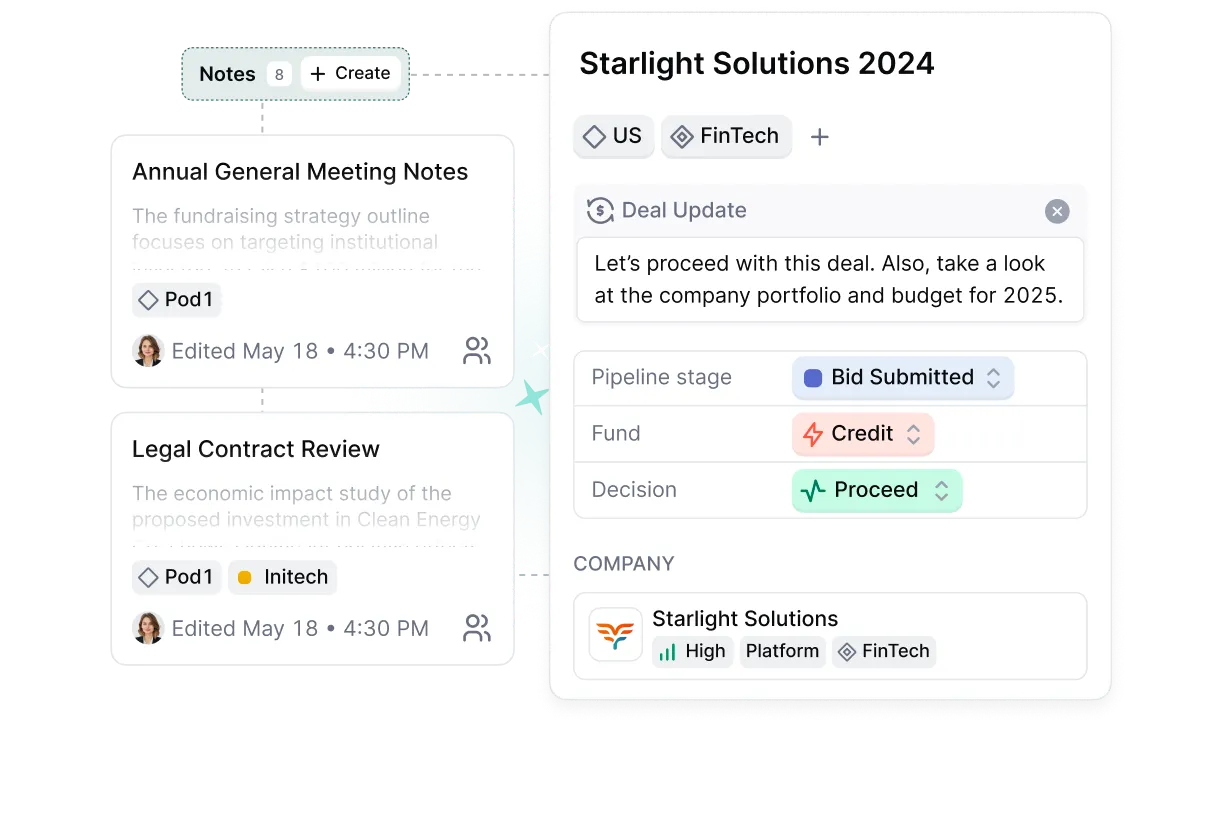
The result of these integrations is a record that maintains itself. When an associate files an NDA or finishes a call, the document lands on the right deal, and the interaction is already logged, so the system keeps up with the work as it happens. That is what makes the pipeline worth reading between committee meetings, when it is usually most out of date. A record a team has to feed by hand is the one the team abandons, while the pipeline drifts from reality.
APIs, webhooks, and a record built to connect
An open system of record exposes its data securely through MCP, API, and/or webhooks, so other systems can read from it and write to it in real time. This is a platform a firm can build on.
Meridian’s integrations are secure, private, and bring communication, intelligence, and operational workflows together. Between native integrations, MCP, API, and webhooks, firms can connect their system of record to the tools and AI they are already using. For how this fits the wider platform decision, our guide to the best private equity CRM tools lays the options out side by side.
Keep the deals that matter moving with Meridian
Make confident, data-driven decisions to close the right deals and improve investment outcomes.
AI agents need a connected system of record to be useful for a firm
An AI agent is only useful when it can reach the system of record directly. When it works from data pasted or exported by hand, it answers from a fragment. A model asked to screen inbound deals or draft the first pass of an IC memo needs the whole record to be any good.
MCP is what closes that gap. The Model Context Protocol is an open standard, originally developed by Anthropic, that gives AI models a consistent way to connect to outside software and data, so a tool and a system can talk without a custom build for each pairing. It works like an agreed interface that any compliant AI tool and any compliant system can use to reach each other.
Meridian ships a hosted MCP server on top of the connected record, so a user can ask Claude, ChatGPT, or another MCP-compatible tool to search the pipeline, relationships, documents, and emails in plain language. A partner can ask which deals in a sector have gone quiet, or pull every interaction with a management team, right from a chat. The answer comes from the same record that captures email and documents automatically, so it is grounded in current data. Because updates made through an agent are stamped in the record’s history, a firm can always separate what a person did from what an agent did, and correct either.
Connecting an agent to live data carries obligations, though. An agent that can read the pipeline and write back to it raises access-control questions a firm has to manage, including who can act through an agent and what it is allowed to touch. We go deeper on how agents fit a deal team in our overview of Scout AI.
Open architecture versus walled suites: Your firm’s future is worth considering
Open architecture means the firm’s data is portable and any AI tool can use it. A walled suite, by contrast, keeps that data inside one vendor’s platform, so the question for a buyer becomes simple: If you adopt a new AI tool next year, can it reach your deal history, or does your deal history belong to the platform you are trying to leave?
The CRM category is consolidating in a way that makes the question urgent. In March 2026, Carta entered private markets CRM by acquiring ListAlpha and pairing front-office deal data with back-office fund data under an AI layer, using an MCP server architecture of its own. 88% of organizations are already on track for partial or full agentic transformation, so where a firm’s deal data lives is a decision with a short fuse.
Meridian takes the open side of that trade. Your Meridian system of record is portable, ready to integrate with your current and future workflow tools, and any MCP-compatible tool can read from it and write to it. Your deal context travels with your firm across whatever tools you adopt. The same openness that lets Claude or ChatGPT reach the record is what keeps your firm’s data your own. If you adopt a new AI model next year, you just point the new tool at your Meridian workspace and you keep your history, with nothing to migrate out of a suite first.
We think long-term here at Meridian, and we make our case for why you should too in this article on the future of private equity CRM.
Discover how Meridian can streamline deal sourcing and enhance your decision-making
How do private equity CRMs integrate with other tools and AI?
An effective and AI-native private equity CRM integrates through first-party connectors, API, webhooks, and MCP. The connectors keep the record current automatically, while the API and MCP let other systems and AI tools read from it and write to it. The piece most CRMs still lack is native agent access, which is why this 2026 benchmark report found 96% of IT leaders tie AI agent success to integration.
What is MCP and why does it matter for a CRM?
MCP, the Model Context Protocol, is an open standard originally developed by Anthropic that gives AI models a consistent way to connect to outside software and data. For a CRM it matters because it lets any compliant AI tool reach the deal record without a custom integration built for each tool. That keeps a firm’s data open to whatever AI it adopts and not bound to one vendor’s assistant.
Can I connect my CRM to Claude or ChatGPT?
Yes, if your CRM has an MCP connection. With Meridian’s hosted MCP server, you can connect the deal record to Claude, ChatGPT, or any MCP-compatible tool and ask it to search your pipeline, relationships, documents, and emails in plain language. Updates made through an agent write back to the record with an audit trail, so you can tell what was done by hand and what was done through an agent.
Does Meridian have an API and webhooks?
Yes. Meridian provides a RESTful API authenticated with OAuth 2.0 that covers companies, deals, people, emails, meetings, notes, and documents, along with webhooks that push changes out in real time. Firms use it to sync with internal systems, trigger workflows in other tools, and build the custom integrations their process depends on.
What integrations does Meridian support?
Meridian offers native Outlook and Google Workspace sync for email and calendar, plus many other integrations through API, webhooks, and MCP. The Meridian Chrome extension captures company data from any website, and Meridian Inbox logs deal activity straight from email.
How does a CRM automate deal-team workflows?
A CRM with the right integrations automates deal-team workflows by capturing emails, meetings, and documents on its own and tagging them to the right deal in the background, so the record updates without anyone logging anything. In Meridian, that extends to auto-tagging NDAs and CIMs and refreshing the record continuously. The result is a pipeline that reflects what actually happened, kept current without manual logging.
author
Alex Sen
Founder and CEO
Alex Sen is the Founder and CEO of Meridian. With nearly a decade of experience at top firms like Blackstone, Thoma Bravo, and CVC, Alex knows the challenges that hold dealmakers back.