
Get the Meridian mobile app!
Your deal data travels with you.
Learn More

Meridian raises $7M seed round led by 645 Ventures.
Read More
The fix for adoption is automatic data capture, not more training or a stricter mandate.
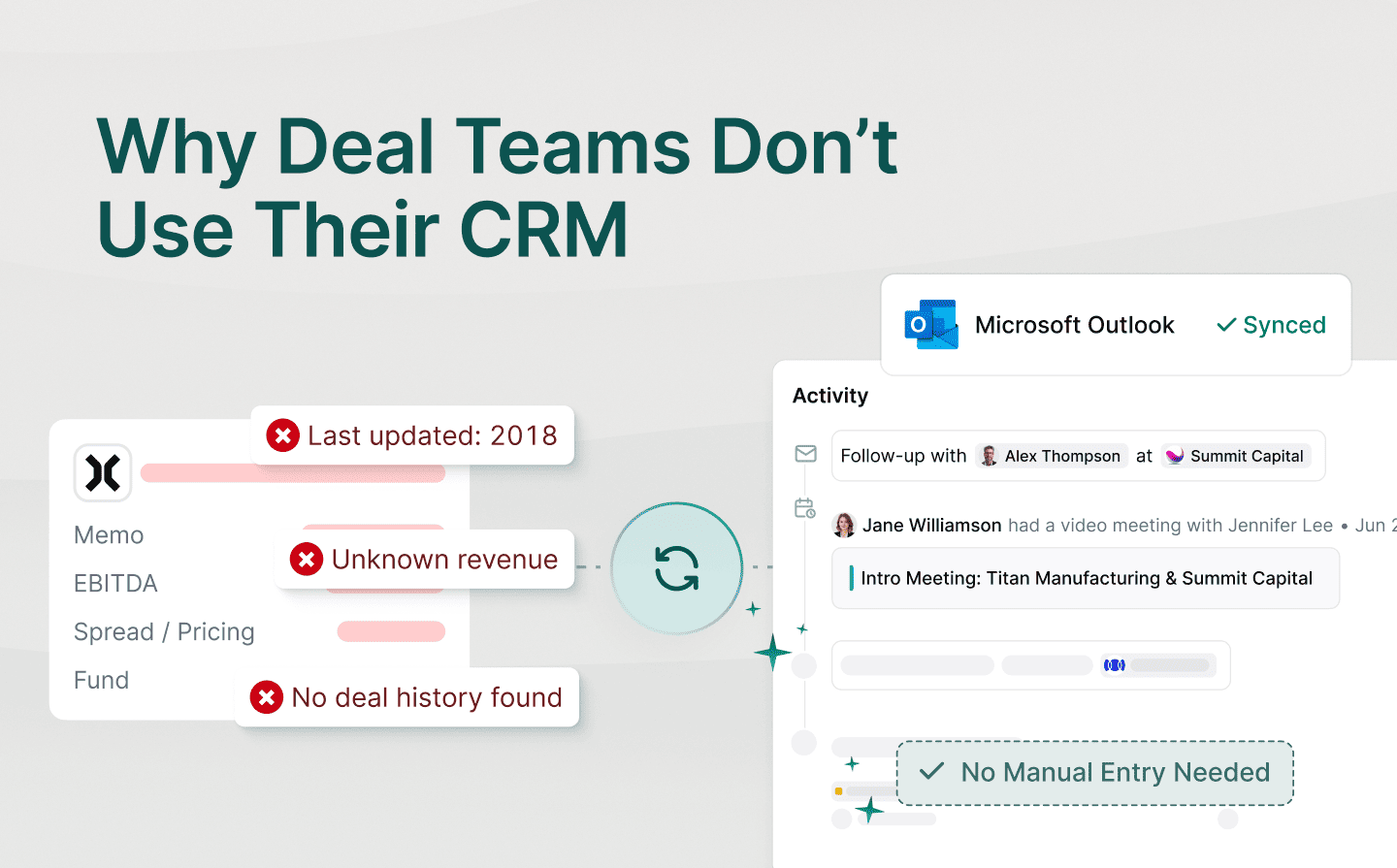
Deal teams don’t use their CRM because it was almost always purchased for the firm’s reporting needs rather than their daily workflow. The CRM asks for manual data entry and gives nothing back before that effort. And let’s face it, a senior partner will not log interactions by hand into a system that does nothing for them first; so records go stale, the pipeline stops reflecting reality, and the rest of the firm stops trusting what it sees.
The cost of that distrusted data is measurable. Poor data quality costs organizations at least $12.9 million a year on average, and a CRM nobody maintains is where that decay starts.
The second cost for a firm is the time spent feeding the system. Associates lose hours every week to manual data entry that more senior reps spend on research and relationships. On a deal team, that is the hour an associate spends typing a meeting note into the CRM instead of working the next introduction.
The firms that fix adoption do not get there with more training or a stricter mandate. They choose a CRM that captures data automatically and earns its place by saving time before it asks for any. This piece covers why adoption fails at investment firms, what to look for in a system your team will actually use, how to migrate off Salesforce, DealCloud, or spreadsheets without losing your history, and how to measure whether adoption worked.
Deal teams stop using a CRM when it was chosen for the firm’s reporting needs rather than the work the deal team does each day. Reporting systems are structured around the fields leadership and LPs want to see, not the steps an associate takes to move a deal forward. The person doing the data entry gets a form to fill in and not much insight in return.
That imbalance is why the manual-entry burden determines adoption. When logging an interaction takes an investment professional several minutes and returns nothing, the rational choice is to skip it, and most of them do. The record then reflects the deals someone had time to update, not the deals that are actually live.
Most firms respond to the resulting mess with cleanup rather than a different system. Validity’s State of CRM Data Management report found that 57% of organizations have run manual data-cleaning efforts while cutting investment in dedicated data-quality staff. Manual cleanup of a system nobody maintains is a treadmill, because the records decay again as soon as the cleaning stops.
Some manual structure is unavoidable in any system, and no tool removes the judgment about which deals matter or how to stage them. The real question you should be thinking about as you’re evaluating a CRM is: Does the tool do the capture, or does the person? We wrote about how this plays out on legacy platforms in this article on the future of private equity CRM.
.png)
The structural fix for CRM adoption is automatic data capture, not more training or a stronger mandate. Training teaches people to do manual work they were always going to avoid, and a mandate turns the CRM into a compliance chore. When emails, meetings, and documents log themselves, the record stays current because no one has to choose to update it.
Automatic capture is at the core of how we built Meridian. Emails and meetings in Outlook and Google sync straight to Meridian without anyone touching a keyboard. Scout AI extracts structured fields from CIMs, news, and external data and links them to the right deal. The record updates continuously, so the pipeline reflects what happened rather than what someone found time to enter.
A CRM your team will use captures data automatically, serves as the system of record, and returns value before it asks for effort. Four criteria separate a system a deal team adopts from one it abandons, and your firm can test each one in a demo, the same way you would run due diligence on a target.
.png)
Migrating off a legacy CRM is faster and lower-risk than most firms expect when the vendor handles the data work. The fear that keeps firms on a system they dislike is the migration itself, the belief that moving years of deal history will be slow, lossy, and disruptive. In practice, the data work is the vendor’s job, not the deal team’s.
Most firms moving to Meridian are fully migrated and live within 12 weeks with minimal internal lift. We connect to the current CRM by API and pull structured data with no manual extraction, import historical deal, contact, and activity records without data loss, and cleanse and enrich that data as it moves. The new system mirrors the firm’s investment processes, pipeline stages, and investment committee (IC) review workflows, so the team recognizes its own process on the other side.
Historical data is the part firms worry about most, and it is the part that transfers. Old records are not left behind; they are imported, de-duplicated, and enriched during the move, so the pipeline that arrives in the new system can be cleaner than the one that left the old one.
Every migration is still a change-management effort, though. What we would weigh against that is the cost of staying on a system the team has already stopped using. For the platform-specific view, we cover moving off each system in our DealCloud alternative and Salesforce alternatives guides, and lay out a direct Meridian and DealCloud comparison.
%20(2).png)
You know CRM adoption worked when the record stays current without anyone being told to update it. Usage is not the same as adoption, because a system can show logins and still hold a stale pipeline. The test is whether the data reflects reality on its own. Track these four signals to assess your firm’s CRM adoption rate:
These signals track the same discipline that Salesforce’s data tied to high performers, moved from the sales floor to a deal team. The caveat is that metrics only matter if leadership acts on them, since a dashboard nobody reviews changes nothing. We go deeper on what a managed rollout looks like on our implementation page.
%20(1).png)
AI in a deal team is only as good as the data underneath it, so adoption is the precondition rather than an afterthought. A model asked to screen inbound deal flow, summarize a CIM, or draft the first pass of an IC memo reads from the system of record, and if that record is half-empty because no one maintained it, the output is confident and wrong.
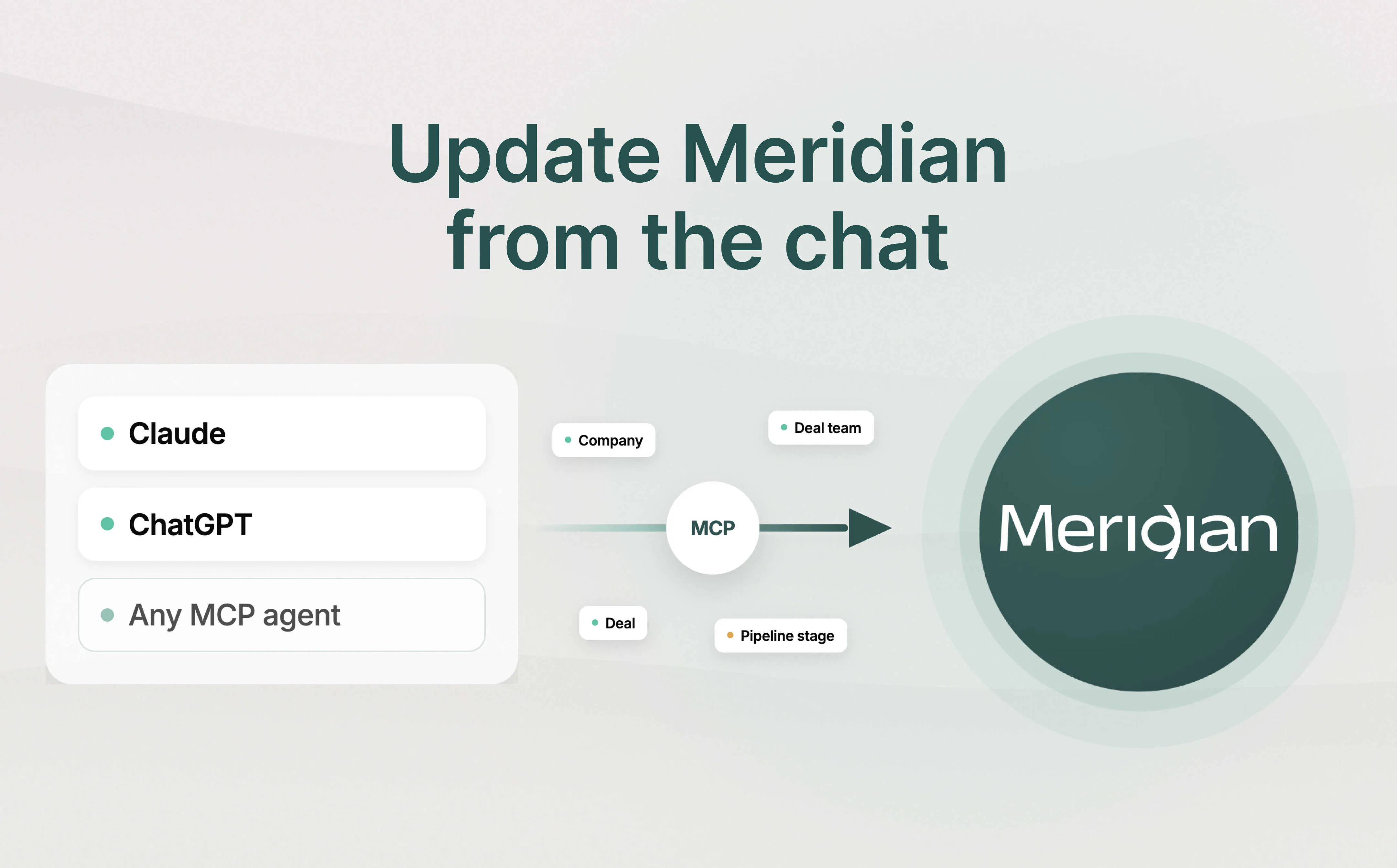
The gulf between AI ambition and data readiness is clearly visible. Firms are building intelligence on foundations that low adoption left shaky. But the CRM category is consolidating around this exact problem. In March 2026, Carta entered private markets CRM by acquiring ListAlpha and pairing front-office relationship data with back-office fund data under an AI agent. It’s a sign the category is unifying toward one system of record. Meridian’s answer to this is to be AI-native and open at the same time. Scout AI reads from a continuously captured record, and Meridian MCP connects that record to Claude, ChatGPT, or any future model, so the firm’s data stays portable rather than locked in.
AI-native and open still asks something of the firm, because the connected sources have to stay in order. An open system of record pointed at neglected data produces the same unreliable answers as a closed one. Adoption is what keeps that data worth querying.
Deal teams don’t use their CRM when it was chosen for the firm’s reporting needs rather than their daily workflow, because it asks for manual data entry and returns nothing before that effort. Senior professionals skip the entry, records go stale, and the pipeline stops reflecting reality. The fix is a system that captures activity automatically instead of relying on people to log it.
You improve CRM adoption by removing the manual entry that causes people to abandon the system, not by adding training or mandates. When emails, meetings, and documents log themselves, the record stays current without anyone choosing to update it. Salesforce found that 79% of high-performing teams prioritize data hygiene, and hygiene is far easier to sustain when capture is automatic.
Most firms moving to a purpose-built private markets CRM like Meridian are fully migrated and live within 6 to 12 weeks, with the vendor handling the data work. The timeline depends on how much historical data moves and how many workflows need to be mirrored. The deal team’s internal lift is minimal when the migration runs by API rather than by hand.
Migrating off DealCloud is mostly a data and configuration exercise that the receiving vendor handles, not a manual rebuild by the deal team. A modern platform connects by API, pulls the structured data, and reconstructs pipeline stages and review workflows to match the firm’s process. The main work left for the firm is change management, the habit shift onto the new system.
You switch from Salesforce by connecting the new system to it by API, importing historical deal, contact, and activity data, and mapping the firm’s pipeline and processes into a model built for private markets. A purpose-built CRM mirrors the investment workflow rather than the generic sales funnel Salesforce defaults to. Historical records move across and are cleaned during the transfer rather than left behind.
No, historical data does not have to be lost in a CRM migration. When the move is handled properly, old deal, contact, and activity records are imported in full, de-duplicated, and enriched as they transfer. The pipeline that lands in the new system can be cleaner than the one that left the old one.
You measure CRM adoption by whether the record stays current on its own, not by login counts. Track active usage across seniority levels, data completeness on live deals, time saved against manual entry, and how current the pipeline is at any moment. A system is adopted when the data reflects reality without anyone being told to update it.
Discover how Meridian can streamline deal sourcing and enhance your decision-making


Table of Contents

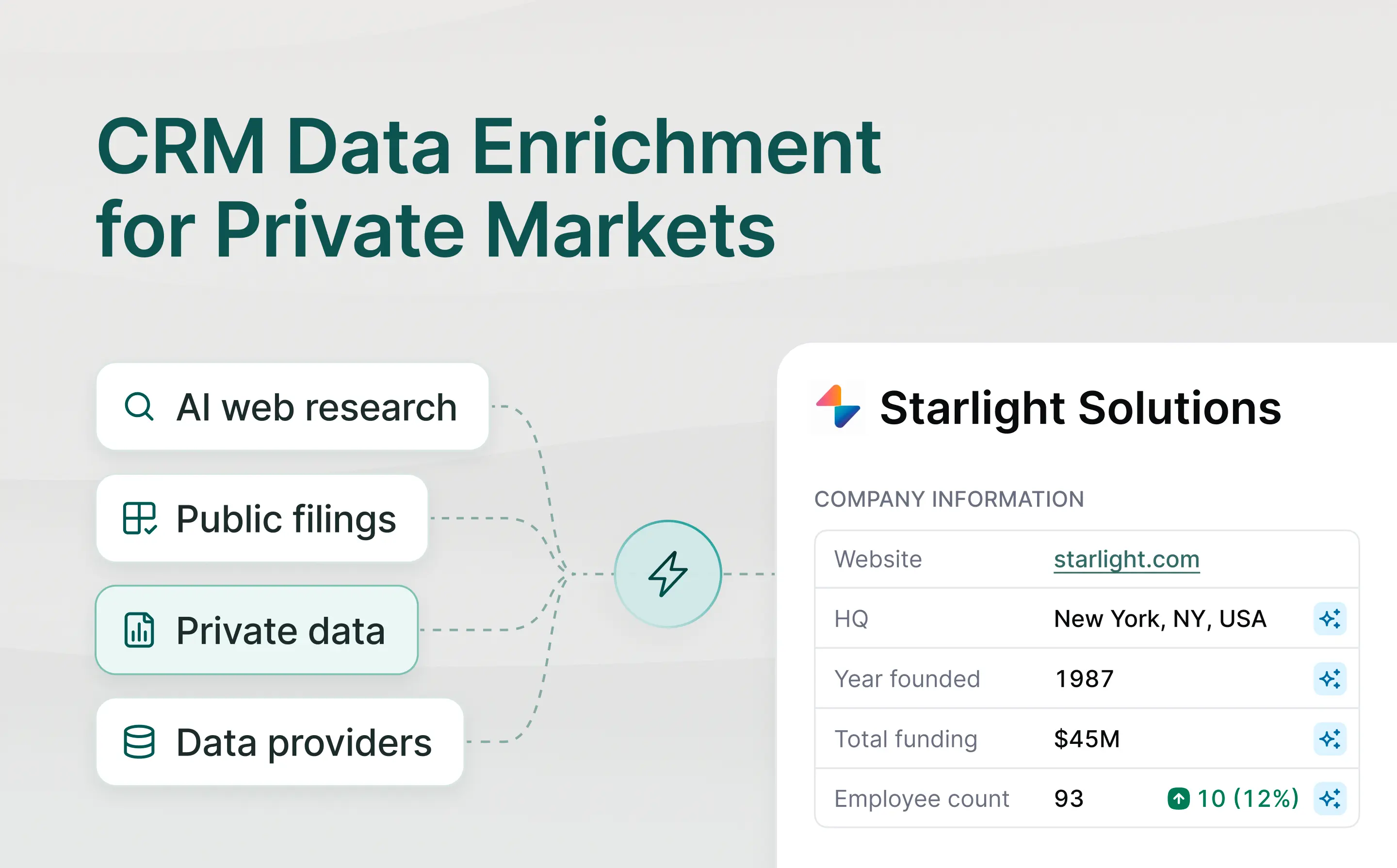
How deal teams keep company data clean and consolidate their vendors with built-in data.