By using this website, you agree to the storing of cookies on your device to enhance site navigation, analyze site usage, and assist in our marketing efforts. View our Privacy Policy for more information.
Accept All
Deny
November 11, 2026
10
min read
Updated
The 2026 Buyer’s Framework for Selecting a CRM for Private Markets Investment Firms
A strategy-first guide to choosing a CRM for private markets: the five features that matter, how to judge AI, and what to ask every vendor.
The 2026 Buyer’s Framework for Selecting a CRM for Private Markets Investment Firms
TL;DR
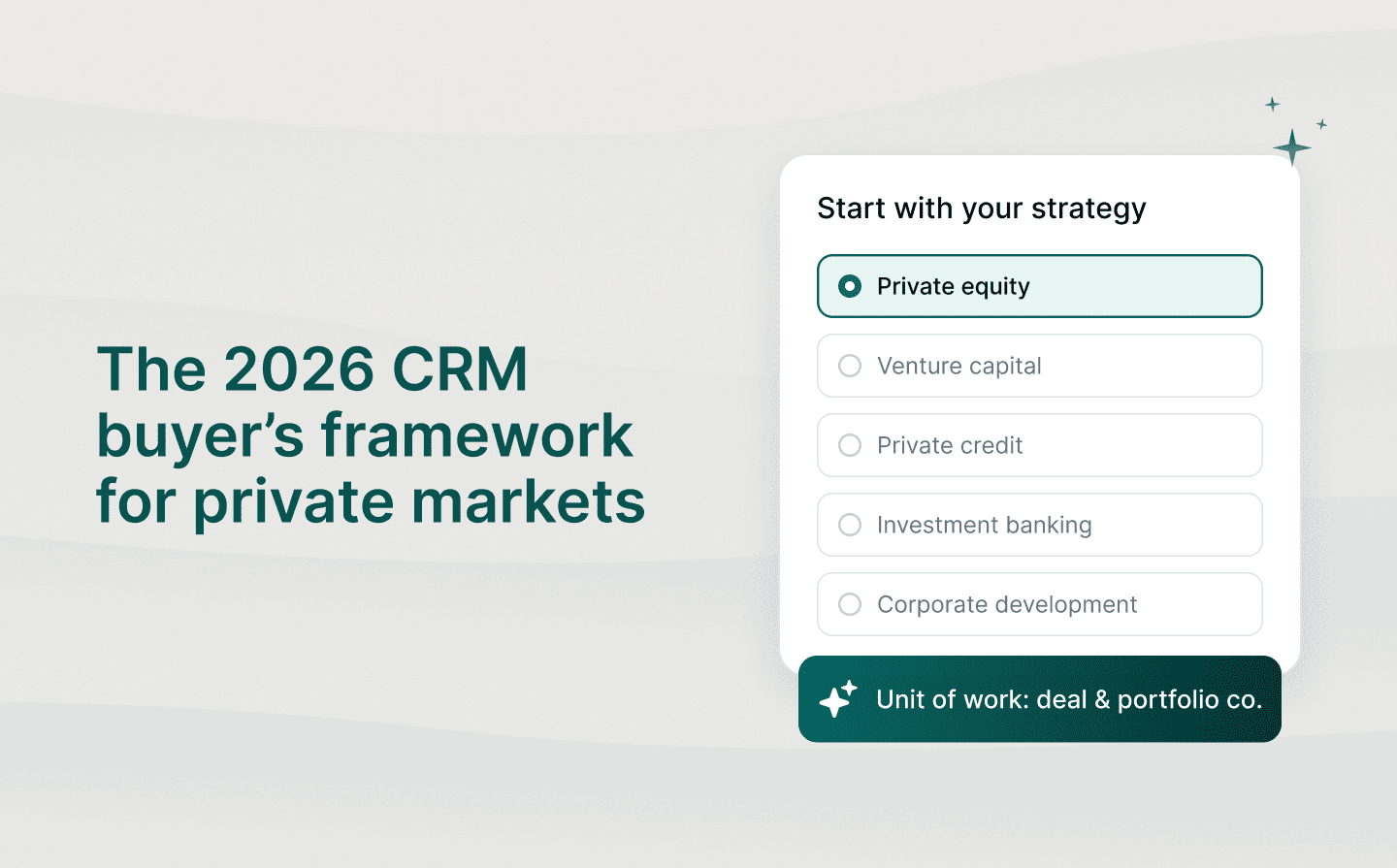
Choose a CRM by investment strategy first.
Automatic activity capture is the feature that decides whether a deal team adopts the system.
Judge “AI-native” by architecture rather than marketing, and ask whether the AI runs on the system of record or sits as a chat layer over a legacy database.
Running deal flow and investor relations in one system removes duplicate contact records and keeps relationship history in one place.
Ask every vendor about data ownership, integration timing, and AI governance.
For private markets firms, buying purpose-built software usually beats customizing a horizontal platform.
Venture capital, private equity, or really any private markets firm should look for five things in a CRM: automatic activity capture, built-in data enrichment, deal flow and investor relations in one system, AI that runs on the system of record, and a data model that fits how the firm actually works. There are more features to consider (and we’ll outline them later in this buyer’s guide), but if you focus your evaluation on these five features alone, your firm will rapidly get ahead of competitors with a new CRM.
The stakes are higher in 2026 because the return math has tightened. Global buyout deal value rose 44% in 2025 to $904 billion, and buyout-backed exit value rose 47% to $717 billion, both the second-highest on record. A typical deal now needs roughly 10% to 12% annual EBITDA growth to reach a 2.5x return over five years, against about 5% in the 2010s. More deals are closing, and each one has to work harder, which rewards firms whose data is clean and whose diligence moves fast.
Most firms are replacing spreadsheets or a generic sales CRM now, and every vendor now markets AI, so the decision has moved from whether to buy purpose-built software to which architecture to commit to. The most useful question you can ask is where the AI lives: on the system of record, with bundled data and agents that act on records, or in a chat window over a database that still runs on manual entry.
This guide gives a strategy-first framework, a feature checklist, a vendor-question scorecard, and a factual map of the 2026 market. Though we built Meridian to solve these challenges for private markets firms, this buyer’s guide will be useful even if you never evaluate us.
Features private markets firms should look for in a CRM
The features that will matter most to venture capital, private equity, and investment banking are automatic activity capture, bundled data enrichment, unified deal and investor workflows, document-to-record extraction, and permissions that respect fund and deal boundaries.
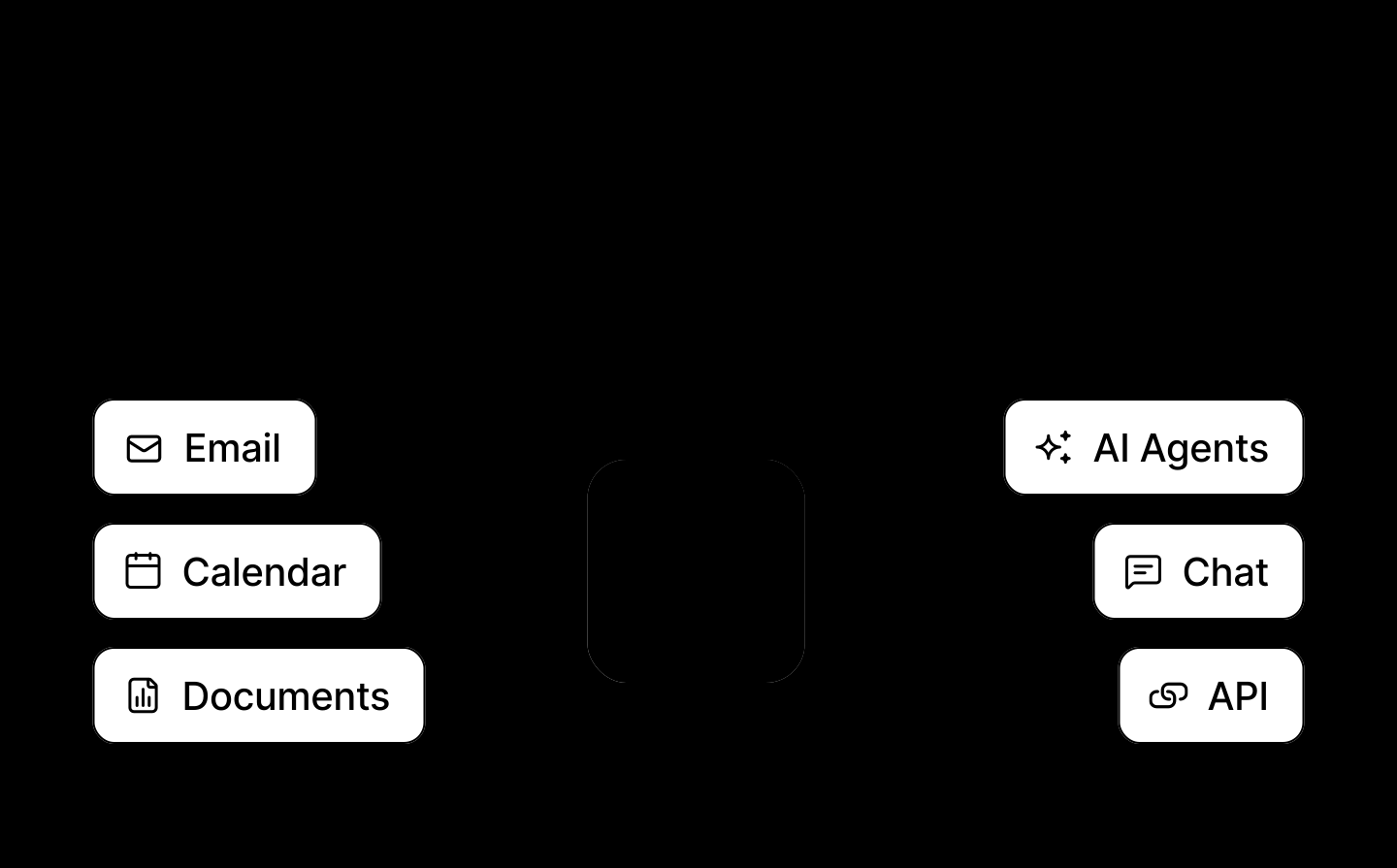
Whether the team actually uses the system matters more than any feature list. A CRM that runs in the background, filling itself from email, calendar, and documents, gets used; one that asks busy investors to retype what they already did gets abandoned.
Here are the features (the top five first, followed by others your firm should consider) and how to test them in a demo.
Automatic activity capture decides adoption
Capture comes first for a reason. A team member who has to stop and log a meeting by hand will skip it, and a pipeline that is only half-logged will not be trusted by the next fundraise.
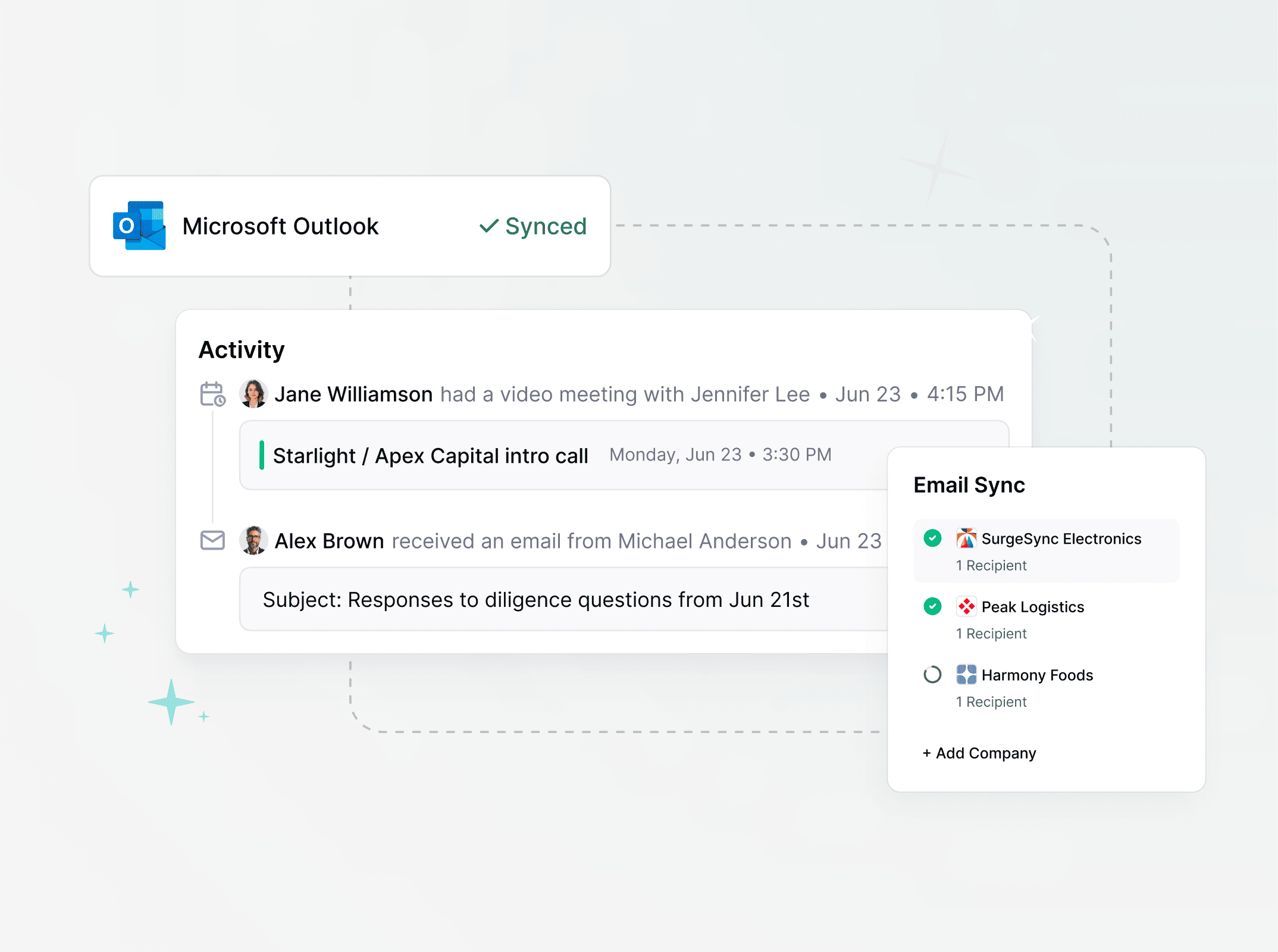
Automatic capture of email, calendar, and meeting activity is the single biggest predictor of CRM adoption at investment firms. When associates log activity by hand, the record holds only the fraction they have time to enter, and partners stop trusting a pipeline that is always part empty. Firmwide activity sync is what turns individual networks into institutional memory that stays when people leave.
We capture activity through a native Outlook and Google Workspace sync, plus Meridian inbox to capture emails through CC and BCC. Interactions route to the right deal without anyone typing them in. Several CRM vendors also capture activity automatically, so the real difference is the depth of the data layer underneath, not whether the feature exists.
One system for deal flow and investor relations
Meridian can run deal flow and investor relations together in one platform, which removes duplicate contact records and keeps relationship context in a single place.
Fundraising got harder in 2025, when global closed-end private equity fundraising fell 17% to about $616 billion, which raises the value of a complete LP relationship history. The same banker, co-investor, or LP often appears on both the deal side and the fund side, and two systems split that person into records that never reconcile.
Our fundraising module tracks raises by fund and close in the same CRM that holds the deal pipeline. Still, depth matters. A firm that needs a full investor portal or capital-call notices may still pair something like Meridian with dedicated IR or fund administration software.
Built-in data enrichment and company coverage
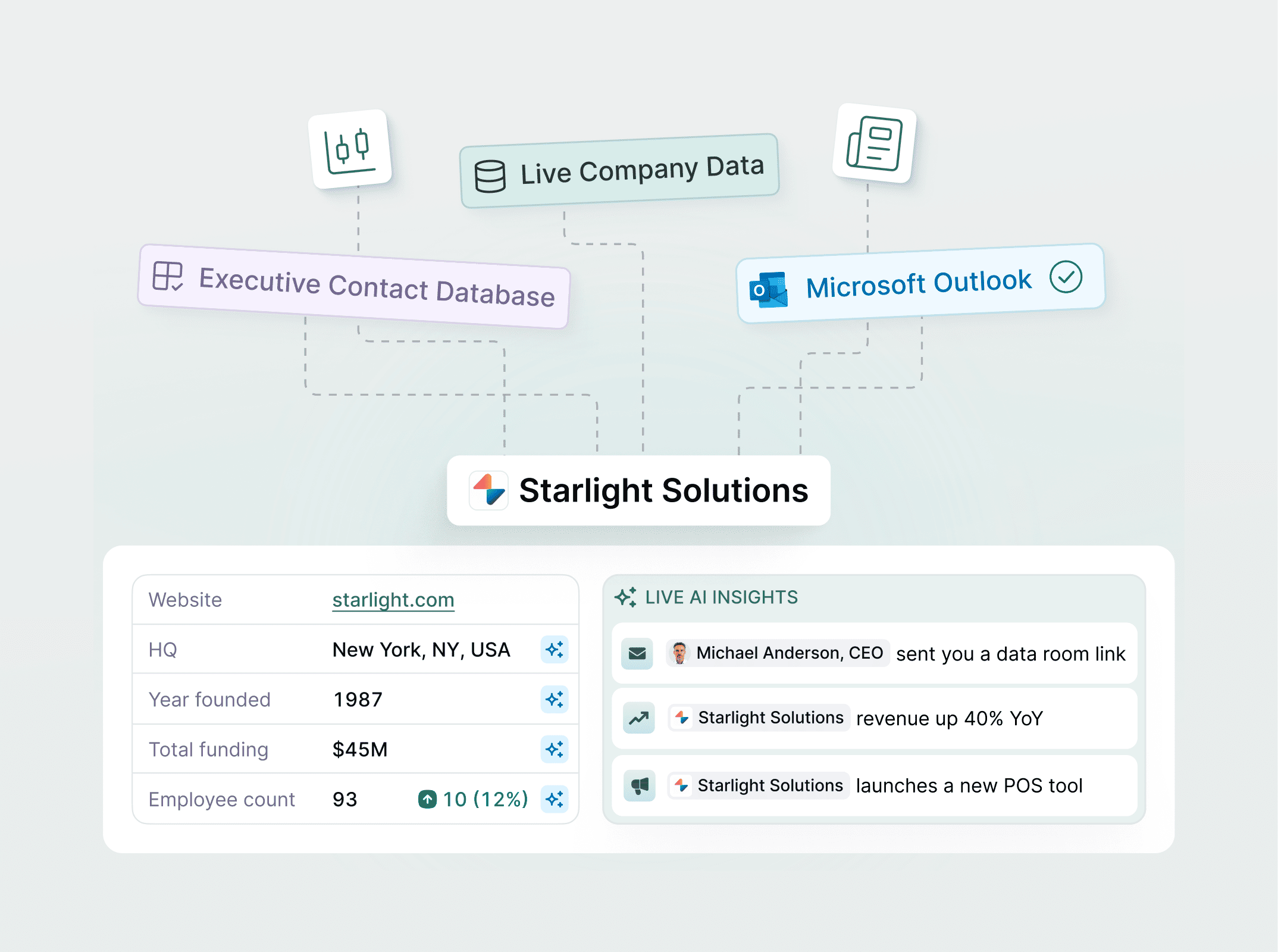
Built-in data enrichment keeps company and contact records current without analysts copying data from separate subscriptions.
Data enrichment is the automatic filling and updating of record fields from outside sources. A living profile is a record that updates continuously as new data appears, rather than a snapshot that goes stale within weeks.
We bundle more than 26 million company records with waterfall enrichment and per-field source control through our deal sourcing and data enrichment layers, so each value shows where it came from. That coverage figure is our own, not an externally audited number.
The trade-off, which is our own published position, is that bundled enrichment covers top-of-funnel screening but does not replace a specialist database’s depth on fund performance or private company financials, a point we develop in our guide to CRM data enrichment for private markets.
Turning CIMs and decks into structured records
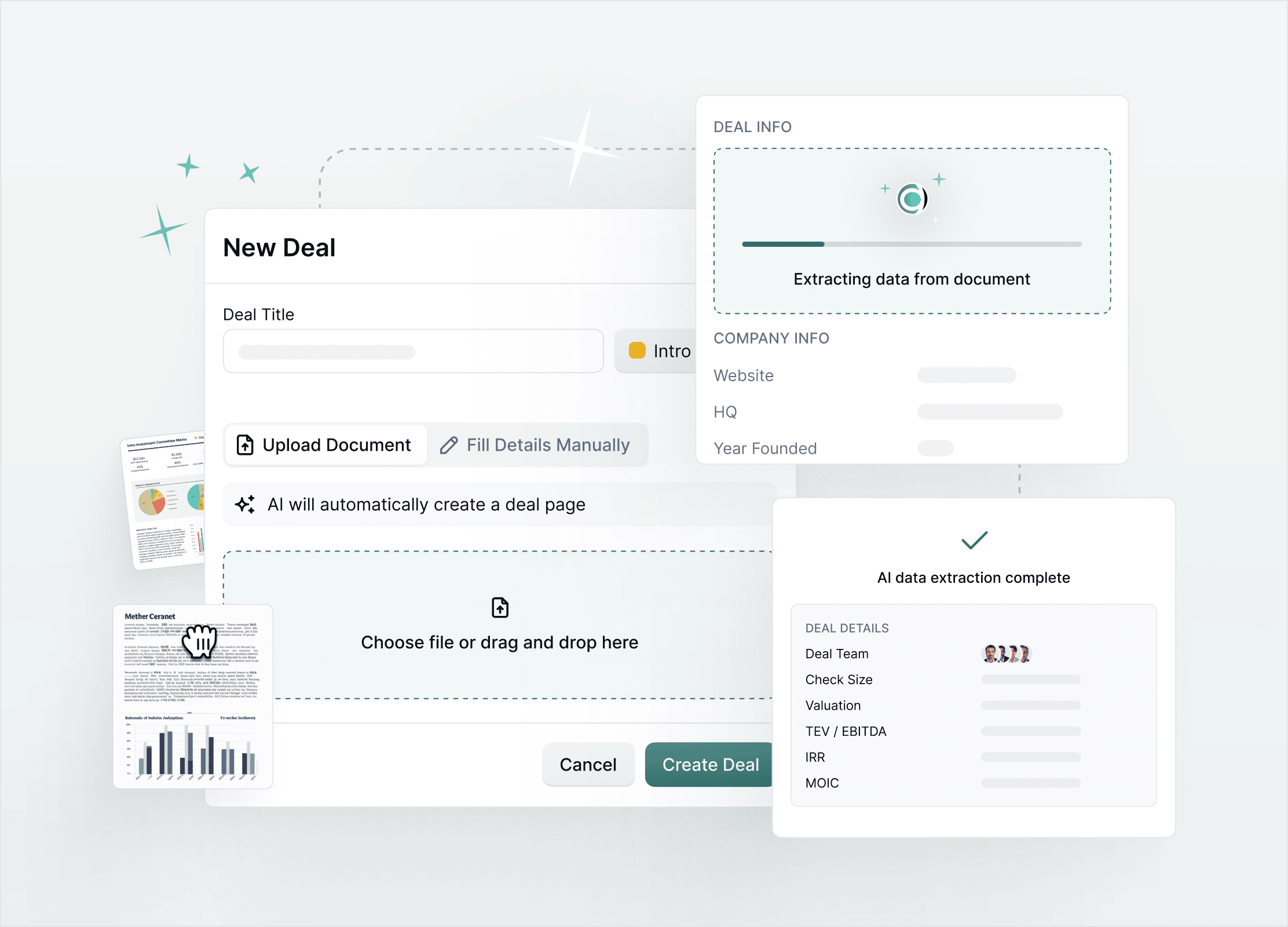
A strong CRM turns CIMs and decks into structured records, extracting financials, KPIs, and risks onto the deal record instead of leaving them in a PDF.
Extraction only helps if the output lands on the deal record and becomes searchable history, though. Firm-defined scoring criteria then make the first read consistent across the team.
We built Frame, our lightweight AI document builder, for exactly this. Frame parses a CIM, deck, or diligence file, extracts the financials, KPIs, risks, and qualitative drivers, and applies firm-defined deal scoring. Then, if you are a Meridian user, it writes to the deal record inside the full CRM, where our Scout AI agents work the same data. So a parsed CIM feeds sourcing and relationship history rather than sitting in a standalone summary.
Bain & Company found GPs name due diligence as the top area where generative AI delivers the highest ROI, at 40%, with deal sourcing and market mapping next at 33%. Other vendors, including Carta, now promote AI-generated IC one-pagers, so the buyer’s test is where the output is stored and whether it draws on the firm’s own history.
Handling high deal volume and long-term relationships at once
A private markets CRM has to run at two speeds at once: high-volume inbound triage and relationships that develop over years. It matters that a CRM can work with a non-linear pipeline, because a company a firm passed on years ago can return with its full history still attached. Mandate-fit scoring helps a team triage inbound volume without dropping the long-tail relationships that produce proprietary deals.
S&P Global Market Intelligence’s 2026 private equity survey found that 64% of GPs still rate AI ineffective for deal sourcing, but we’ve seen an enormous improvement when triage scoring runs on the firm’s own history rather than a generic model. Our Scout AI benchmarks each opportunity against the firm’s deal history and public comparables and builds market maps against the mandate.
Security and permissions controls that are nonnegotiable for a firm today
At a minimum, your firm should require SOC 2 compliance, single sign-on, encryption at rest and in transit, and deal- and fund-level permissions in a new CRM. AI governance is now part of the security review: where data goes, which models touch it, whether the firm’s data trains them, and whether AI actions respect access controls.
That same S&P Global survey ranks data privacy among the most-cited barriers to AI adoption in private equity, named by 43% of GPs. Meridian’s own security overview lists SOC 2, SSO, AES-256 encryption at rest, and TLS 1.2+ in transit, and the practical move is to ask every vendor the same questions in writing.
AI-native CRM versus a horizontal CRM with AI added
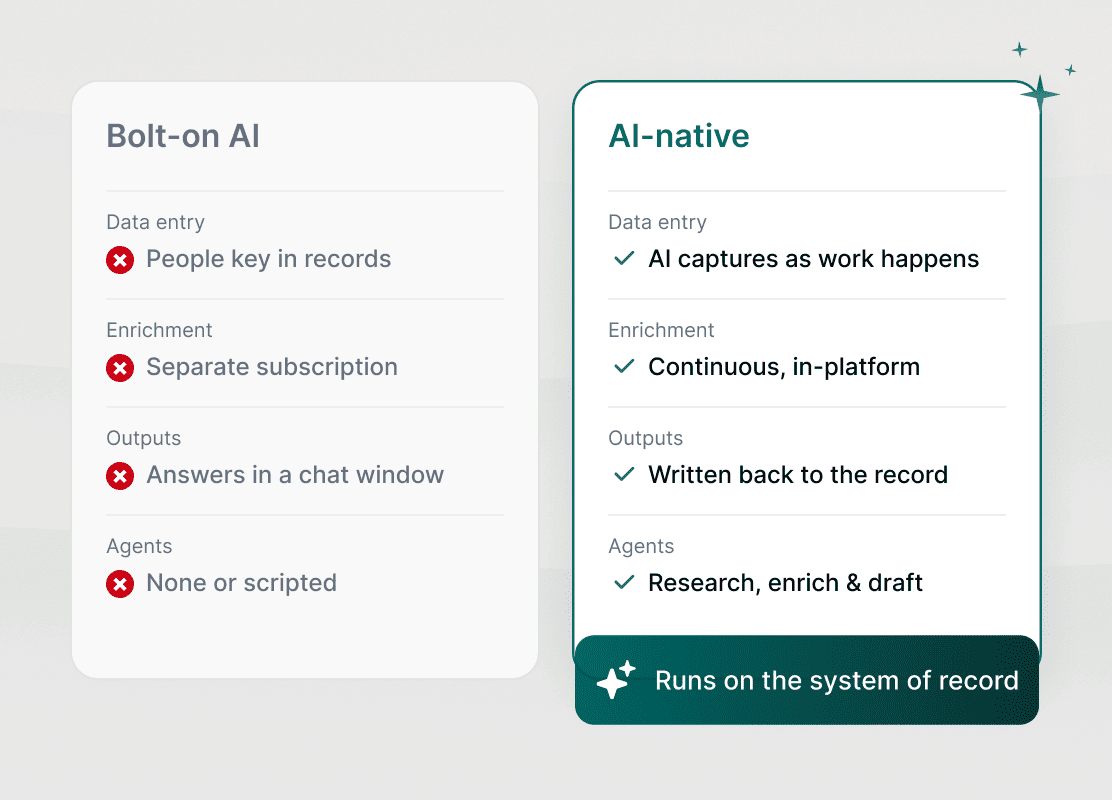
An AI-native CRM is built so AI runs on the system of record itself, capturing, enriching, and acting on data as work happens, rather than answering questions from a chat window over a legacy database. The system of record is the authoritative source for a firm’s deals, contacts, and relationship history, the one version every other tool and report reads from.
A horizontal CRM is general-purpose software built for sales funnels and adapted to investing through customization. A purpose-built deal CRM ships with private markets data models and workflows already in place.
The test for “AI-native” is architectural, not linguistic. Ask where the data comes from, whether agents can act on records, and whether the AI uses the firm’s own history. Several established vendors repositioned around AI-first and agentic language in 2026, so the label no longer separates products. (We explore this deeply in our articles on the future of private equity CRMs and the difference between private equity CRMs and standard CRMs.)
How to tell native AI from bolted-on AI
A firm can tell native AI from bolted-on AI by what the AI touches: Bolted-on AI answers questions about data someone already entered, while native AI fills and maintains the record itself.
Native AI draws on live public data and the firm’s own deal history, so its outputs reflect the firm’s mandate rather than generic web knowledge. Agentic AI goes a step further, with agents that research, enrich, draft, and update records inside defined permissions.
Take Meridian as an example of AI-native. Our Scout AI agents map markets, extract CIM metrics, and enrich profiles, and our Meridian MCP server gives open access from tools like Claude and ChatGPT. A Deloitte survey found 86% of corporate and PE organizations already use generative AI in dealmaking, so the differentiator has moved from whether a CRM has AI to how it is wired in. Every vendor, Meridian included, should be able to answer these questions about its own architecture.
Moving off spreadsheets for deal tracking
Firms usually outgrow spreadsheets when one or more of these situations start happening frequently and costing the company deals.
The pipeline passes through more hands than one owner can keep accurate, and data is stale and untrustworthy.
A deal comes back after a pass, and nobody can find the earlier diligence.
An investment committee or LP asks for history the spreadsheet never recorded.
Migrating from spreadsheets is usually faster than migrating from a heavily customized legacy CRM, because there is less structure to unwind, but it’s still a process. Be sure the vendors you are evaluating are prepared to help you through the migration and implementation, and have a strong reputation for customer service.
Where AI delivers value today, and where it is still unproven
AI in a CRM can deliver the clearest value today in diligence and sourcing preparation, such as document review, market mapping, and meeting prep, and is least proven in portfolio monitoring.
The industry data is mixed. Bain and StepStone’s report puts due diligence (40%) and deal sourcing and market mapping (33%) at the top of where generative AI delivers ROI; while S&P Global’s survey finds 64% of GPs still rate AI ineffective for deal sourcing, and 75% rate it ineffective for portfolio monitoring, with only 31% saying AI is somewhat or fully integrated into diligence.
The gap usually comes down to data quality, because AI cannot source well from an incomplete, manually maintained CRM. The results depend on the AI running on complete, structured firm data.
A strategy-first way to choose a CRM in 2026
A private markets firm should choose a CRM by starting first with its strategy and the unit of work each team tracks, only then testing vendors against that data model (rather than a generic feature list). Ask every vendor about data ownership, AI governance, integration with existing data subscriptions, and realistic time to firmwide adoption. Favor a platform that fits your strategy out of the box over an enterprise tool that needs heavy customization to get there.
Here is a five-step process that keeps the evaluation grounded in your firm’s real workflows:
Define the unit of work by strategy, meaning the object your team actually tracks.
List the must-have workflows for the unit of work before looking at any vendor.
Test capture and enrichment on your own data, not a vendor’s demo dataset.
Run a vendor-question scorecard across capture, data, AI, security, and commercial terms.
Pilot with the deal team that will use it daily, not with operations alone.
What matters most by strategy, from PE to venture capital to corporate development
The CRM features that matter most differ by strategy, because each firm type tracks a different unit of work.
Private credit is a good example of why strategy fit is not optional. McKinsey’s private credit analysis reports evergreen private credit AUM grew about 27% year over year in 2025 while closed-end private credit fundraising fell 16% to about $165 billion, and covenant-lite transactions rose to 21% of direct lending deals in 2025 from 4% in 2023. Those shifts are why credit teams need covenant and term data structured in the CRM, not buried in PDFs.
The 2026 CRM market falls into five approaches: purpose-built private markets CRMs, configurable enterprise CRMs for financial services, ERP-extended CRMs tied to fund administration, horizontal CRMs adapted for investing, and adjacent AI research and data tools.
The biggest structural change in 2026 has been Carta’s entry into CRM through its March 2026 acquisition of ListAlpha. Several established vendors also added agent platforms during 2026, which makes architecture questions even more useful than feature checklists.
Two of these vendors added agent platforms in 2026: Intapp’s Celeste on DealCloud, and Affinity’s Ascend. The rest hold distinct positions, with Affinity on relationship intelligence, Carta CRM linking records to fund accounting, Salesforce as a configurable enterprise platform, and Hebbia and similar tools as research layers that sit beside a CRM rather than replace it.
Build on a horizontal platform or buy purpose-built
We believe in transparency here at Meridian, so let’s put it plainly: Most firms should buy a purpose-built CRM rather than build on a horizontal platform, because the data model and workflows ship ready instead of becoming an internal project.
Building on a horizontal platform can make sense for a large institution that wants one enterprise system across many business lines and can staff it permanently. The cost of building is ongoing maintenance, since every new workflow, report, and AI capability becomes work for an internal team.
The questions to ask every CRM vendor
Every firm should ask each CRM vendor how activity is captured, where enrichment data comes from, who owns the data if the firm leaves, how AI is governed, and how long firmwide adoption actually takes. Here is a question set you can copy and use.
Use the same questions for every vendor, Meridian included. Our comparison hub lays platforms out side by side if you want to create a shortlist before you start getting on vendor demo calls.
What drives the CRM implementation time
CRM implementation time depends mostly on data migration complexity and how much customization the platform needs. Purpose-built platforms with standard private markets data models generally deploy faster than heavily configured enterprise systems. Measure success by firmwide adoption rather than the go-live date, though, because a system that is live but unused has not really been implemented.
We bring firms live with enhanced data in weeks through a direct CRM import, which you can read about on our implementation page. What drives any timeline is the same set of factors: data cleanup, the migration source, integrations, and permissions design.
The right CRM is the one your deal team uses without being asked
The best CRM for a private markets firm is the one that fits its strategy and fills itself from the team’s actual work, so the AI on top has a complete record to run on.
In 2026, when every vendor claims AI, architecture and data ownership are the real differentiators. “AI-native” means little without a definition you can test. A short, structured evaluation on your own data will tell you more than any vendor ranking. Bain’s own analysis shows tighter returns favor firms whose data is complete and current.
Frequently asked questions
What features should a VC look for in a CRM?
A VC firm should look for automatic email and calendar capture, relationship intelligence that maps the firm’s network, built-in data enrichment, and fast triage for high deal volume. AI that runs on the firm’s own history and bundled company data adds the most value at the sourcing stage.
What is an AI-native CRM for private markets?
An AI-native CRM is built so AI runs on the system of record itself, capturing, enriching, and acting on data as work happens. That differs from a CRM where AI is a chat layer added on top of a manually maintained database.
What’s the difference between a horizontal CRM and a purpose-built deal CRM?
A horizontal CRM is general-purpose software designed for sales funnels and adapted to investing through customization. A purpose-built deal CRM ships with private markets data models, such as deals, funds, LPs, bankers, and portfolio companies, already in place.
Why doesn’t Salesforce work well for private equity?
Salesforce was designed for linear sales pipelines, so private equity firms usually need custom objects, consultants, and ongoing admin to model funds, deals, and long-term relationships. It can work for large firms with dedicated Salesforce teams, but mid-market firms often find the maintenance burden too high.
What CRM should a private credit fund use?
A private credit or direct lending fund should use a CRM that tracks sponsor coverage and borrower records and pulls covenant, leverage, and DSCR data from credit documents into structured fields. Generic CRMs and equity-focused tools often lack these credit-specific data models.
How should a private markets firm choose a CRM in 2026?
Start with the unit of work your strategy tracks, test vendors on your own data, and score them on capture, enrichment, AI governance, and time to firmwide adoption. Ask every vendor about data ownership and, where relevant, post-acquisition roadmap timing.
What should an investment firm use instead of spreadsheets for deal tracking?
Use a CRM that fills itself from email, calendar, and documents so the team does not recreate manual entry in a new tool. Look for non-linear pipelines that keep the full history when a passed deal comes back.
What CRM do most private equity firms use?
Private equity firms use a mix of configurable financial services CRMs, relationship intelligence platforms, newer AI-native systems of record, and adapted horizontal CRMs like Salesforce. Many smaller firms still track deals in spreadsheets.
Discover how Meridian can streamline deal sourcing and enhance your decision-making
Alex Sen is the Founder and CEO of Meridian. With nearly a decade of experience at top firms like Blackstone, Thoma Bravo, and CVC, Alex knows the challenges that hold dealmakers back.